
 EN
ENCanada Visitor Visa: Approval, New Rules & Guide 2026
A Canada Visitor Visa (TRV) in 2026 is issued when the applicant can satisfy the immigration officer regarding the purpose of travel, sufficient financial capacity, and return to the home country.
A Canada Visitor Visa is a temporary entry document that is usually valid for up to 10 years and allows stays of up to 6 months per entry.
Canada Visitor Visa (also known as a Tourist Visa) is a temporary entry document that allows you to travel to Canada for tourism, family visits, or short-term business.
In this 2026 guide, you will learn the requirements, documents, cost, processing time, refusal reasons, and how to improve your approval chances based on the latest IRCC updates.
Canada Visitor Visa Overview
- Validity: Up to 10 years, depending on passport validity
- Length of stay: Usually up to 6 months per entry
- Proof of funds: Approximately CAD 10,000 to 15,000 per person
- Application fee + biometrics: CAD 185
[ez-toc title="Table of Contents"]

What is a Canada Visitor Visa?
A Canada Visitor Visa, also known as a Temporary Resident Visa (TRV), is a temporary entry document issued for tourism, family visits, short-term events, or business travel. It usually allows stays of up to 6 months per entry, but the final length of stay is determined by the border officer.
A Canada Visitor Visa does not allow long-term study or work in Canada. To be approved, you must show a clear travel purpose, sufficient financial support, and a genuine intention to leave Canada at the end of your stay.
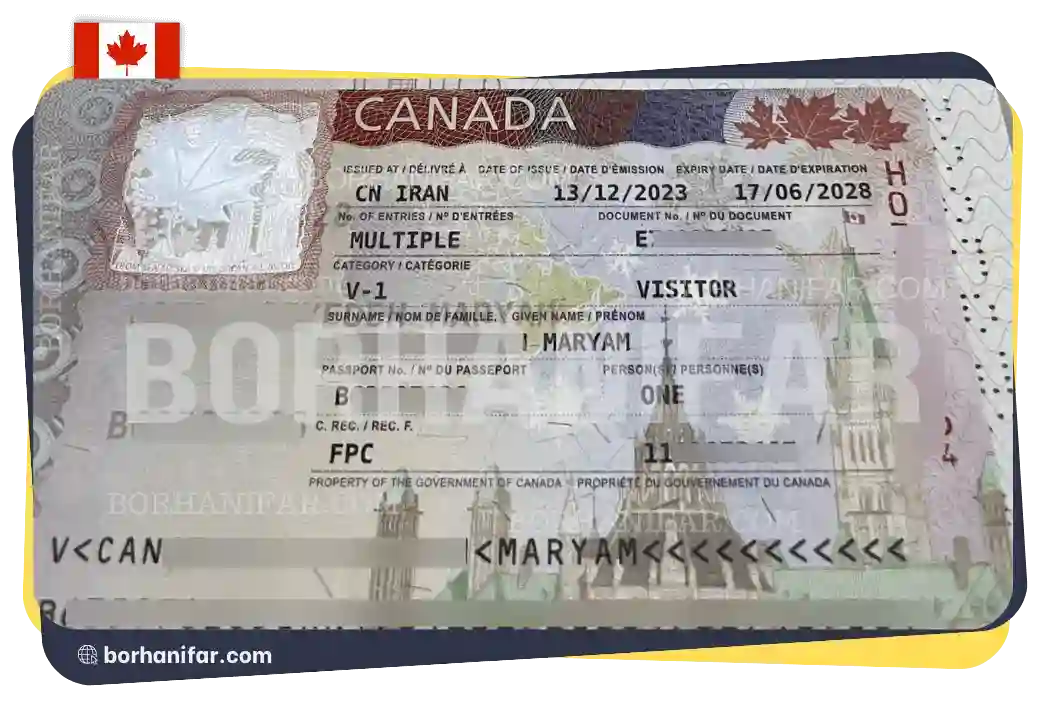
The visa may be issued as a Single Entry or Multiple Entry visa and can be valid for up to 10 years. However, the validity usually cannot exceed your passport validity. For Iranian applicants, the visa is often issued based on passport validity, such as a shorter 5-year period.
Canada Visitor Visa rules and updates in 2026
What are the Canada Visitor Visa rules in 2026?
In 2026, Canada Visitor Visa applications are reviewed more carefully. IRCC places greater emphasis on financial capacity, travel purpose, ties to the home country, and the applicant’s likelihood of leaving Canada after the visit.
Key Canada Visitor Visa updates in 2026
- More scrutiny on proof of funds and source of income
- Possible issuance of single-entry visas in some cases
- Closer review of travel purpose and stay plans
- Greater importance of international travel history
- Enhanced biometric and security checks
- Possibility of refusal or cancellation at the border if concerns arise
- Lower approval chances for weak or inconsistent applications
Who is the Canada Visitor Visa not suitable for?
The Canada Visitor Visa may not be suitable for applicants who lack sufficient financial resources, travel history, or clear ties to their home country. If the travel purpose is unclear or unsupported by evidence, the risk of visa refusal may increase.
Types of Canada Visitor Visa
What are the types of Canada Visitor Visa?
The Canada Visitor Visa includes different options based on travel purpose and applicant circumstances. The most common categories include Single Entry, Multiple Entry, Super Visa, and Business Visitor.
| Visa Type | Feature | Purpose |
|---|---|---|
| Single Entry | One-time entry | Short and specific trip |
| Multiple Entry | Multiple entries up to 10 years | Frequent travel |
| Super Visa | Up to 5 years stay | Parents & grandparents |
| Business Visitor | No work permit | Business activities |
Most approved applicants receive a Multiple Entry visa, but the final visa type depends on the immigration officer’s decision.
What is the difference between visa types?
The main differences are the length of stay, travel purpose, and eligibility requirements. A Multiple Entry visa is suitable for repeated short visits, while a Super Visa is designed for longer stays by parents and grandparents. Business Visitor status is for short-term business activities without entering the Canadian labour market.
Who needs a visa or eTA to enter Canada?
Do you need a Canada Visitor Visa or eTA?
For temporary entry into Canada, the required travel document depends on your nationality, passport type, and mode of travel. Some travelers require a Canada Visitor Visa, some can travel by air with an eTA, and some may qualify under specific conditions.
Who does not need a visa or eTA?
United States citizens generally do not need a visitor visa or eTA. Canadian permanent residents must travel with a valid PR card or travel document. Some U.S. permanent residents may also be exempt from the eTA requirement.
Do students and workers need a visa or eTA?
Holding a Study Permit or Work Permit alone is not sufficient. In most cases, applicants must also have a valid visa or eTA linked to their passport.
Difference between Canada Visitor Visa and eTA
The Canada Visitor Visa and the Electronic Travel Authorization (eTA) are both entry documents, but they apply to different travelers. Your nationality and travel conditions determine which one you need.
A Visitor Visa (TRV) requires a full application with documents, while an eTA is a simplified online authorization for visa-exempt travelers entering Canada by air.
| Feature | Visitor Visa (TRV) | eTA |
|---|---|---|
| Who needs it | Visa-required countries | Visa-exempt countries |
| Application type | Full application with documents | Simple online form |
| Processing time | Weeks to months | Minutes to days |
| Validity | Up to 10 years | Up to 5 years |
| Travel type | Air, land, sea | Air travel only |
Can you choose between a Visitor Visa and an eTA?
No. Your nationality determines whether you need a Visitor Visa or an eTA.
Who qualifies for an eTA instead of a Visitor Visa?
Travelers from visa-exempt countries usually qualify for an eTA, but it is only valid for air travel and must be linked to the passport.
Can an eTA be refused?
Yes. Even though the process is simpler, an eTA can still be refused if there are security, admissibility, or background concerns.
Pros and Cons of a Canada Visitor Visa
A Canada Visitor Visa allows temporary entry for tourism, family visits, and short-term travel, but it also has important limitations. Understanding both the advantages and restrictions helps you make a realistic decision and prepare a stronger application.
Pros
- Possibility of receiving a Multiple Entry visa
- Stay up to 6 months per entry in most cases
- Improves travel history and passport strength
- Allows tourism, family visits, and business travel
- Multiple entries until visa expiry
Limitations
- No authorization to work in Canada
- No long-term study allowed
- No direct pathway to permanent residence
- Requires strong proof of return
- Risk of refusal if application is weak or inconsistent
A Canada Visitor Visa is a temporary status, and approval depends on how clearly your documents support your travel purpose and return plan.
Check if you need a visitor visa or eTA
Search your country of citizenship to find out whether you may need a Canada Visitor Visa or an electronic travel authorization (eTA). Updated 8 June 2026
| Country | Entry Status | Explanation |
|---|---|---|
| No search has been performed yet. | ||
Note: An eTA usually applies to visa-exempt travelers arriving by air. Some countries may qualify for eTA only under specific conditions.
Canada Visitor Visa requirements and document checklist
Canada Visitor Visa requirements include a valid passport, proof of funds, a clear travel purpose, and documents showing that your stay in Canada will be temporary.
The document checklist includes identity documents, IRCC forms, financial records, employment or study documents, travel plans, and invitation letters if applicable.
Identity documents
- Valid passport
- Full scan of stamped and visa pages
- National ID or birth certificate
- Marriage or divorce documents
- Name change documents, if applicable
IRCC application forms
- IMM 5257 – Visitor Visa form
- IMM 5645 – Family information form
- IMM 5476 – Use of representative (if applicable)
- Travel and residence history
Proof of funds documents
- Bank statements (3–6 months)
- Bank balance certificate
- Proof of income (salary, business, contracts)
- Property or investment documents (if available)
Employment or study documents
- Employment letter (position, salary, duration)
- Pay slips or contract
- Business registration (self-employed)
- Proof of enrollment (students)
Travel plan documents
- Purpose of travel letter
- Entry and exit dates
- Accommodation details
- Travel itinerary
- Return ticket (if available)
Invitation letter documents + sample
- Invitation letter from host in Canada
- Host’s full details and contact information
- Proof of status in Canada
- Proof of relationship
- Financial documents of host (if supporting)
Sample invitation letter:
Date: [Insert Date]
To Whom It May Concern,
I, [Full Name], a Canadian citizen/permanent resident living at [Address], would like to invite
[Visitor’s Full Name], born on [Date of Birth], currently residing at [Address], to visit me in Canada.
The purpose of the visit is [tourism/family visit], and the intended stay is from [Start Date] to [End Date].
During this time, the visitor will stay at my residence. I confirm that I will provide
[accommodation/financial support if applicable].
I kindly request that you grant a visitor visa.
Sincerely,
[Full Name]
[Signature]
[Contact Information]
Family or minor documents
- Birth certificate
- Parental consent letter
- Custody documents
- School letter
Business visitor documents
- Invitation from Canadian company
- Business documents
- Event or meeting details
Biometrics and photo
- Digital photo
- Biometric instruction letter
Translation and format
- Certified translations
- Clear scanned copies
- Consistent information
Important: Requirements may vary based on your country, travel purpose, and personal situation.
How much proof of funds is required for a Canada Visitor Visa?
There is no fixed minimum bank balance required for a Canada Visitor Visa. However, most applicants should show approximately CAD 10,000 to CAD 15,000 per person for a short visit, depending on the length of stay, travel plan, and accommodation details.
Proof of funds must show that you can cover your travel, accommodation, and daily expenses in Canada. Your financial documents should also be realistic, consistent, and supported by a clear source of income.
How much bank balance is required for Canada Visitor Visa?
For most applicants, CAD 10,000 to CAD 15,000 per person is generally considered reasonable for a short visit. The amount may increase based on travel duration, number of applicants, accommodation, and planned expenses.
What financial documents are required for proof of funds?
- Bank statements for the last 3 to 6 months
- Official bank balance certificate
- Proof of income, such as salary slips, employment letter, business income, or contracts
- Property, investment, or tax documents, if available
Is bank balance alone enough for approval?
No. A high bank balance alone is not enough. IRCC also reviews the source of funds, transaction history, income stability, and whether the financial documents match the purpose and length of your visit.
What can weaken proof of funds?
- Large unexplained deposits before applying
- No clear source of income
- Low or unstable account balance
- Financial documents that do not match the travel plan
Check Your Chances for a Canada Visitor Visa
By answering a few simple questions, you can get a preliminary assessment of your chances of receiving a Canada Visitor Visa. This tool does not replace a legal review of your case.
Preliminary Assessment Result
Case Summary
Possible Weaknesses
Actions That May Strengthen Your Application
If you have questions about your weaknesses or required documents after this assessment, you can contact us through WhatsApp.
How to apply for a Canada Visitor Visa step by step
To apply for a Canada Visitor Visa, you must submit an online application through your IRCC account, complete the required forms, upload supporting documents, pay the government fees, and provide biometrics if required. After submission, IRCC reviews your application and issues a decision.
A strong application should be accurate, complete, and consistent. Your forms, financial documents, travel purpose, and supporting evidence should all support the same temporary visit plan.
Create or sign in to your IRCC account
Create an IRCC account or sign in to your existing account to start the online visitor visa application.
Answer the eligibility questions
Complete the online questionnaire so IRCC can generate the correct document checklist based on your nationality, travel purpose, and personal situation.
Complete the required forms
Fill out the Visitor Visa application form, such as IMM 5257, and any required family or representative forms accurately and consistently.
Prepare and upload supporting documents
Upload your passport, proof of funds, employment or study documents, travel plan, invitation letter if applicable, and other documents required by IRCC.
Pay the application and biometrics fees
Pay the visitor visa processing fee and biometrics fee online. In most cases, the total government fee is CAD 185 per applicant.
Receive the Biometric Instruction Letter
After submitting the application, IRCC may issue a Biometric Instruction Letter if biometrics are required.
Complete biometrics at a VAC
Book an appointment at a Visa Application Centre and provide your fingerprints and photo within the required deadline.
Wait for IRCC application review
An immigration officer reviews your forms, documents, travel purpose, financial situation, ties to your home country, and overall consistency.
Receive the decision and passport request
If approved, IRCC will usually issue a passport submission request so the visa can be placed in your passport.
Can I apply for a Canada Visitor Visa online?
Yes. Most applicants must apply online through their IRCC account by completing the forms, uploading documents, paying fees, and submitting biometrics if required.
What happens after submitting a Visitor Visa application?
After submission, IRCC checks your application, confirms biometrics if required, reviews your documents, and then issues either a decision or a request for additional information.
What happens if my Canada Visitor Visa is approved?
If approved, IRCC usually sends a passport request so the visa counterfoil can be placed in your passport, if required.
How much does a Canada Visitor Visa cost?
The Canada Visitor Visa fee is CAD 100 per person. If biometrics are required, the biometrics fee is CAD 85 per person, bringing the usual government cost to CAD 185 for one applicant.
Additional costs may include certified translation, document preparation, travel insurance, airfare, accommodation, and professional consulting fees if you choose to use immigration support.
Canada Visitor Visa government fees
| Fee Type | Amount | Notes |
|---|---|---|
| Visitor Visa processing fee | CAD 100 | Applies to single-entry or multiple-entry TRV applications |
| Biometrics fee | CAD 85 | Required for most applicants unless exempt |
| Visitor Visa + biometrics | CAD 185 | Typical total government fee for one applicant |
| Family Visitor Visa fee | Maximum CAD 500 | For eligible families of 5 or more applying together |
| Family biometrics fee | Maximum CAD 170 | For eligible family members applying at the same time |
Government fees are paid online when submitting the application. The same CAD 100 fee applies whether IRCC issues a single-entry or multiple-entry visitor visa.
Additional Canada Visitor Visa costs
| Cost Item | Estimated Range | Notes |
|---|---|---|
| Document translation | Varies | Required if documents are not in English or French |
| Travel insurance | CAD 50 to 200+ | Depends on age, coverage, and travel duration |
| Round-trip flight | CAD 1,000 to 2,000+ | Depends on country, season, and airline |
| Accommodation | Varies by city | Toronto and Vancouver are usually more expensive |
| Daily expenses | CAD 50 to 150+ | Food, transport, local travel, and personal costs |
Important notes about Canada Visitor Visa fees
- Visitor Visa fees are usually non-refundable, even if the application is refused.
- Fees must be paid online at the time of application submission.
- Incorrect or incomplete payment may delay processing.
- Biometrics are not required for every applicant, but most applicants must provide them.
- Family fee caps only apply when eligible family members apply together.
Is the Canada Visitor Visa fee refundable?
In most cases, the Visitor Visa processing fee is not refunded after IRCC starts processing the application, even if the visa is refused.
Do I have to pay biometrics again?
You may not need to pay or give biometrics again if your previous biometrics are still valid. Temporary resident biometrics are generally valid for 10 years.
How much is a Canada Visitor Visa for a family?
The Visitor Visa fee for a family of 5 or more may be capped at CAD 500 if eligible family members apply at the same time and place. The family biometrics fee may be capped at CAD 170.
Is the eTA cheaper than a Visitor Visa?
Yes. An eTA is usually cheaper than a Visitor Visa, but only visa-exempt travelers can use an eTA. If your nationality requires a Visitor Visa, you cannot choose an eTA instead.
Official fee reference: IRCC fee list
Canada Visitor Visa processing time in 2026
Canada Visitor Visa processing time depends on the country of application, biometrics completion, application volume, and the complexity of your case. In most cases, processing time ranges from a few weeks to several months.
For example, recent processing time for Indian applicants is around 27 days, but this timeline can change depending on IRCC workload, biometrics, and additional document requests.
Canada Visitor Visa processing time by country
| Country | Estimated Processing Time | Trend |
|---|---|---|
| India | 3 to 6 weeks | Fast |
| China | 4 to 8 weeks | Moderate |
| Philippines | 4 to 10 weeks | Moderate |
| Nigeria | 6 to 12 weeks | Slow |
| Pakistan | 6 to 12 weeks | Slow |
| Iran | Around 83 days | Moderate |
| Türkiye | 4 to 8 weeks | Moderate |
| United Arab Emirates | 2 to 5 weeks | Fast |
| United Kingdom | 2 to 4 weeks | Fast |
| United States | 2 to 4 weeks | Fast |
Processing times are estimates and may change based on IRCC workload and the complexity of each application.
Average Canada Visitor Visa processing stages
| Stage | Estimated Time |
|---|---|
| Application review | 1 to 3 weeks |
| Biometrics completion | A few days to 2 weeks |
| Final officer review | Several weeks |
| Total processing time | 2 weeks to 6 months |
What affects Canada Visitor Visa processing time?
- Country of application and IRCC workload
- Completeness and accuracy of documents
- Security checks or background review
- Biometrics completion speed
- Peak travel seasons and application volume
How to avoid delays in Visitor Visa processing
- Submit complete and consistent documents
- Avoid errors or contradictions in forms
- Complete biometrics as soon as possible
- Provide a clear and logical travel plan
- Respond quickly if IRCC requests additional documents
Is Canada Visitor Visa processing time fixed?
No. Processing time changes regularly depending on IRCC workload, country of application, biometrics, and individual case complexity.
Why is my Canada Visitor Visa taking longer?
Delays can happen because of incomplete documents, background checks, high application volume, biometrics delays, or additional document requests from IRCC.
Can I speed up Canada Visitor Visa processing?
There is no guaranteed fast-track process for a Visitor Visa, but a complete and consistent application can help avoid unnecessary delays.
Check official updates here: IRCC Processing Time Tool
Canada Visitor Visa result after applying: approval or refusal
After submitting your Canada Visitor Visa application, IRCC reviews your forms, documents, biometrics, travel purpose, financial situation, and overall consistency. The final result will usually be approval, refusal, or a request for more information.
Understanding what happens after applying helps you track your application, respond correctly to IRCC requests, and avoid mistakes after approval or refusal.
What happens after submitting a Canada Visitor Visa application?
After submission, your application moves through several review stages. IRCC may confirm your biometrics, review your documents, conduct background checks, request additional information, and then issue a final decision.
What happens after biometrics for Canada Visitor Visa?
After biometrics are completed, IRCC links your fingerprints and photo to your application. The officer may then continue reviewing your eligibility, travel purpose, financial capacity, ties to your home country, and admissibility.
How can you track your Canada Visitor Visa application?
You can track your application through your IRCC account or the application status tracker, depending on how the application was submitted. You should check regularly for messages, biometric updates, document requests, or passport request letters.
What does background check mean in a Visitor Visa application?
A background check may include identity verification, security screening, travel history review, and admissibility assessment. This stage may take longer if IRCC needs more time to verify information.
Can IRCC ask for more documents after submission?
Yes. IRCC may request additional documents, clarification, updated financial records, or other evidence. You must respond before the deadline stated in the request letter.
Canada Visitor Visa timeline: step-by-step application journey
The Canada Visitor Visa process follows a structured timeline from application submission to final decision. Understanding this timeline helps you avoid delays and better manage your travel plans.
Processing times vary by country and application quality, but the overall journey usually follows these key stages.
Online application submission
You submit your Visitor Visa application through your IRCC account, including forms, documents, and fees.
Biometric Instruction Letter (BIL)
IRCC issues a biometrics request shortly after submission if required.
Biometrics completion
You provide fingerprints and a photo at a Visa Application Centre (VAC).
Background and eligibility review
IRCC reviews your financial documents, travel purpose, ties to your home country, and overall consistency.
Additional document request (if needed)
IRCC may request additional documents or clarification in some cases.
Final decision
Your application is either approved or refused based on the officer’s assessment.
Passport request (if approved)
If approved, you receive instructions to submit your passport for visa stamping.
How long does the full Visitor Visa timeline take?
The full process can take from a few weeks to several months, depending on your country of application, biometrics timing, and application complexity.
What stage takes the longest?
The background and eligibility review stage usually takes the longest, as IRCC carefully evaluates your financial situation, travel purpose, and ties to your home country.
Can you track your Visitor Visa application?
Yes. You can track your application status through your IRCC account, where updates such as biometrics, document requests, and final decisions are shown.
What happens if your Canada Visitor Visa is approved?
If your visitor visa application is approved, IRCC will usually issue a Passport Request (PPR) so the visa counterfoil can be placed in your passport. You must then submit your passport and prepare for travel to Canada.
Passport Request (PPR): what to do next
After approval, IRCC sends a Passport Request letter. You must submit your passport to the Visa Application Centre (VAC) or follow the instructions provided in the letter within the specified deadline.
How long does Canada visa stamping take?
Visa stamping usually takes a few days to a few weeks, depending on the country, VAC processing time, courier service, and passport submission method.
Does visa approval guarantee entry to Canada?
No. A Canada Visitor Visa allows you to travel to Canada, but the final decision is made by the border officer. You must still show that your visit is temporary and that you meet the entry requirements.
Canada Visitor Visa biometrics: what it is, how it works, and why it matters
Biometrics for a Canada Visitor Visa include fingerprints and a photo, which are used by IRCC to verify your identity and assess security and admissibility. Most applicants must complete biometrics after submitting their application.
Biometrics are a required step in the application process, and delays in completing them can slow down your visa processing time.
- Includes fingerprints and digital photo
- Collected at Visa Application Centres (VACs)
- Linked directly to your application
- Used for identity verification and security screening
Who needs biometrics for a Canada Visitor Visa?
Most applicants between the ages of 14 and 79 must provide biometrics. However, some applicants may be exempt depending on their nationality, visa history, or previous biometrics submissions.
When do you give biometrics after applying?
After submitting your application, IRCC will issue a Biometric Instruction Letter (BIL). You must then book an appointment and complete biometrics within the deadline provided.
How long are biometrics valid for Canada?
Biometrics are usually valid for 10 years. If you have already provided biometrics within this period, you may not need to provide them again for a new application.
What happens after biometrics are completed?
Once biometrics are completed, IRCC continues processing your application. This includes background checks, document review, and final assessment by an immigration officer.
Can biometrics delay your Visitor Visa application?
Yes. Delays in booking or completing biometrics can slow down processing. Completing biometrics as soon as possible helps avoid unnecessary delays.
What happens after entering Canada with a Visitor Visa?
After arriving in Canada, a border officer from the Canada Border Services Agency (CBSA) makes the final decision on your entry. A valid Visitor Visa does not guarantee entry, and the officer must be satisfied that you meet all entry requirements and will leave Canada at the end of your stay.
What happens at the border?
- Verification of identity and consistency with your application
- Review of your travel purpose and supporting documents
- Assessment of security and admissibility
- Determination of your authorized stay period
How long can you stay in Canada?
- Usually up to 6 months per entry
- The duration may be stamped in your passport
- If unclear, you should ask the officer directly
Can you be refused entry at the border?
- Providing incorrect or inconsistent information
- Unclear or unsupported travel purpose
- Failure to demonstrate temporary intent
- Inadmissibility
How to extend your stay in Canada as a visitor (Visitor Record)
You can extend your stay in Canada as a visitor by applying for a Visitor Record. This allows you to remain in Canada legally beyond your initial authorized stay, but it does not extend your visa itself.
A Visitor Record extends your temporary resident status inside Canada. Even if your visa expires, you may remain in Canada as long as your status is valid and your extension was submitted on time.
Requirements to extend your visitor status
- Apply before your current authorized stay expires
- Provide sufficient financial resources for the extended stay
- Explain a clear and reasonable reason for extension
- Maintain compliance with all visa conditions
What happens after applying for an extension?
- You may stay in Canada under maintained status while waiting
- You must follow the same visitor conditions during this period
- The final decision is made by IRCC based on your application
What happens if your Canada Visitor Visa is refused?
If your application is refused, IRCC will provide refusal reasons. A refusal does not mean you cannot apply again, but reapplying without addressing the issues may lead to another refusal.
Common Canada Visitor Visa refusal reasons
- Insufficient financial proof or unclear source of funds
- Weak ties to home country
- Unclear or unsupported travel purpose
- Lack of travel history
- Inconsistencies in documents or forms
Can you reapply after a visa refusal?
Yes. You can reapply at any time, but you should first analyze the refusal reasons and correct the weaknesses in your application before submitting again.
Should you request GCMS notes after refusal?
In complex cases, requesting GCMS notes can help you understand the officer’s detailed concerns and improve your next application.
Common mistakes in Canada Visitor Visa applications
Many Canada Visitor Visa refusals are not caused by eligibility alone, but by mistakes in how the application is prepared and presented. Even strong applicants can be refused if their documents are inconsistent, unclear, or not properly explained.
Understanding the most common mistakes can significantly reduce your refusal risk and improve your chances of approval.
Most common reasons Visitor Visa applications are refused
- Sudden or unexplained bank deposits before applying
- Weak or unclear proof of ties to the home country
- Unclear or unrealistic travel purpose
- Inconsistent information between forms and documents
- Incomplete or poorly prepared document checklist
- Lack of a proper explanation letter (Purpose of Travel)
- Submitting generic or copied application content
Why do sudden bank deposits cause refusal?
Large or recent deposits without a clear source can raise concerns about financial credibility. Officers expect consistent financial history, not last-minute fund adjustments.
Why is proof of ties so important?
Immigration officers must be convinced that you will leave Canada after your visit. Employment, family, and assets are key indicators of your intent to return.
What makes a travel purpose weak?
A vague or generic travel plan without details (dates, places, purpose) reduces credibility. A strong application includes a clear and logical itinerary.
How can you avoid inconsistencies in your application?
All forms, letters, and documents must align. Any contradiction between employment, finances, or travel details can lead to refusal.
Canada Visitor Visa refusal rate, reasons, and approval risk
The Canada Visitor Visa refusal rate varies by country, applicant profile, financial evidence, travel purpose, and document consistency. In many countries, refusal rates may range from moderate to high, especially where officers have concerns about temporary intent and return to the home country.
For Iranian applicants, refusal risk is often higher than the global average and is commonly estimated between 40% and 65% in some periods. However, each application is assessed individually, and a strong, consistent application can still be approved.
Approximate Canada Visitor Visa refusal rate by country
| Country | Approximate Refusal Rate | Risk Level | Common Officer Concern |
|---|---|---|---|
| Iran | 40% to 65% | High | Proof of return, financial source, and travel purpose |
| India | 30% to 50% | Medium | Travel history, funds, and family ties |
| Pakistan | 35% to 55% | High | Financial consistency and temporary intent |
| Nigeria | 40% to 60% | High | Purpose of travel and source of funds |
| China | 20% to 40% | Medium | Employment and financial stability |
| Türkiye | 20% to 35% | Medium to low | Consistency of documents |
| United Arab Emirates | 15% to 30% | Low | Residency status and travel purpose |
| Europe / Schengen | 10% to 20% | Low | Usually lower risk due to travel and economic profile |
These figures are practical estimates based on public trends and case experience. They are not a guarantee and may vary depending on each applicant’s circumstances.
Main reasons for Canada Visitor Visa refusal
Weak proof of funds or unclear source of money
A high bank balance is not enough if the source of funds is unclear. Sudden deposits, weak income evidence, or financial documents that do not match the travel plan can increase refusal risk.
Weak ties to the home country
Officers may refuse an application if the applicant does not show strong employment, family, property, study, or business ties that support their return after visiting Canada.
Unclear purpose of travel
A vague or unrealistic travel purpose can lead to refusal. The travel plan should be clear, reasonable, and supported by documents such as an invitation letter, itinerary, or event details.
Inconsistent documents or forms
Different dates, conflicting employment information, inconsistent financial records, or mismatched statements can make the application appear unreliable.
Weak or limited travel history
Travel history is not mandatory, but a weak or limited travel history may increase scrutiny, especially if other parts of the application are also weak.
What should you do after a Canada Visitor Visa refusal?
- Review the refusal letter carefully.
- Identify the officer’s concerns and weak parts of the application.
- Request GCMS Notes if the reasons are unclear or the case is complex.
- Correct the issues before submitting a new application.
- Consider reconsideration or judicial review only where legally appropriate.
Should you reapply immediately after refusal?
You should not reapply immediately unless the refusal reasons have been fully addressed. Reapplying with the same documents or the same explanation usually increases the risk of another refusal.
Is reconsideration better than reapplying?
Reconsideration may be appropriate if there was a clear error or important evidence was overlooked. In most cases, however, a stronger new application is more practical than asking for reconsideration.
How to reduce the risk of Visitor Visa refusal
- Provide genuine and explainable financial evidence.
- Show strong ties to your home country.
- Prepare a clear purpose of travel letter.
- Submit a logical travel plan and supporting documents.
- Make sure all forms, letters, and documents are consistent.
Canada Visitor Visa approval chances and success factors in 2026
Canada Visitor Visa approval chances in 2026 depend on financial strength, travel purpose, ties to the home country, and overall document consistency. Immigration officers assess the entire application as a single, consistent profile rather than relying on one document alone.
Applicants with strong, well-structured applications may still have a high chance of approval even in higher-risk countries, while weak or inconsistent applications may be refused regardless of background.
High approval chance
- Strong and transparent financial capacity
- Stable employment or business
- Clear and realistic travel purpose
- Strong travel history
- Consistent documents with no contradictions
Medium approval chance
- Moderate financial capacity
- Limited travel history
- Acceptable but not strong ties
- General but reasonable travel plan
- Some areas need clarification
Low approval chance
- Unclear or weak financial situation
- Sudden or unexplained bank deposits
- Weak ties to home country
- Unclear travel purpose
- Inconsistent or incomplete documents
Key factors that affect approval chances
| Factor | Impact | Explanation |
|---|---|---|
| Financial capacity | Very high | Funds must be real, stable, and proportional to the trip |
| Ties to home country | Very high | Employment, family, and assets show intent to return |
| Purpose of travel | High | Must be clear, logical, and supported by documents |
| Travel history | Medium to high | Previous travel increases officer confidence |
| Document consistency | Very high | All documents must tell one consistent story |
Can applicants from high refusal countries still get approved?
Yes. Approval depends on the strength of the application, not only the country of origin. A well-prepared application with strong financial proof, clear travel purpose, and solid ties can still have a high chance of approval.
Does a high bank balance guarantee approval?
No. The source of funds, consistency of transactions, and overall financial profile are more important than the amount alone.
How to increase your Canada Visitor Visa approval chances
To increase your Canada Visitor Visa approval chances, your application must be consistent, well-documented, and clearly demonstrate a temporary travel purpose. Immigration officers focus on whether you will leave Canada at the end of your stay and whether your documents support that conclusion.
- Provide strong and verifiable proof of funds with a clear source of income
- Demonstrate strong ties to your home country (employment, business, family, assets)
- Prepare a clear and realistic travel plan with dates, purpose, and supporting details
- Ensure all forms, documents, and explanations are fully consistent
- Include a well-written Purpose of Travel letter explaining your visit
- Avoid sudden bank deposits or unexplained financial activity
- Present employment or business documents that support your return
Which countries can you visit with a Canada Visitor Visa?
A valid Canada Visitor Visa can make travel to certain countries easier, depending on your nationality. Some countries allow visa-free entry, eVisa, or simplified visa processes if you hold a valid Canadian visa.
However, entry rules vary by passport, visa validity, and travel history. You must always check the official requirements before traveling.
Countries that may allow easier travel with a Canadian visa
- Mexico: visa-free entry in many cases with a valid Canadian visa
- Türkiye: eligible for eVisa for certain nationalities
- United Arab Emirates: visa on arrival for some passport holders
- Qatar: simplified entry or visa on arrival in some cases
- Caribbean countries: easier entry depending on nationality
- Georgia: visa-free or simplified entry for some travelers
Important conditions to consider
- Your Canadian visa must be valid at the time of travel
- Your passport nationality determines eligibility
- Some countries require prior use of the Canadian visa
- Entry rules may change and must be verified before travel
Can a Canada Visitor Visa guarantee entry to other countries?
No. A Canadian visa does not guarantee entry to other countries. It may simplify the process, but final entry conditions depend on each country’s immigration rules and your nationality.
Do you need to enter Canada first before using the visa elsewhere?
In some cases, yes. Certain countries require that the Canadian visa has been used at least once before granting easier entry.
Canada Visitor Visa FAQ
Below are the most frequently searched questions about the Canada Visitor Visa, including requirements, processing time, approval chances, and common concerns. These answers are based on real applicant scenarios and current IRCC practices.
What is a Canada Visitor Visa?
A Canada Visitor Visa (Temporary Resident Visa – TRV) is a temporary authorization that allows foreign nationals to enter Canada for tourism, family visits, or short-term business travel. It does not allow long-term work or study.
How long is a Canada Visitor Visa valid?
It can be issued for up to 10 years or until your passport expires. However, the length of each stay is usually limited to 6 months per entry.
How long can you stay in Canada as a visitor?
Most visitors can stay up to 6 months per entry. The exact duration is decided by the border officer and may be shorter or longer depending on your situation.
How much bank balance is required for a Canada Visitor Visa?
There is no fixed amount, but generally CAD 10,000 to 15,000 per person is recommended. The funds must be genuine, consistent, and proportional to your travel plan.
Is travel history important for visa approval?
Yes. A strong travel history shows compliance with visa rules and increases the officer’s confidence. However, applicants without travel history can still be approved with strong documentation.
Is an invitation letter required for a Canada Visitor Visa?
No, it is not mandatory. However, a well-prepared invitation letter can strengthen your application by clearly explaining your purpose of travel and accommodation details.
How long does Canada Visitor Visa processing take?
Processing time varies by country and application volume. It typically ranges from a few weeks to several months depending on biometrics, document quality, and background checks.
What are the main reasons for visa refusal?
Common refusal reasons include weak financial proof, lack of ties to the home country, unclear travel purpose, inconsistent documents, and concerns about returning after the visit.
Can I reapply after a visa refusal?
Yes. You can reapply after carefully addressing the refusal reasons. Submitting the same application without changes usually results in another refusal.
Can I work in Canada with a Visitor Visa?
No. A Visitor Visa does not allow employment in Canada. You need a valid work permit to work legally.
Can I study in Canada with a Visitor Visa?
Yes, but only for short-term courses of less than 6 months. Longer studies require a Study Permit.
Is biometrics required for a Visitor Visa?
In most cases, yes. Biometrics include fingerprints and a photo and must be completed at a Visa Application Centre (VAC).
What is a multiple-entry Canada visa?
A multiple-entry visa allows you to travel to Canada multiple times during its validity period without reapplying for a new visa.
Does a visa guarantee entry to Canada?
No. The final decision is made by the border officer. You must still satisfy entry conditions upon arrival.
How can I increase my visa approval chances?
You should provide strong financial documents, clear travel purpose, proof of ties to your home country, and ensure all information is consistent and accurate.
What is proof of ties to home country?
This includes employment, business ownership, family connections, property, or other commitments that show you will return after your visit.
Can I extend my stay in Canada?
Yes. You can apply for a Visitor Record to extend your stay before your current status expires.
What happens if I overstay my visa?
Overstaying can negatively affect future applications and may require restoration of status or lead to removal from Canada.
How much does a Canada Visitor Visa cost?
The government fee is CAD 100, and biometrics costs CAD 85. Additional costs depend on document preparation and services.
Can I apply for a Visitor Visa online?
Yes. Most applicants must apply online through an IRCC account by submitting forms, documents, and payment.
What documents are required for a Visitor Visa?
Key documents include passport, financial proof, employment or study documents, travel plan, and supporting evidence such as an invitation letter.
What is a Visitor Record in Canada?
A Visitor Record allows you to stay longer in Canada legally but does not extend your visa. It extends your status inside Canada.
Can I convert a Visitor Visa to permanent residence?
No. A Visitor Visa is temporary, but you may apply for permanent residence through other immigration programs if eligible.
Can I travel to the USA with a Canada visa?
No. A Canadian visa does not grant entry to the United States. You need a separate US visa.
Is interview required for Canada Visitor Visa?
Usually no, but in some cases IRCC may request an interview or additional documents.
What is a strong Visitor Visa application?
A strong application is consistent, well-documented, and clearly demonstrates temporary intent, financial stability, and ties to your home country.
Can family apply together?
Yes, but each applicant must submit a separate application, even if applying as a family group.
Can I apply without travel history?
Yes, but your application must be stronger in other areas such as financial proof and ties to your home country.
What is dual intent in Visitor Visa?
Dual intent means you may have both temporary and permanent intentions, but you must still prove you will leave Canada if required.
Can a Visitor Visa be refused after approval at the border?
Yes. Even with a valid visa, a border officer can refuse entry if you do not meet entry requirements.
Canada Visitor Visa Services
If you are planning to apply for a Canada Visitor Visa, you can start by completing our
immigration assessment form to review your basic eligibility and identify potential weaknesses in your application.
If you have questions about your documents, proof of funds, invitation letter, refusal history, or application strategy, you can also contact us via WhatsApp for guidance.
Editorial and Professional Notice
This article was prepared for general informational purposes based on publicly available Canadian immigration laws, IRCC operational guidance, and current immigration policies.
At Borhanifar Immigration, we provide professional Canadian immigration services focused on clarity, strategy, and practical immigration solutions tailored to each client’s situation and long-term objectives.
Content on this page is reviewed under the supervision of a licensed Canadian immigration professional (RCIC). Immigration laws, policies, processing trends, and eligibility requirements may change over time, and readers should verify important information directly through official Government of Canada sources.
This article does not constitute individualized legal advice and should not be interpreted as a guarantee of approval, processing time, or immigration outcome.