
 EN
ENCanada Study Permit 2026: Requirements, Costs, PGWP & PR
A Canada study permit in 2026 requires a genuine study purpose, sufficient financial support, and a clear academic plan. IRCC officers assess the full application, including credibility, documents, and ties to the home country.
This guide explains Canada Study Permit requirements, costs, work rights, family options, and possible pathways to permanent residence after graduation.
A Canada Study Permit allows eligible international students to study at approved Canadian institutions, often with limited work rights during studies.
Canada Study Permit Overview
| Key Factor | Details |
|---|---|
| Program Type | Temporary resident authorization for international students studying in Canada |
| Immigration Program | Canada Study Permit Program |
| Eligible Applicants | Students accepted by eligible Canadian designated learning institutions (DLIs) |
| Permit Validity | Usually valid for the study period plus 90 days |
| Main Requirement | Letter of Acceptance (LOA) from a DLI |
| Estimated Financial Capacity | Often CAD $40,000–$55,000+ including tuition and living expenses |
| Government Fees | CAD $150 study permit fee plus $85 biometrics fees if required |
| Processing Time | Varies by country, visa office, biometrics, and application complexity |
| Family Options | Spousal work permits and children’s study permits may be available |
| Future Immigration Pathways | PGWP, Express Entry, and PNP pathways may become available after graduation |
Table of Contents
Study Permit Updates in 2026
Canada study permit rules changed significantly in 2026. The system now focuses on limiting intake, prioritizing higher-level programs, and increasing competition for applicants.
For 2026, IRCC set new study permit targets to better manage international student volumes.
Co-op work permit update
As of April 1, 2026, eligible post-secondary international students no longer need a separate co-op work permit for required student work placements, such as co-op placements or internships. Secondary students may still need a co-op work permit.
International student cap (2026)
IRCC introduced a national cap of 408,000 study permits, including both new applications and permit extensions.
Study permit cap breakdown
| Category | Allocation | Notes |
|---|---|---|
| Master’s & PhD | 49,000 | Generally exempt from PAL requirements |
| School students | 115,000 | Exempt category |
| Other exempt applicants | 64,000 | No PAL required |
| PAL-required applicants | 180,000 | Most competitive category |
| Total | 408,000 | Annual national cap |
Spousal open work permit restrictions
Spousal open work permits are now more limited and generally apply only to:
- Master’s programs lasting at least 16 months
- PhD programs
- Selected professional or regulated programs
These policy changes make study permit applications more competitive, especially for college and undergraduate applicants. A well-structured study plan and strong supporting documents are now more important than before.

What Is a Canada Study Permit?
A Canada study permit is an official immigration document that allows most international students to study at approved Canadian institutions for programs longer than 6 months.
A study permit gives legal student status in Canada and may affect work eligibility, permit conditions, PGWP access, and future immigration pathways.
How does a study permit work in Canada?
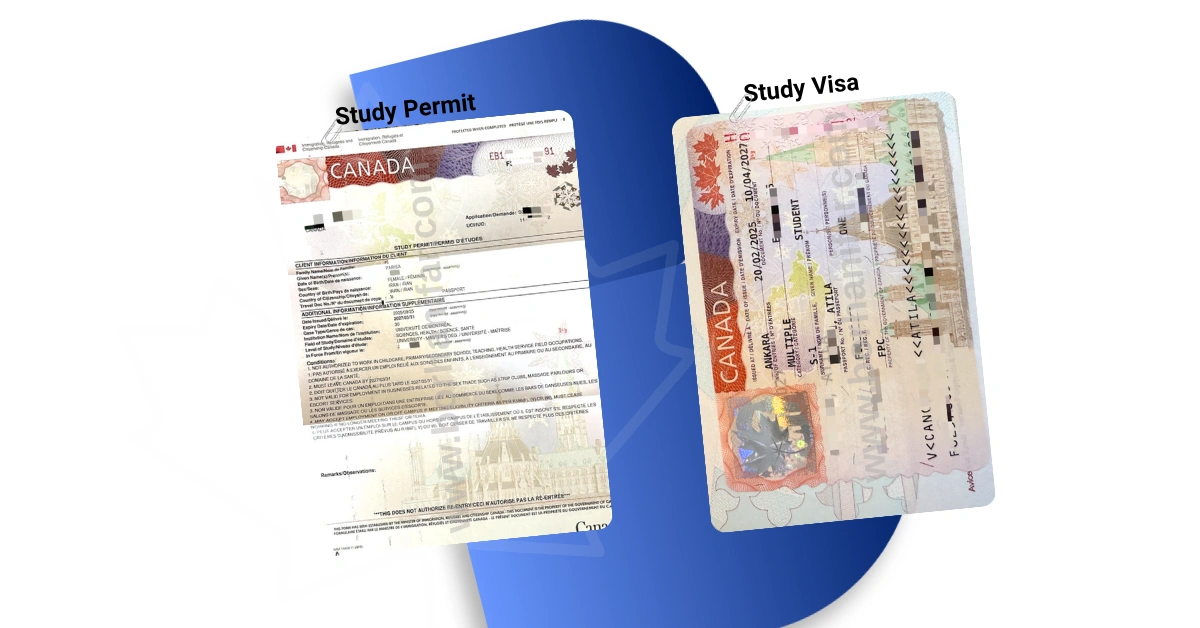
A study permit is issued by Immigration, Refugees and Citizenship Canada (IRCC). It allows eligible foreign nationals to study at designated learning institutions (DLIs) in Canada.
A Designated Learning Institution (DLI) is a Canadian school approved to accept international students.
| Document | Purpose |
|---|---|
| TRV or eTA | Allows travel and entry to Canada |
| Study Permit | Allows legal study status inside Canada |
In most cases, study permit holders receive their actual permit at the Canadian port of entry after arrival.
What information appears on a study permit?
- The name of the designated learning institution
- The validity period of the permit
- Work authorization conditions
- Restrictions or additional requirements
Failure to follow study permit conditions may affect future immigration applications, work eligibility, or PGWP access.
→ Important factors to review before applying for a Canada study permit
Difference between a Canada study permit and visa
Who needs a study permit in Canada?
Most foreign nationals need a study permit for programs longer than 6 months in Canada.
This usually applies to university degrees, college diplomas, certificate programs, and many secondary school studies.
Students planning to apply for a Post-Graduation Work Permit (PGWP) generally need a valid study permit from an eligible institution and program.
Who usually needs a study permit?
- Students enrolled in programs longer than 6 months
- Applicants pursuing degrees, diplomas, or certificates
- International students attending Canadian schools
- Students planning to qualify for PGWP pathways
Who may not need a study permit?
- Students in short-term programs under 6 months
- Certain foreign diplomatic representatives and family members
- Some foreign military personnel under official agreements
- Visitors taking short recreational or temporary courses
Eligibility for exemptions depends on the applicant’s specific situation and immigration status.
What types of study permits are available in Canada?
Canada generally separates study permit pathways based on the applicant’s age and level of education.
Requirements, supporting documents, and supervision rules can differ between minor and adult applicants.
Study permit for minors
This category applies to children studying at primary or secondary schools in Canada.
Minor students usually need a legal custodian in Canada.
- School acceptance documents
- Custodianship documentation
- Financial support evidence
- Accommodation details
Parents may also review our guide on the Canada Minor Study Permit, custodianship requirements and visa process.
Study permit for adults
This pathway is commonly used by college, university, graduate, and doctoral students.
Eligible students may work during studies and later explore PGWP or immigration pathways.
Pros and cons of studying in Canada
Studying in Canada offers education and immigration opportunities, but applicants should understand the costs, responsibilities, and refusal risks.
Advantages of studying in Canada
- Globally recognized education system
- Potential work authorization during studies
- Access to PGWP pathways in qualifying cases
- Opportunity to bring family members
- Canadian education and work experience
- Possible long-term immigration opportunities
Challenges and considerations
- High tuition and living costs
- Strong financial evidence requirements
- Strict review of study intent
- Risk of refusal with weak documentation
- Changing immigration policies and processing times
Who can apply for a Canada study permit?
Most foreign nationals can apply for a study permit if they are accepted by an eligible Canadian institution and meet IRCC requirements.
- Students enrolling in programs longer than 6 months
- Applicants pursuing diplomas, degrees, or certificates
- Students planning to work during or after studies
- Minor students with proper guardianship arrangements
Applicants must also demonstrate temporary intent and show that they will leave Canada at the end of their authorized stay if required.
Study permit requirements for minor students under 18
Minor students can apply if accepted by a recognized school and supported by proper living arrangements in Canada.
- Acceptance from a public or private school
- Recent academic records
- Proof of financial support from parents
- Clear accommodation plan
- Custodianship documents, if required
- Parental consent and identity documents
The application should clearly show safety, supervision, and financial support.
Is there an age limit for a Canada study permit?
There is no official age limit for a Canada study permit. However, officers assess whether the applicant’s age, academic background, and chosen program form a logical study pathway.
Age alone should not cause refusal, but an unexplained study gap or unclear program choice can increase refusal risk.
You can also review our complete Canada study permit requirements guide for eligibility rules, required documents, proof of funds, and application steps.
How to apply for a Canada study permit (step-by-step guide)
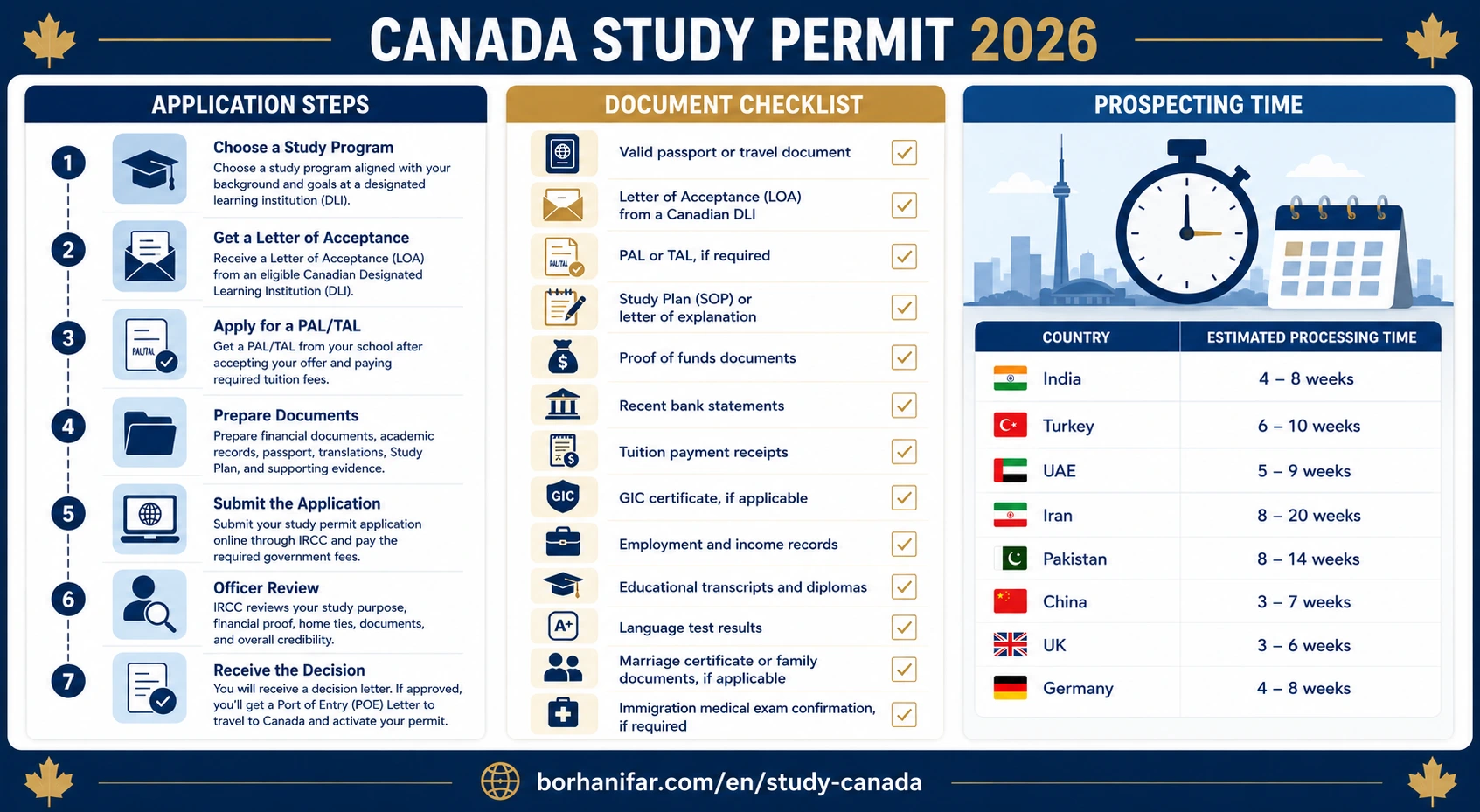
To get a Canada study permit in 2026, you must complete a series of structured steps, from choosing a program to receiving your permit at the port of entry.
Each stage should be completed carefully with accurate documentation to reduce the risk of delay or refusal.
Canada Study Permit Application Pathway
Choose a Study Program
Choose a study program aligned with your background and goals at a designated learning institution (DLI).
Get a Letter of Acceptance
Receive a Letter of Acceptance (LOA) from an eligible Canadian Designated Learning Institution (DLI).
Apply for a PAL/TAL
Get a PAL/TAL from your school after accepting your offer and paying required tuition fees.
Prepare Documents
Prepare financial documents, academic records, passport, translations, Study Plan, and supporting evidence.
Submit the Application
Submit your study permit application online through IRCC and pay the required government fees.
Officer Review
IRCC reviews your study purpose, financial proof, home ties, documents, and overall credibility.
Receive the Decision
If approved, you may receive a Port of Entry Letter and visa or eTA. If refused, IRCC will provide refusal reasons.
Can I apply for a study permit from inside Canada?
Some foreign nationals may apply for a study permit from inside Canada, including certain visitors, workers, students, minor children, exchange students, and eligible family members already in Canada.
Eligibility depends on current immigration status, previous permits, family relationships, and specific IRCC requirements.
Learn more about applying for a study permit inside Canada, including visitor-to-student applications, maintained status, restoration rules, and in-Canada eligibility categories.
Choose a Study Program in Canada
Choosing the right Canadian study program is one of the most important parts of a successful study permit strategy. Your program choice can affect admission, study permit approval, PGWP eligibility, future work opportunities, and long-term immigration pathways.
International students should confirm that their school is an approved Designated Learning Institution (DLI) before applying.
What is a Designated Learning Institution (DLI)?
A Designated Learning Institution (DLI) is a Canadian school approved by a provincial or territorial government to host international students.
Most international students need a valid Letter of Acceptance (LOA) from a DLI before applying for a Canada study permit.
Why program choice matters for study permit approval
IRCC officers assess whether your chosen program makes sense based on your education history, work experience, language ability, and future career goals.
- Programs should match your academic or professional background
- Career progression should appear realistic and logical
- Short-term or unrelated programs may increase refusal risk
- Some programs may affect PGWP eligibility
A strong study plan usually connects your previous background, your Canadian education, and your future career direction into one consistent story.
You can review the official list of approved Canadian schools, colleges, and universities in our guide to Canadian Designated Learning Institutions (DLIs).
Get a Letter of Acceptance (LOA)
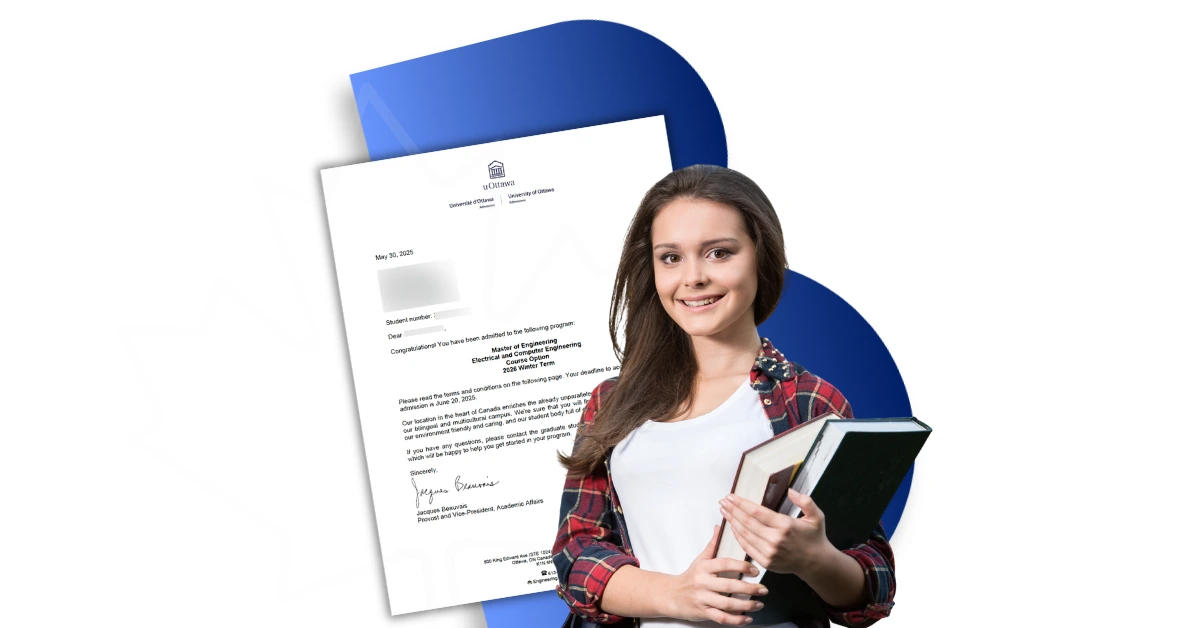
Most international students must receive a valid Letter of Acceptance (LOA) from a Canadian Designated Learning Institution (DLI) before applying for a study permit.
An LOA confirms that a Canadian school has officially accepted you into an eligible academic program.
What is a Letter of Acceptance (LOA)?
A Letter of Acceptance is an official admission document issued by a Canadian college, university, or other approved educational institution.
IRCC usually requires a valid LOA before processing a Canada study permit application.
What information should an LOA include?
- Name of the student
- Name of the Designated Learning Institution (DLI)
- Program name and level of study
- Program start and end dates
- Tuition information
- Conditions of admission, if applicable
Some LOAs may include academic or language conditions that students must complete before entering the main program.
Conditional admission and pathway programs
Some schools issue conditional Letters of Acceptance for students who must first complete prerequisite courses such as ESL, FSL, or pathway programs.
Conditional admission can still support a study permit application, but the overall study plan should clearly explain the academic pathway and future progression into the main program.
- Language pathway programs
- Foundation or bridging programs
- Prerequisite academic courses
- Conditional graduate admissions
Why the LOA matters in study permit assessment
IRCC officers do not review the LOA alone. They assess whether the chosen school and program appear reasonable based on the applicant’s background, finances, and long-term educational goals.
An expensive or unrelated program without a clear explanation may increase study permit refusal risk.
Strong applications usually show:
- A logical program selection
- Realistic educational progression
- Clear career relevance
- Consistent financial planning
You can learn more about LOA requirements, admission conditions, deferred intake rules, and common mistakes in our guide to Canada letter of acceptance (LOA).
Apply for a Provincial or Territorial Attestation Letter (PAL/TAL)
Many international students must obtain a valid Provincial Attestation Letter (PAL) or Territorial Attestation Letter (TAL) before submitting a Canada study permit application.
A PAL/TAL confirms that a province or territory has assigned you one of its available spaces to study in Canada.
What is a Provincial or Territorial Attestation Letter?
A PAL or TAL is an official document issued by the province or territory where you plan to study.
In most cases, you receive it through your Designated Learning Institution (DLI) before applying for a study permit.
How do you get a PAL/TAL?
You should contact your school to confirm its PAL/TAL process. Each DLI may have its own steps, deadlines, and tuition deposit requirements.
- Accept your admission offer
- Pay any required tuition deposit
- Provide passport or identity details
- Follow the DLI’s PAL/TAL instructions
Once issued, the PAL/TAL should be included with your study permit application.
When should you submit your PAL/TAL?
You should submit your PAL/TAL with your study permit application, not after submission.
Each study permit applicant normally needs their own PAL/TAL, even if family members submit applications together.
- Submit it with the initial study permit application
- Make sure it is valid when you apply
- Do not use an expired PAL/TAL
- Do not use a PAL/TAL from a previous cap year
When do you need a new PAL/TAL?
You may need a new PAL/TAL if your previous document expired, your study permit was refused, or you are changing schools or study levels.
Study permit extensions at the same DLI and same level of study may not require a new PAL/TAL.
- Expired or invalid PAL/TAL
- Previous study permit refusal
- Changing schools or DLIs
- Changing level of study
- Restoration of student status
You can learn more about PAL/TAL validity, exemptions, reapplication rules, and school changes in our guide to Canada PAL/TAL requirements.
Canada Study Permit Documents Checklist
After receiving your LOA and PAL/TAL, you must prepare the supporting documents for your Canada study permit application.
IRCC officers review whether your documents are complete, consistent, financially credible, and aligned with your study purpose.
What documents are required for a Canada study permit?
Most applicants must provide identity documents, proof of funds, academic records, a Study Plan, translations, and any additional documents required by IRCC or the local visa office.
The exact checklist depends on your country of residence, study level, family situation, program type, and whether you are applying from inside or outside Canada.
Canada study permit document checklist (2026)
Most Canada study permit applications commonly include the following documents and supporting evidence.
- Valid passport or travel document
- Letter of Acceptance (LOA) from a Canadian DLI
- PAL or TAL, if required
- Study Plan (SOP) or letter of explanation
- Proof of funds documents
- Recent bank statements
- Tuition payment receipts
- GIC certificate, if applicable
- Employment and income records
- Educational transcripts and diplomas
- Language test results
- Marriage certificate or family documents, if applicable
- Immigration medical exam confirmation, if required
Below, we explain the most important documents for Canada study permit applications.
Proof of identity
Proof of identity is always required for the applicant and each family member included in the application.
- Copy of a valid passport or travel document
- Passport information page uploaded with the online application
- Name and date of birth written on the back of each photo, where applicable
Applicants may also need to provide a photocopy of their marriage certificate, if applicable, and one digital photo that meets the official IRCC photo specifications.
If the application is approved, IRCC may request the original passport for visa issuance.
U.S. citizens and lawful permanent residents may have additional identity or travel document options, including proof of U.S. status where applicable.
Proof of funds and financial support
Proof of funds is always required. Applicants must show enough money to cover tuition, living expenses, travel costs, and expenses for accompanying family members.
Outside Quebec, the minimum living-cost requirement starts at CAD 22,895 for a single student, excluding tuition.
- Bank statements for the past 4 months
- Guaranteed Investment Certificate (GIC)
- Tuition payment receipts for the first year of tuition
- Scholarship or funding confirmation
- Education loan approval letters
- Sponsor support letter and financial documents
- Bank draft convertible to Canadian dollars
IRCC officers assess not only the amount of money, but also the source, history, accessibility, and credibility of the funds.
IRCC Minimum Living Cost Table Outside Quebec
Updated based on IRCC financial requirements effective September 1, 2025.
| Family members | Minimum funds per year (CAD) |
| 1 | 22,895 |
| 2 | 28,502 |
| 3 | 35,040 |
| 4 | 42,543 |
| 5 | 48,252 |
| 6 | 54,420 |
| 7 | 60,589 |
| Each additional family member | 6,170 |
Example: If you and 2 family members plan to study in a province or territory outside Quebec for one year, you may need at least CAD 35,040 for living expenses, excluding tuition and travel costs.
These amounts cover living expenses only. Tuition fees must be added separately.
Most applicants must show tuition fees, living expenses, and travel costs for at least one year of studies in Canada.
- One year of tuition fees
- One year of living expenses
- Return travel costs
- Additional funds for accompanying family members
Study Permit Funds Calculation Example
If annual tuition is CAD 25,000 and the applicant is applying alone:
Estimated Minimum Funds = CAD 22,895 + CAD 25,000 = CAD 47,895
Applicants should generally show funds above the minimum requirement where possible.
How IRCC Officers Assess Proof of Funds
- Source of funds and income history
- Bank transaction patterns
- Real access to the money
- Consistency between income and savings
- Sponsor credibility and supporting documents
A high bank balance alone is not enough. Weak or unexplained financial documents may increase study permit refusal risks.
What Should Proof of Funds Cover?
Required study permit expenses
- Tuition fees
- Housing and utilities
- Food and transportation
- Health insurance
- Books and study materials
- Daily personal expenses
Extra costs students often forget
Students should also plan for winter clothing, rental deposits, phone setup, emergency expenses, and initial settlement costs after arrival.
You can also read our complete guide to proof of funds for Canada study permits, including bank statements, sponsor documents, GICs, education loans, and common financial refusal concerns.
Detailed guide about international student living costs, housing, transportation, and student life in Canada.
Weak or unclear financial planning may increase refusal risks and affect overall application credibility.
Study Plan or Statement of Purpose (SOP)
A Study Plan or Statement of Purpose explains why you chose the program, why Canada, and how the studies connect to your academic or career goals.
- Why this program is logical
- Why the Canadian institution was selected
- How the program connects to past education or work experience
- How the applicant will fund the studies
- Future career plans after graduation
- Temporary resident intent and home ties
A generic, copied, or unrealistic SOP may increase refusal risk even if the required documents are included.
Strong vs Weak SOP Example
| Strong SOP | Weak SOP |
| Clear connection between education, work experience, and future career goals. | Generic statements with no logical academic or career direction. |
| Explains why the specific Canadian program is necessary. | No clear explanation for choosing the program or Canada. |
| Realistic post-graduation career plan outside Canada. | Unclear future plans or excessive focus on immigration. |
How to Write a Strong SOP for Canada Study Permit
A strong SOP should clearly explain your academic background, study purpose, career goals, financial situation, and temporary resident intent in Canada.
Recommended structure for a Study Plan (SOP)
- Introduction and personal background
- Academic history and qualifications
- Why this program and institution
- Why Canada
- Career goals after graduation
- Financial situation and funding source
- Home ties and temporary intent
- Conclusion and study purpose
Important SOP writing tips
- Keep the explanation clear and structured
- Use realistic academic and career goals
- Match all information with submitted documents
- Avoid emotional or unnecessary storytelling
- Explain study gaps or program changes properly
Temporary intent and dual intent explained
A study permit is temporary resident status.
Officers must be satisfied that the applicant will comply with immigration conditions and leave Canada at the end of the authorized stay if no new legal status is obtained.
At the same time, future immigration plans may still exist. This is known as dual intent under Canadian immigration law.
Applicants should also review our complete guide to writing a Canada Study Plan (SOP) to understand officer expectations, refusal risks, and strong SOP structure.
Academic documents and language evidence
Academic records help IRCC assess whether the chosen program is reasonable and whether the applicant is prepared to complete it.
- Transcripts
- Diplomas and certificates
- Graduation letters
- Professional certificates
- IELTS, CELPIP, TOEFL, PTE, TEF, or TCF results, if available
- Proof of previous English or French education, if applicable
If no formal language test is provided, the application should still show academic and language readiness through other credible evidence.
Most Canadian colleges and universities generally require English proficiency equivalent to IELTS Academic 6.5–7.0 overall or comparable scores in recognized tests such as TOEFL, PTE, CELPIP, CAEL, Duolingo English Test, TEF, or TCF Canada.
Home ties and supporting evidence
Home ties help support temporary resident intent and show that the applicant has reasons to comply with Canadian immigration conditions.
- Employment or business documents
- Property or asset records
- Family responsibilities outside Canada
- Financial commitments
- Professional licensing or career plans
- Clear post-study plan
Strong files connect home ties, study purpose, financial capacity, and future plans into one consistent explanation.
Medical exam
You may need an immigration medical exam if any of these situations apply to you:
- You plan to stay in Canada for more than 6 months
- You recently spent time in certain countries
- You plan to work in jobs where public health must be protected
Medical exams must usually be completed by an IRCC-approved panel physician.
Additional details are available through official IRCC guidelines for medical exams.
Police certificate
In some cases, IRCC may ask for a police certificate to assess admissibility and background history.
If you think you may need one, it is usually better to apply early because police certificate processing times vary by country.
- Current country of residence
- Previous countries of residence
- Expired or incomplete certificates may delay processing
More details are available through official IRCC guidelines for police certificates.
Proof of custodianship for minor children
Children under 17 who come to Canada without a parent or legal guardian may need an appointed custodian in Canada.
- Custodianship declaration forms
- Parent or guardian authorization
- Custodian identity documents
- Proof of Canadian address
- School and accommodation details
Weak or unclear care arrangements may create concerns in minor study permit applications.
Country-specific visa office documents
Some applicants must submit additional documents based on the country they are applying from.
- Local visa office forms
- Military service records
- Civil status documents
- Additional financial evidence
- Travel history documents
- Proof of legal status in the country of application
- Re-entry permit, if required by the issuing country
Applicants should check the local visa office instructions before submitting the application.
Quebec CAQ, if required
Students planning to study in Quebec generally need a Quebec Acceptance Certificate (CAQ) before applying for a Canada study permit.
Applications are submitted through Quebec’s official Arrima platform.
Certified translations and document consistency
Documents not issued in English or French should normally be submitted with a certified translation.
- Certified translation
- Copy of the original document
- Translator affidavit, if required
Names, dates, financial amounts, employment history, and school details should remain consistent across all forms and supporting documents.
Inconsistent translations, missing pages, or unclear documents may weaken the application and increase processing delays.
A successful study permit application is not just a checklist. It should present a clear, credible, and well-documented study plan supported by complete evidence.
Submit the Study Permit Application
After preparing your study permit documents, the next step is submitting the application online through the official IRCC portal and paying the required government fees.
A complete and well-organized submission can help reduce delays, document requests, and study permit refusal risks.
Prepare and review all study permit documents
Before submitting the application, students should carefully review all forms, supporting documents, translations, passport information, and financial records.
- Letter of Acceptance (LOA)
- PAL/TAL, if required
- Passport and identity documents
- Proof of funds
- Study Plan or SOP
- Academic records and certified translations
- Medical exam confirmation, if applicable
- Police certificates, if requested
- Family or custodianship documents, where applicable
All uploaded information should remain accurate and consistent across forms and supporting evidence.
Important IRCC study permit forms
Most study permit applicants complete their forms online through the IRCC portal. Depending on the applicant’s situation, additional family or representative forms may also be required.
- IMM 1294 — Main application form for study permits made outside Canada
- IMM 5707 — Family information form
- IMM 5476 — Use of a representative form
- IMM 5409 — Statutory declaration of common-law union
- IMM 5646 — Custodianship declaration for minor children
- IRCC forms and guides — Official application forms and document guides
Create an IRCC online account
Most study permit applications are submitted electronically through the IRCC secure portal.
Applicants can create an account, upload documents, complete forms, pay fees, and track application progress through the official IRCC account system.
Applications should be reviewed carefully before final submission because missing information or inconsistencies may affect processing.
Government processing fees
Applicants must pay the required government processing fees when submitting the study permit application.
- Study permit processing fee
- Biometrics fee, if required
- Additional fees for accompanying family members
Government fees may change based on future IRCC policy updates.
Biometrics appointment
Many applicants must provide biometric fingerprints and a photo after submitting the application.
Biometrics are usually completed at an approved Visa Application Centre (VAC) after receiving the biometric instruction letter from IRCC.
Additional details are available through the official IRCC biometrics guide.
If biometric fingerprints and a photo are required, applicants normally do not need to include paper photos with the application package.
A strong study permit submission should present complete forms, organized supporting documents, consistent information, and a clear academic purpose aligned with IRCC requirements.
You can also review our Canada study permit approval rate guide and study permit success tips to better understand approval trends, refusal risks, SOP strategies, proof of funds, and application success factors.

Canada Study Permit Fees and Processing Time in 2026
Canada study permit costs include government fees, biometrics, medical exams, document preparation, and tuition-related expenses.
Processing times vary by country, application volume, biometrics, medical exams, and document quality.
Canada Study Permit Government Fees
| Application Type | Government Fee CAD |
|---|---|
| Study Permit Application | $150 |
| Study Permit Extension | $150 |
| Status Restoration | $396.25 |
| Spouse Open Work Permit | $255 |
| Visitor Visa for Family Member | $100 |
| Child Study Permit | $150 |
Canada Biometrics Fees
| Biometrics Type | Fee CAD |
|---|---|
| Per Person | $85 |
| Family, 2 or more people | $170 |
Additional Study Permit Application Costs
| Expense | Estimated Cost CAD |
|---|---|
| IELTS / TOEFL / PTE | Around $300 |
| Certified Translation | $200–$400 |
| Medical Exam | $150–$300 |
| Police Certificate | Varies by country |
| Tuition Deposit | Varies by institution |
Before travel, many applicants spend approximately CAD $3,500 to CAD $5,500 on preparation and related expenses, excluding full tuition and living costs.
Estimated Tuition Fees in Canada
School tuition costs in Canada
- Public school: CAD 12,000–18,000 per year
- Private school: CAD 20,000–50,000 per year
- Boarding school: CAD 35,000–70,000 per year
College tuition fees in Canada
- Business Administration: CAD 13,000–18,000
- Computer Programming: CAD 14,000–20,000
- Practical Nursing: CAD 16,000–22,000
- Marketing: CAD 13,000–18,500
- Construction Management: CAD 14,000–19,000
University tuition fees in Canada
- Computer Science: CAD 20,000–45,000
- Engineering: CAD 25,000–50,000
- Business / MBA: CAD 22,000–55,000
- Health Sciences: CAD 22,000–40,000
- Law / LLM: CAD 30,000–60,000
PhD tuition and funding
- PhD tuition: CAD 7,000–18,000 per year
- Scholarship / TA / RA funding: CAD 15,000–35,000 per year
Many PhD programs provide partial or full funding packages for qualified students.
Canada Study Permit Processing Time
Canada study permit processing times often range between 3 and 16 weeks, but timelines can change.
Processing depends on the applicant’s country, security checks, medical requirements, seasonal volume, and document quality.
Estimated processing time by country
| Country | Estimated Processing Time |
|---|---|
| India | 4–8 weeks |
| Turkey | 6–10 weeks |
| UAE | 5–9 weeks |
| Iran | 8–20 weeks |
| Pakistan | 8–14 weeks |
| China | 3–7 weeks |
| UK | 3–6 weeks |
| Germany | 4–8 weeks |
Processing timelines are estimates only and may change depending on application complexity and IRCC workload.
You can also review current Canada study permit processing times in 2026, including biometrics delays, medical exam timelines, IRCC backlogs, and country-specific processing estimates.
Official IRCC source: Canada study permit processing times tool
Canada Study Permit Refusals, Assessment and Decision
IRCC officers assess study permit applications based on credibility, consistency, financial capacity, study purpose, and temporary resident intent.
The decision is not based on a single document alone. Officers review whether the entire application supports a genuine and realistic study plan.
A strong application should clearly demonstrate that the applicant is a genuine student with a logical academic pathway, credible financial support, and realistic educational goals.
Main factors IRCC officers evaluate
- Study purpose: The chosen program should match the applicant’s education history, work experience, and future goals.
- Financial capacity: Funds should be sufficient, traceable, accessible, and supported by credible documentation.
- Study Plan (SOP): The application should explain why Canada, why the selected program, and how the studies support long-term goals.
- Home ties: Employment, business activity, property, financial commitments, or family ties outside Canada may support temporary intent.
- Academic consistency: Educational progression, study gaps, and program changes should be properly explained.
- Travel history: Previous immigration compliance may support overall credibility.
- Document quality: Missing, inconsistent, or weak documents may increase refusal risks.
Common Canada study permit refusal reasons
Many study permit refusals happen because the overall file lacks consistency or credibility, not necessarily because the applicant lacks qualifications.
- Weak or generic Study Plan
- Unclear career direction or unrealistic educational progression
- Unexplained study gap or field change
- Insufficient, unexplained, or inconsistent financial evidence
- Weak home-country ties
- Program choice unrelated to previous studies or work experience
- Missing PAL, TAL, CAQ, or valid LOA where required
- Contradictions between forms and supporting documents
What makes a strong study permit application?
- Clear academic and career progression
- Well-structured and realistic SOP
- Transparent financial documents
- Strong explanation for study gaps or program changes
- Evidence of temporary intent and ties outside Canada
- Consistent information across all forms and documents
- Proper translations and organized evidence
- Reasonable program choice based on the applicant’s profile
Strong files reduce uncertainty for the officer and make the application easier to assess.
How IRCC officers make study permit decisions
Study permit decisions are discretionary. Officers assess both the submitted documents and the overall credibility of the application.
Canadian immigration law recognizes dual intent. Future immigration goals may exist, but the current study purpose must still appear genuine and temporary.
What should you do after a study permit refusal?
The appropriate response depends on the refusal reasons, the strength of the evidence, and the circumstances of the application.
- Review the refusal letter carefully
- Request GCMS notes where appropriate
- Identify the officer's concerns
- Strengthen weak areas of the application
- Consider submitting a stronger new application
Some applicants may benefit from seeking professional advice regarding reconsideration requests, reapplications, or other available legal options.
Example case
One applicant previously received a study permit refusal because of weak financial evidence and an unclear study purpose. After improving the Study Plan, strengthening financial documentation, and clearly explaining career progression, the applicant later received approval under a new application.
You can also review common Canada study permit refusal reasons, including weak SOPs, financial concerns, temporary resident intent issues, study gaps, and inconsistent supporting documents.
Learn more about reapplying after a Canada study permit refusal, including GCMS notes, stronger SOPs, and refusal analysis.
Important Steps After Arriving in Canada as an International Student
After receiving a Canada study permit and arriving in Canada, international students should complete several important settlement and administrative steps before starting their studies.
This includes obtaining a Social Insurance Number (SIN), arranging health insurance, opening a Canadian bank account, securing housing, understanding study permit conditions, and preparing for life in Canada.
If your study permit is approved
Approved applicants usually receive a Port of Entry (POE) Letter. The actual study permit is commonly issued after arrival in Canada.
- Review your TRV or eTA details carefully
- Carry your LOA and financial documents during travel
- Prepare documents for airport inspection
- Verify study permit conditions after issuance
International Student Life in Canada
After receiving a Canada study permit, international students must prepare for housing, banking, transportation, healthcare, phone services, and daily settlement in Canada.
Most international students rent apartments, shared housing, or student residences after arriving in Canada.
- University or college residence options
- Shared apartments and basement rentals
- Lease agreements and rental deposits
- Tenant rights and rental obligations
- Monthly housing and utility costs
- Short-term temporary accommodation after arrival
Students should carefully review lease terms, location, transportation access, and total monthly expenses before signing a rental agreement.
Getting a SIN number in Canada
International students usually need a Social Insurance Number (SIN) to work legally in Canada.
- Apply through Service Canada
- Valid study permit with work authorization is generally required
- SIN is needed for employment and tax purposes
- Temporary SIN numbers usually start with the number 9
Students should verify that their study permit includes valid work authorization conditions before applying for a SIN.
Opening a Canadian bank account
Most students open a Canadian bank account shortly after arrival to manage tuition, rent, daily expenses, and payroll deposits.
- Passport and study permit
- Letter of Acceptance (LOA)
- Proof of address in Canada
- SIN number may be requested in some situations
Many Canadian banks offer special student banking packages with reduced fees and newcomer benefits.
Getting a phone number and mobile plan in Canada
International students usually need a Canadian mobile phone number for banking, housing, school registration, and employment purposes.
- Prepaid and postpaid mobile plans
- Student discounts and newcomer offers
- eSIM and physical SIM card options
- Coverage differences between providers
Major Canadian providers include Rogers, Bell, Telus, Freedom Mobile, and several budget carriers.
Buying or leasing a car as an international student
Some students choose to lease or purchase a vehicle depending on their city, transportation needs, and financial situation.
- Driver’s licence requirements
- Vehicle insurance costs
- Monthly lease payments
- Used versus new vehicle considerations
- Public transportation alternatives
Car ownership in Canada may involve significant costs including insurance, fuel, maintenance, parking, and winter tires.
Health insurance for international students
Health insurance rules vary by province and school.
- Some provinces provide public healthcare access
- Many schools offer mandatory private insurance plans
- Coverage may include emergency and basic medical services
- Waiting periods may apply in some provinces
Students should confirm health coverage immediately after arrival to avoid uninsured medical expenses.
Working while studying in Canada
Eligible international students may work during studies if their study permit includes valid work authorization conditions.
- On-campus and off-campus work opportunities
- Part-time work during academic sessions
- Full-time work during scheduled breaks in eligible situations
- Work restrictions linked to enrollment status
Students should always verify current IRCC work rules because policies and temporary public measures may change.
Important settlement costs students often forget
- Winter clothing and seasonal expenses
- Rental deposits and utility setup fees
- Furniture and household items
- Public transit costs
- Internet and phone bills
- Emergency savings and unexpected expenses
Settlement expenses during the first months in Canada are often higher than students initially expect.
Family Members of International Students in Canada
International students may be able to include their spouse or dependent children in their Canada study permit plan, depending on the program, financial situation, and current IRCC rules.
Officers assess whether the study plan, finances, and relocation strategy realistically support the temporary purpose of the application.
Family applications usually require stronger financial evidence and a well-structured study plan.
Who can bring family members to Canada?
- Students in eligible Master’s programs
- PhD students
- Students in selected professional programs
- Applicants with sufficient and traceable financial support
Students in many college diploma or short-term programs may face restrictions for spouse open work permit eligibility.
Can a spouse work while the student studies?
A spouse may qualify for an open work permit only if the student is enrolled in an eligible program, such as a Master’s, PhD, or certain professional degree programs.
This rule can significantly affect long-term family planning and study pathway selection.
Can dependent children study in Canada?
- Children usually require their own study permit
- Minor children may attend public school in many provinces
- A Letter of Acceptance may not always be required for minor children
- Language tests are generally not required for minor children
Public education may be low-cost or free depending on the province, school board, and the parent’s immigration status.
Financial requirements for family applications
When family members are included, officers assess whether the applicant can realistically support the entire family in Canada.
- Student tuition fees
- Student living expenses
- Spouse living costs
- Children’s housing, school, and daily expenses
- Travel and settlement costs
Weak financial evidence is a common concern in family-based study permit applications.
Key documents for spouse and children
- Marriage certificate or common-law evidence
- Birth certificates for dependent children
- Proof of funds and income documents
- Student’s Letter of Acceptance
- Study permit application documents
- Explanation letter, where appropriate
Can family applications be submitted together?
Yes. In many situations, the student, spouse, and children may apply together.
Combined applications can help present a unified immigration plan, but they also require stronger financial documentation and clearer explanations.
Each family member must still independently meet temporary resident requirements.
How officers assess family applications
Family applications often receive closer review because they increase the financial and temporary intent burden on the file.
- Program eligibility: Does the student’s program support spouse work permit eligibility?
- Financial realism: Are the funds sufficient for the whole family?
- Family purpose: Does the relocation plan support the study objective?
- Consistency: Do all applications align with the same overall explanation?
A strong family application should support the student’s academic purpose rather than create additional concerns.
Family members may often accompany international students to Canada, but successful applications generally require eligible study programs, sufficient finances, and well-organized supporting documents for every applicant.
Canada Study Permit Expiry and Extension Rule
A Canada study permit is usually valid for the length of the study program plus an additional 90 days. The extra time allows students to prepare to leave Canada or apply for another legal status, such as a Post-Graduation Work Permit (PGWP), if eligible.
The actual validity period may be shorter depending on the passport expiry date, study completion date, or the type of academic program.
What affects study permit validity?
- Official duration of the academic program
- Passport expiry date
- Early completion of studies
- Conditional admission or pathway programs
- Maintaining active student status at a DLI
If a passport expires before the end of the program, the study permit will usually be shortened accordingly.
In pathway or language-program cases, the initial permit may cover only the preliminary program. Students may later need to apply for an extension before starting the main academic program.
What happens after program completion?
A study permit generally becomes invalid 90 days after the school confirms program completion through documents such as:
- Completion letter
- Official transcript
- Diploma or graduation confirmation
Students planning to remain in Canada should review PGWP eligibility and immigration options before this period ends.
When should you extend a study permit?
If the study permit will expire before the program ends, students should usually apply for an extension at least 30 days before expiry.
- Apply before the expiry date
- Keep proof of enrollment and tuition payment
- Maintain legal student status during processing
- Monitor passport validity before applying
Students who apply on time from inside Canada can often continue studying under maintained status while the extension is processed.
What happens if a study permit expires?
If the study permit expires before an extension application is submitted:
- Legal student status is lost
- The student must stop studying immediately
- Restoration of status may be possible within 90 days
Restoration applications are more expensive and may carry higher immigration risk compared to timely extensions.
Important tips to avoid status problems
- Monitor study permit and passport expiry dates
- Maintain active enrollment at a DLI
- Keep academic and enrollment records
- Apply for extensions early
- Review PGWP eligibility before graduation
A well-managed immigration status history is important for future applications such as PGWP, work permits, or permanent residence.
Study permit validity depends not only on the program length, but also on maintaining legal student status, passport validity, and compliance with immigration conditions in Canada.
Learn more about changing schools or programs in Canada as an international student, including updated IRCC DLI transfer rules, PAL/TAL requirements, and study permit extension obligations.

How to Change or Extend a Canada Study Permit
International students may need to change schools, extend their study permit, or restore their status during their studies in Canada.
These processes involve strict IRCC compliance requirements, and mistakes can affect future applications such as PGWP, work permits, or permanent residence.
Students must comply with Canada study permit conditions and IRCC student compliance rules while studying in Canada.
Maintaining continuous legal student status is important throughout your studies in Canada.
Changing colleges or universities in Canada
Under updated IRCC rules, many post-secondary students must apply for a new study permit or extension before changing their Designated Learning Institution (DLI).
- Changing schools without updating IRCC may create compliance issues
- Applications should be submitted before changing institutions
- Students should maintain legal status during the process
- Program changes should remain academically logical and consistent
Unauthorized school changes may negatively affect future applications, including PGWP eligibility.
How to extend a Canada study permit
If your studies continue beyond the permit expiry date, you must apply for an extension before the permit expires.
- Valid enrollment confirmation from the institution
- Updated proof of financial support
- Valid passport covering the extended period
- Application submitted before expiry
IRCC commonly recommends applying at least 30 days before expiry to reduce status risks.
Maintained status vs restoration of status
Students who apply before the permit expires may usually continue studying under maintained status while waiting for a decision.
If the permit already expired:
- The student must stop studying immediately
- Restoration must normally be requested within 90 days
- Additional government fees apply
Restoration applications carry higher legal and immigration risks compared to maintaining continuous status.
What IRCC officers assess in extensions and school changes
IRCC officers often review the applicant’s compliance history carefully when assessing future applications.
- Clear academic progression strengthens credibility
- Frequent or unexplained program changes may create concerns
- Status gaps or late applications increase risk
- Financial documents should remain realistic and updated
Strong applications show continuous status, logical academic direction, and consistent supporting documents.
Following IRCC compliance rules during your studies is important for future pathways such as PGWP, work permits, and permanent residence.
Learn more about extending or restoring a Canada study permit, including maintained status, IMM 5709, and restoration applications.

Working While Studying and After Graduation in Canada
International students in Canada may be allowed to work during their studies and after graduation if they meet IRCC study permit conditions and program eligibility requirements.
Work authorization depends on the student’s status, institution, and program type. Following IRCC rules is essential for maintaining legal status and protecting future immigration pathways.
Students should verify work eligibility and PGWP rules before starting a program in Canada.
Working while studying in Canada
Most full-time students at eligible Designated Learning Institutions (DLIs) may work without a separate work permit if their study permit includes work authorization.
- Up to 24 hours per week off-campus during academic sessions
- Full-time work during scheduled school breaks
- Students must remain enrolled full-time in an eligible program
- The study permit must include permission to work
If a student loses full-time status or becomes ineligible, work authorization normally ends immediately.
International students should also review our complete guide to working while studying in Canada to understand on-campus and off-campus work rules, SIN requirements, and student work eligibility.
Post-Graduation Work Permit (PGWP)
The Post-Graduation Work Permit (PGWP) allows eligible graduates to work in Canada after completing their studies.
- University programs are commonly PGWP eligible
- Some college or non-degree programs must meet eligible field requirements
- Students usually must study full-time in an approved program
- PGWP validity may be issued for up to 3 years
- Applications generally must be submitted within 180 days of graduation
Choosing a PGWP-eligible program is essential for students planning future Canadian work experience or permanent residence pathways.
Common PGWP mistakes students should avoid
- Studying at a non-eligible institution
- Changing programs without proper authorization
- Studying part-time outside permitted exceptions
- Missing the PGWP application deadline
These issues may affect PGWP eligibility even if the academic program was completed successfully.
Students should review PGWP eligibility, work conditions, and study permit compliance rules before beginning their studies in Canada.
For full PGWP eligibility rules, work permit duration, requirements, and permanent residence pathways, visit the Canada Post-Graduation Work Permit (PGWP) Guide.
This below table includes PGWP-eligible fields of study organized by category, CIP 2021 code, and official program title.
PGWP Eligible Fields of Study by CIP Code
Use this table to search and sort eligible PGWP fields of study by category, CIP 2021 code, and program title.
| Field of Study Category | CIP 2021 Code | CIP 2021 Title |
|---|
How to Get Permanent Residency After Studying in Canada
Many international students apply for permanent residence (PR) after graduation, but PR is not automatic.
Eligibility depends on factors such as the study program, Canadian work experience, language scores, and the immigration pathway selected after graduation.
In many cases, students first obtain a Post-Graduation Work Permit (PGWP) and later apply for PR after gaining skilled Canadian work experience.
Common PR pathways for international students
- Express Entry – Canadian Experience Class (CEC)
- Provincial Nominee Programs (PNP)
- Employer-supported immigration pathways
- Quebec immigration programs
Most pathways require skilled work experience, language test results, and a competitive immigration profile.
Typical study-to-PR pathway in Canada
- Complete an eligible study program
- Apply for a Post-Graduation Work Permit (PGWP)
- Gain skilled Canadian work experience
- Improve language scores if necessary
- Apply for PR through Express Entry or a PNP stream
A well-planned study and work strategy can significantly improve long-term immigration opportunities.
Programs that usually provide stronger PR potential
| Study Path | PGWP Eligibility | PR Potential |
|---|---|---|
| College (non-aligned field) | Limited | Lower |
| College (in-demand field) | Yes | Moderate |
| Bachelor’s degree | Yes | High |
| Master’s degree | Yes | Stronger |
| PhD | Yes | Stronger |
Choosing the right study program can directly affect PGWP eligibility and future PR opportunities.
What improves PR chances after graduation?
- Skilled Canadian work experience
- Strong IELTS, CELPIP, or TEF scores
- Education aligned with labour market demand
- Provincial nomination or a valid job offer
- Consistent academic and employment history
Students with realistic long-term planning often have stronger immigration outcomes.
How IRCC views PR intent during study permit assessment
Canadian immigration law recognizes dual intent. International students may legally have future PR goals while still applying for temporary resident status.
- The study program should remain academically logical
- The Study Plan should focus primarily on education
- Career goals should appear realistic and structured
- Weak or inconsistent long-term planning may increase refusal risk
Strong applications present a credible pathway from education to future career development.
A successful study-to-PR strategy often begins with choosing the right academic program, maintaining legal status, and building relevant Canadian work experience after graduation.
Official Government Sources and Legal References
Study permits are primarily governed by the Immigration and Refugee Protection Regulations (IRPR).
Official study permit eligibility requirements, application procedures, and document checklists are available through the Government of Canada study permit guide.
Applicants planning to study in Quebec may also require a Quebec Acceptance Certificate (CAQ) through the Government of Quebec education and immigration portal.
Canada Study Permit FAQ (2026)
Below are common questions about Canada study permits, tuition costs, work authorization, PGWP eligibility, refusal reasons, and permanent residence pathways for international students.
Who can apply for a Canada study permit?
Applicants generally need a valid Letter of Acceptance (LOA), sufficient financial support, and a genuine study purpose connected to their academic or professional background.
Do I need a PAL or TAL for a Canada study permit?
Many applicants now need a Provincial or Territorial Attestation Letter (PAL/TAL) before applying for a Canada study permit, depending on the program and applicant category.
What is a Designated Learning Institution (DLI)?
A Designated Learning Institution (DLI) is a Canadian school approved to host international students under the study permit program.
How much money is required for a Canada study permit?
Most applicants must show one year of tuition plus living expenses. Outside Quebec, the minimum living-cost requirement starts at CAD 22,895 for a single student.
Is IELTS required for a Canada study permit?
IRCC does not always require IELTS directly, but most schools require language proof for admission. Strong IELTS or other language scores can improve application credibility.
How important is the Study Plan (SOP)?
The Study Plan is one of the most important parts of a study permit application. It explains the study purpose, program choice, academic progression, and future goals.
What are common study permit refusal reasons?
Common refusal reasons include weak SOPs, unclear finances, weak home ties, unexplained study gaps, unrealistic career plans, and inconsistent supporting documents.
Can my study permit application be refused?
Yes. Applications may be refused due to weak study plans, financial concerns, insufficient ties, inconsistent documents, or doubts about temporary intent.
Can I work while studying in Canada?
Eligible international students can usually work up to 24 hours per week during academic sessions and full-time during scheduled school breaks.
What is a Post-Graduation Work Permit (PGWP)?
The Post-Graduation Work Permit (PGWP) allows eligible graduates to work in Canada after completing their studies at an approved institution and program.
Do all Canadian study programs qualify for PGWP?
No. Only eligible programs at approved institutions qualify for PGWP, and some programs must also meet field-of-study requirements.
Can a Canada study permit lead to permanent residence?
Not automatically. Studying in Canada may support future PR planning through PGWP, Express Entry, PNP, or other pathways if the applicant meets eligibility requirements.
.
Can I bring my spouse and children to Canada?
In eligible cases, spouses may qualify for an open work permit and dependent children may study in Canada.
Can I apply for a study permit from inside Canada?
Some foreign nationals may apply for a study permit from inside Canada if they meet specific eligibility requirements under immigration regulations.
Can I extend my Canada study permit?
Yes. Students should apply before the permit expires and provide updated enrollment confirmation and financial documents.
Can I change schools or programs in Canada?
Yes. Many post-secondary students must update their study permit or apply for a new permit before changing their Designated Learning Institution.
How long does Canada study permit processing take?
Processing times vary by country, season, biometrics completion, and application complexity. Many applications take several weeks to several months.
Do international students need health insurance in Canada?
Yes. Health insurance is generally mandatory for international students, although requirements vary by province and educational institution.
Need Help With Your Canada Study Permit Application?
Canada study permit applications are assessed based on financial credibility, study purpose, academic progression, and the overall consistency of the application.
Professional preparation of supporting documents, study plans, and application strategy may help reduce common refusal risks and improve application clarity.
For personalized guidance, you can book a Canada immigration consultation or send us a message on WhatsApp.
In this article:
About Borhanifar Immigration
Borhanifar Immigration provides professional Canadian immigration services and strategic guidance for temporary and permanent residence applications, including business immigration and individual immigration pathways. Professional memberships include CICC, CBA, OBA, and CAPIC.
Our practice is supervised by a licensed Canadian immigration professional (RCIC) and focuses on practical immigration solutions, strategic case preparation, and clear guidance based on current Canadian immigration laws and IRCC policies.
This content is provided for general informational purposes only and should not be interpreted as individualized legal advice or a guarantee of approval or immigration results.