Canada Express Entry 2026: Requirements, CRS & PR Guide
Canada Express Entry is an online immigration system used to select candidates for permanent residence based on their Comprehensive Ranking System (CRS) score. Applicants with higher scores are invited to apply (ITA).
Table of Contents

What Is Canada Express Entry?
Express Entry is one of Canada’s most important economic immigration systems. It has been managed by Immigration, Refugees and Citizenship Canada (IRCC) since 2015.
Under this system, applicants first create a profile and enter the Express Entry pool. Candidates are ranked based on their CRS score, which takes into account factors such as age, education, work experience, and language ability.
Applicants with higher scores have a better chance of receiving an Invitation to Apply (ITA). After receiving an ITA, the applicant must submit a permanent residence application. If the application is approved, Canadian permanent residence (PR) is granted.
Express Entry Canada Updates in 2026
Canada’s Express Entry system continues to evolve in 2026, with a stronger focus on selecting candidates who can integrate quickly into the labour market. While some changes have been officially implemented, others remain proposed or under discussion.
Understanding the difference between confirmed updates and potential reforms is essential for building a reliable immigration strategy.
Has the structure of Express Entry changed in 2026?
As of now, Express Entry still operates through its three main federal programs: the Federal Skilled Worker (FSW), Canadian Experience Class (CEC), and Federal Skilled Trades (FST).
To enter the pool, applicants must continue to meet the eligibility criteria of at least one of these programs.
What is the focus of Express Entry draws in 2026?
In recent updates, IRCC has emphasized targeted selection based on labour market needs. Category-based draws remain a key tool for selecting candidates with in-demand skills, Canadian work experience, or specific qualifications.
Are category-based draws still important?
Yes. Category-based selection continues to play a major role in 2026. These draws allow IRCC to prioritize candidates in specific occupations or sectors where Canada faces shortages.
Will the three Express Entry programs be merged?
At this time, there is no official confirmation that the FSW, CEC, and FST programs will be merged into a single system. While discussions and proposals exist, they have not been implemented as policy.
Are there confirmed changes to the CRS scoring system?
No major structural changes to the CRS system have been officially finalized for 2026. Some proposals—such as reducing certain bonus points or introducing new economic factors—have been discussed, but should not be treated as confirmed rules.
What should applicants focus on in 2026?
Applicants should focus on strengthening core factors such as language scores, Canadian work experience, education, and employability. Following official IRCC updates and draw trends is more important than relying on speculation.
Express Entry in 2026
In 2026, some Express Entry policies and trends have continued to shift based on Canada’s labour market needs.
Main Express Entry changes in 2025–2026:
- Category-based draws for in-demand occupations such as healthcare, technology, and education
- Greater value placed on French-language skills in certain draws
- Removal of job offer points: 50 and 200 CRS points were removed on March 25, 2025
- Program-focused draws with stronger attention on Canadian work experience and provincial pathways
- Changing CRS cut-off scores depending on labour market conditions
- Use of the NOC and TEER system to assess eligible work experience
Who Is Express Entry Ideal For?
- Applicants at a competitive age, usually under 35
- Those with a university degree, such as a bachelor’s degree or higher
- Applicants with strong English or French test results
- Skilled workers with qualifying professional experience
- Those with Canadian study or work experience
- Applicants who receive a provincial nomination (PNP)
- Those with a valid job offer from a Canadian employer
- Applicants who can prove French-language ability
Key Benefits of Express Entry
- Fast permanent residence processing, often around 6 months
- A fully online application and file management process
- The system remains open throughout the year
- No fixed cap on the number of profiles in the pool
- Priority selection for certain in-demand occupations and French-speaking candidates
- More ways to improve your chances through provincial programs and Canadian experience
Challenges and Limitations of Express Entry
- High competition in the Express Entry pool
- A relatively strong CRS score is often needed to receive an ITA
- Age, language results, and Canadian work experience can strongly affect your score
- Applicants must prepare key documents such as language test results and an Educational Credential Assessment (ECA)
- The CRS cut-off score changes from draw to draw based on Canada’s labour market needs
Who Can Apply for Canada Express Entry?
To qualify for Express Entry, you generally need skilled work experience, valid language test results, and an Educational Credential Assessment if your education was completed outside Canada.
Without meeting the basic requirements, your profile cannot enter the Express Entry pool.
- At least one year of eligible work experience
- Work experience in TEER 0, 1, 2, or 3 occupations
- Valid English or French language test results
- An Educational Credential Assessment (ECA) for education completed outside Canada
Canadian Experience Class (CEC)
The Canadian Experience Class (CEC) is one of the most strategic immigration pathways for individuals who have already worked in Canada and want to transition to permanent residence through Express Entry.
Unlike other programs, CEC focuses on real integration into the Canadian labour market. Applicants with proven Canadian work experience are considered lower risk and more likely to succeed economically.
Eligibility Requirements for CEC
- At least 1 year (1,560 hours) of skilled work experience in Canada within the last 3 years
- Work must fall under TEER 0, 1, 2, or 3 categories
- Language requirements:
- CLB 7 for TEER 0 and 1 occupations
- CLB 5 for TEER 2 and 3 occupations
- Work must be legally obtained with valid work authorization
- No minimum education requirement (but education improves CRS score)
What Type of Work Experience Qualifies?
Only skilled, paid work experience in Canada counts. This includes full-time work (30 hours/week) or an equivalent amount of part-time work.
- Must match NOC job duties and responsibilities
- Must be continuous or accumulated within the eligible period
- Self-employment does NOT count
- Work gained without proper authorization does NOT count
Co-op placements or internships may count only if they meet all eligibility criteria and were authorized.
CRS Advantage for CEC Candidates
Canadian work experience significantly increases CRS scores. Candidates under CEC often have a competitive advantage compared to overseas applicants.
- Additional CRS points for Canadian experience
- Higher ranking in category-based draws
- Better profile strength when combined with Canadian education
This is why many international students follow a study → PGWP → CEC strategy.
Documents Required for CEC
- Employer reference letters (must include duties, hours, salary)
- Proof of employment (pay stubs, contracts, tax documents)
- Language test results (IELTS General or CELPIP)
- Valid work permits or proof of legal status
- Educational credentials (if claiming CRS points)
Incomplete or vague documentation is one of the most common reasons for delays or refusal.
Do You Need Proof of Funds for CEC?
In most cases, proof of settlement funds is NOT required for CEC applicants, especially if you are already working in Canada.
However, you must still demonstrate financial stability if requested.
Common Mistakes in CEC Applications
- Incorrect NOC/TEER classification
- Reference letters missing job duties
- Counting ineligible work experience (e.g. self-employment)
- Insufficient language scores
- Inconsistency between documents and Express Entry profile
Even small inconsistencies can reduce credibility and affect approval.
Officer Perspective: How CEC Applications Are Evaluated
From an officer’s perspective, CEC is about verifying real Canadian work experience and consistency across documents.
- Does the job match the NOC description?
- Are duties consistent with the claimed occupation?
- Is the experience genuine and verifiable?
If any doubt exists, additional review or refusal may occur.
Strategic Insight: Why CEC Is One of the Strongest PR Pathways
CEC is widely considered one of the most reliable immigration pathways because it is based on actual Canadian experience rather than projected potential.
Applicants who:
- Study in Canada
- Work under PGWP
- Gain 1 year of skilled experience
can often transition smoothly into permanent residence through Express Entry.
This makes CEC a core strategy in long-term immigration planning.
Federal Skilled Worker Program (FSWP)
The Federal Skilled Worker Program (FSWP) is designed for skilled professionals outside Canada who want to immigrate based on their education, work experience, and language ability.
Unlike the Canadian Experience Class, this program evaluates applicants using a selection grid system before they enter the Express Entry pool.
To qualify under the Federal Skilled Worker Program, the applicant must score at least 67 out of 100 points under the official selection grid.
Eligibility Requirements for FSWP
- At least 1 year of continuous full-time skilled work experience (or equivalent part-time) in the last 10 years
- Work must fall under TEER 0, 1, 2, or 3
- Minimum language level of CLB 7 in English or French
- Educational Credential Assessment (ECA) required for foreign education
- Must meet the minimum 67-point threshold
- Proof of settlement funds required (unless exempt)
How the 67-Point System Works
The FSWP uses a selection grid to assess your eligibility before entering the Express Entry pool. This is separate from the CRS score used later.
- 67 points → eligibility to enter Express Entry
- CRS score → ranking inside the pool
Meeting 67 points does NOT guarantee an invitation to apply (ITA).
Proof of Funds Requirement
Applicants must show sufficient settlement funds unless they have a valid job offer or are authorized to work in Canada.
- Funds must be available and accessible
- Must be legally obtained
- Must be supported with clear documentation
Documents Required for FSWP
- Educational Credential Assessment (ECA)
- Language test results (IELTS or TEF)
- Work experience letters with duties and salary
- Proof of funds documents
- Passport and identity documents
Common Mistakes in FSWP Applications
- Assuming 67 points guarantees permanent residence
- Incorrect job classification (NOC mismatch)
- Weak or incomplete reference letters
- Unclear or inconsistent financial documents
- Low CRS score after entering the pool
Strategic Insight: When FSWP Works Best
FSWP is most effective for applicants with strong profiles outside Canada, especially those with high language scores, advanced education, and multiple years of skilled work experience.
Improving CRS score is critical for success after meeting the 67-point eligibility threshold.
67-Point Selection Grid for the Federal Skilled Worker Program
1. Age (Maximum 12 points)
| Age | Points |
|---|---|
| Under 18 | 0 |
| 18 to 35 | 12 |
| 36 | 11 |
| 37 | 10 |
| 38 | 9 |
| 39 | 8 |
| 40 | 7 |
| 41 | 6 |
| 42 | 5 |
| 43 | 4 |
| 44 | 3 |
| 45 | 2 |
| 46 | 1 |
| 47 or older | 0 |
2. Education (Maximum 25 points)
| Education level | Points |
|---|---|
| Doctoral degree (PhD) | 25 |
| Master’s degree | 23 |
| Two or more credentials | 22 |
| 3-year credential | 21 |
| 2-year credential | 19 |
| 1-year credential | 15 |
| High school diploma | 5 |
3. Work Experience (Maximum 15 points)
| Work experience | Points |
|---|---|
| 1 year | 9 |
| 2–3 years | 11 |
| 4–5 years | 13 |
| 6+ years | 15 |
4. First Official Language (Maximum 24 points)
| Language level | Points per ability |
|---|---|
| CLB 9 or higher | 6 |
| CLB 8 | 5 |
| CLB 7 | 4 |
| Below CLB 7 | Not eligible |
5. Second Official Language (Maximum 4 points)
| Situation | Points |
|---|---|
| CLB 5+ | 4 |
| Below CLB 5 | 0 |
6. Job Offer (Maximum 10 points)
| Situation | Points |
|---|---|
| Valid job offer | 10 |
| No job offer | 0 |
7. Adaptability (Maximum 10 points)
You can earn points through factors such as spouse language ability, Canadian study/work experience, or having relatives in Canada.
Federal Skilled Trades Program (FSTP)
The Federal Skilled Trades Program (FSTP) is designed for applicants with hands-on technical or trade experience who want to immigrate to Canada through Express Entry.
This pathway is intended for qualified tradespersons in eligible occupations, including electricians, welders, plumbers, industrial mechanics, construction trades, chefs, cooks, and other designated trade categories.
To qualify, the applicant must have at least 2 years of full-time work experience, or an equal amount of part-time experience, in a skilled trade within the last 5 years.
In addition, the applicant must have either:
- a valid full-time job offer for at least 1 year in Canada, or
- a certificate of qualification in their skilled trade issued by a Canadian provincial, territorial, or federal authority
Eligibility Requirements for FSTP
- At least 2 years of full-time paid work experience in an eligible skilled trade within the last 5 years
- Work experience must match the duties of the relevant NOC trade occupation
- A valid job offer for full-time employment for at least 1 year, or a Canadian certificate of qualification
- Minimum language level:
- CLB 5 for speaking and listening
- CLB 4 for reading and writing
- Meet admissibility requirements for permanent residence
Which Trades Are Usually Eligible?
The FSTP generally covers eligible skilled trade occupations under specific major groups in the National Occupational Classification (NOC), mainly in TEER 2 and TEER 3 categories.
- Construction trades
- Industrial, electrical, and mechanical trades
- Maintenance and equipment operation trades
- Supervisors and technical occupations in natural resources, agriculture, and related production
- Processing, manufacturing, and utilities supervisors and central control operators
- Chefs and cooks
- Butchers and bakers in certain qualifying classifications
Applicants should always confirm that their occupation fits the current FSTP-eligible trade categories and that their duties match the NOC description closely.
What Type of Work Experience Qualifies?
The work experience must be paid, genuine, and performed in an eligible skilled trade. Volunteer work and unpaid internships do not count.
- The experience can be full-time or an equivalent amount of part-time work
- The work must have been performed after becoming qualified to practise the trade
- The applicant must have carried out the main duties and most essential duties of the trade occupation
Reference letters should clearly describe job title, duties, hours, salary, and period of employment. Weak or generic letters can create serious credibility issues.
Job Offer vs Certificate of Qualification
One of the defining features of the FSTP is that the applicant must have either a qualifying job offer or a Canadian certificate of qualification.
Valid Job Offer
- Must be for continuous, paid, full-time work
- Must be for at least 1 year
- Can come from one or up to two Canadian employers
- Must be in an eligible skilled trade occupation
Certificate of Qualification
- Issued by a Canadian provincial, territorial, or federal authority
- Confirms that the applicant is certified to work in the trade in Canada
- Often requires trade assessment, testing, or licensing steps
For many applicants outside Canada, obtaining a valid job offer may be more practical than first securing a Canadian trade certificate. However, in regulated trades, certification can make the profile significantly stronger.
Language Requirements for FSTP
The language threshold under FSTP is lower than under many other Express Entry pathways, but it still matters.
- Speaking: CLB 5
- Listening: CLB 5
- Reading: CLB 4
- Writing: CLB 4
Although these are the minimum requirements, stronger language results can improve the overall CRS score and increase competitiveness in the Express Entry pool.
Education and CRS Advantage
There is no minimum education requirement under the FSTP. However, education can still add significant CRS points.
- Foreign education may count if supported by an Educational Credential Assessment (ECA)
- Canadian education can strengthen the profile even further
- Higher education improves ranking, even when not required for eligibility
This means an FSTP applicant can qualify without formal education, but education remains a strong advantage inside Express Entry.
Proof of Funds Requirement
Most FSTP applicants must show proof of settlement funds unless they are already authorized to work in Canada and have a valid job offer.
Settlement funds must be:
- Available and accessible
- Legally obtained
- Supported by credible financial documents
Applicants often underestimate this requirement, especially when they assume that trade experience alone is sufficient.
Documents Required for FSTP
- Language test results
- Detailed work experience letters
- Proof of valid job offer, if applicable
- Certificate of qualification, if applicable
- Proof of funds documents
- Passport and identity documents
- Educational documents, if claiming CRS points
Each document must support the claimed trade background and show that the applicant is genuinely qualified in the occupation.
Common Mistakes in FSTP Applications
- Claiming an occupation that does not fit the eligible trade groups
- Submitting weak or incomplete work reference letters
- Confusing general work experience with trade-specific work experience
- Failing to provide a valid job offer or certificate of qualification
- Assuming that low CRS can be ignored because the trade is in demand
Many FSTP refusals happen because the applicant clearly works in a technical field, but the file does not prove that the job matches the legal requirements of the program.
Strategic Insight: When FSTP Works Best
The FSTP works best for applicants who have strong practical trade experience and either:
- a realistic pathway to obtaining a valid Canadian job offer, or
- a clear route to obtaining a Canadian certificate of qualification
This program can be especially valuable for skilled tradespersons who may not have high academic credentials but have real labour market value in Canada.
It is also strategically strong because trade occupations may benefit from category-based draws in Express Entry, which can reduce CRS pressure in some cases.
Officer Perspective: How FSTP Applications Are Evaluated
From an officer’s perspective, the key issue is whether the applicant is genuinely qualified in the trade and whether the file proves it clearly.
- Do the duties match the claimed trade occupation?
- Is the work experience recent and substantial enough?
- Is the job offer or certificate valid and relevant?
- Does the file show real employability in Canada?
FSTP applications are often document-sensitive. Even when the applicant is genuinely experienced, poor supporting evidence can undermine the file.
Are you a physician or international medical graduate? Canada has introduced additional immigration pathways and healthcare-focused opportunities for qualified doctors. Learn more in our Canada Immigration for Medical Doctors Guide.
How Is the Express Entry Score Calculated?
The Express Entry score is calculated under the Comprehensive Ranking System (CRS), with a maximum of 1,200 points.
It includes factors such as age, education, language ability, work experience, and additional points such as a provincial nomination. The higher your CRS score, the better your chances of receiving an Invitation to Apply (ITA).
Canada Express Entry Points Table
| Scoring factor | Maximum points (single) | Maximum points (married) |
|---|---|---|
| Core human capital factors (age, language, education, and work experience) | 500 | 460 |
| Spouse factors | — | 40 |
| Skill transferability factors | 100 | 100 |
| Additional factors (provincial nomination, French, etc.) | 600 | 600 |
| Total score | 1,200 | 1,200 |
Not sure what your CRS score is?
Breakdown of Express Entry CRS Factors
Below, we explain each scoring factor step by step so you can understand how many points each one may add to your profile.
Note: As of March 25, 2025, job offer points of 50 and 200 were removed from the CRS system.
Age (Maximum 110 points)
| Age | With spouse | Without spouse |
|---|---|---|
| 17 or younger | 0 | 0 |
| 18 | 90 | 99 |
| 19 | 95 | 105 |
| 20 to 29 | 100 | 110 |
| 30 | 95 | 105 |
| 31 | 90 | 99 |
| 32 | 85 | 94 |
| 33 | 80 | 88 |
| 34 | 75 | 83 |
| 35 | 70 | 77 |
| 36 | 65 | 72 |
| 37 | 60 | 66 |
| 38 | 55 | 61 |
| 39 | 50 | 55 |
| 40 | 45 | 50 |
| 41 | 35 | 39 |
| 42 | 25 | 28 |
| 43 | 15 | 17 |
| 44 | 5 | 6 |
| 45 or older | 0 | 0 |
Education (Maximum 150 points)
| Education level | With spouse | Without spouse |
|---|---|---|
| Less than secondary school | 0 | 0 |
| Secondary school diploma | 28 | 30 |
| One-year post-secondary credential from a university, college, or technical institution | 84 | 90 |
| Two-year post-secondary program | 91 | 98 |
| Bachelor’s degree or a program of three years or longer | 112 | 120 |
| Two or more credentials, with at least one being three years or longer | 119 | 128 |
| Master’s degree or professional degree required for a licensed profession | 126 | 135 |
| Doctoral degree (PhD) | 140 | 150 |
Language Ability (Maximum 160 points)
First official language is scored separately for each ability: reading, writing, speaking, and listening. The maximum score in this section is 136 for applicants without a spouse and 128 for applicants with a spouse.
| CLB level in each ability | With spouse | Without spouse |
|---|---|---|
| Below CLB 4 | 0 | 0 |
| CLB 4 or 5 | 6 | 6 |
| CLB 6 | 8 | 9 |
| CLB 7 | 16 | 17 |
| CLB 8 | 22 | 23 |
| CLB 9 | 29 | 31 |
| CLB 10 or higher | 32 | 34 |
Second official language is also scored separately for each ability. The maximum total in this section is 22 points with a spouse and 24 points without a spouse.
| CLB level in each ability | With spouse | Without spouse |
|---|---|---|
| CLB 4 or lower | 0 | 0 |
| CLB 5 or 6 | 1 | 1 |
| CLB 7 or 8 | 3 | 3 |
| CLB 9 or higher | 6 | 6 |
Canadian Work Experience (Maximum 80 points)
This section is based on the number of years of full-time work experience, or an equal amount of part-time experience, gained in Canada.
| Length of work experience | With spouse | Without spouse |
|---|---|---|
| Less than 1 year or no experience | 0 | 0 |
| 1 year | 35 | 40 |
| 2 years | 46 | 53 |
| 3 years | 56 | 64 |
| 4 years | 63 | 72 |
| 5 years or more | 70 | 80 |
Skill Transferability Factors (Maximum 100 points)
This section combines multiple factors and can add up to 100 points. Your score increases when you have strong combinations, such as education plus language ability.
Education + Language
| Condition | CLB 7 | CLB 9+ |
|---|---|---|
| Less than secondary school | 0 | 0 |
| Post-secondary credential of at least 1 year | 13 | 25 |
| Two credentials or a bachelor’s degree and above | 25 | 50 |
Education + Canadian Work Experience
| Condition | 1 year | 2 years or more |
|---|---|---|
| Post-secondary credential | 13 | 25 |
| Bachelor’s degree or higher | 25 | 50 |
Foreign Work Experience + Language
| Experience | CLB 7 | CLB 9+ |
|---|---|---|
| 1 to 2 years | 13 | 25 |
| 3 years or more | 25 | 50 |
Foreign Work Experience + Canadian Work Experience
| Experience | 1 year in Canada | 2 years in Canada |
|---|---|---|
| 1 to 2 years foreign experience | 13 | 25 |
| 3 years or more foreign experience | 25 | 50 |
Trade Certificate + Language
| Condition | Points |
|---|---|
| CLB 5 | 25 |
| CLB 7 or higher | 50 |
The maximum score available from this section is 100 points, even if you qualify under multiple combinations.
Additional Points (Maximum 600 points)
In addition to the main CRS factors, some elements can give your profile important extra points.
| Factor | Maximum points |
|---|---|
| Brother or sister in Canada (citizen or permanent resident, age 18 or older) | 15 |
| French: NCLC 7 or higher + CLB 4 or lower in English | 25 |
| French: NCLC 7 or higher + CLB 5 or higher in English | 50 |
| Study in Canada: one- or two-year credential | 15 |
| Study in Canada: credential of three years or more | 30 |
| Provincial or territorial nomination (PNP) | 600 |
Your CRS score plays a central role in receiving an invitation for permanent residence. By understanding these factors clearly, you can identify weak points in your profile and improve them to significantly increase your chances.
Canada Express Entry Draws Table: Latest Rounds
This table lets you search and sort the latest Canada Express Entry draws, from draw number 1 on January 31, 2015 to today, by date, draw type, number of invitations, and minimum CRS score.| Draw | Date | Draw Type | ITAs Issued | Minimum CRS |
|---|---|---|---|---|
| Loading data... | ||||
Requirement documents for Canada Express Entry
To apply through Express Entry, some documents must be prepared before creating your profile, while others are submitted after receiving an Invitation to Apply (ITA).
Documents needed to create your Express Entry profile
- Valid passport: Includes your identity details and personal information
- Valid Language results: Approved English or French test (IELTS, CELPIP, TEF)
- Educational Credential Assessment (ECA): Required for education completed outside Canada
- NOC/TEER code: Based on your work experience
- Job offer (if available): A valid offer, sometimes supported by LMIA
- Provincial nomination (if applicable): Can significantly increase your CRS score
Documents required after receiving an ITA
- Identity documents: Passport, birth certificate, and photos
- Valid Language test results: Must be valid at submission time
- Proof of work experience: Reference letters, contracts, and pay slips
- Educational documents: Degrees, transcripts, and ECA report
- Proof of funds: Required for certain programs
- Police certificates: From countries where you lived for more than 6 months
- Medical exam: Completed by IRCC-approved physicians
- Family documents: Marriage certificate and children’s records
- Additional documents: Depending on your case
- Government fees: Payment confirmation for PR application
Below, we break down the most important requirements in more detail.
Language requirements for Express Entry Canada
A valid language test is required to enter the Express Entry system. You must include your results when creating your profile. Language ability is measured using CLB for English and NCLC for French. Minimum scores depend on the program and job level. Higher scores can significantly improve your CRS ranking.
Minimum language requirements by program
| Program | Minimum Level |
|---|---|
| Canadian Experience Class (CEC) | TEER 0–1: CLB 7 TEER 2–3: CLB 5 |
| Federal Skilled Worker (FSW) | Minimum CLB 7 in all abilities |
| Federal Skilled Trades (FST) | Speaking & Listening: CLB 5 Reading & Writing: CLB 4 |
Language results are usually valid for two years and must remain valid at both profile creation and PR submission.
Work experience requirements for Express Entry
Each Express Entry program has different work experience requirements based on duration and job type.
| Program | Minimum Experience | TEER Level |
|---|---|---|
| Federal Skilled Worker (FSW) | At least 1 year continuous work in the last 10 years | TEER 0, 1, 2, or 3 |
| Federal Skilled Trades (FST) | At least 2 years in the last 5 years | TEER 2 or 3 |
| Canadian Experience Class (CEC) | At least 1 year in Canada within the last 3 years | TEER 0, 1, 2, or 3 |
More experience can increase your CRS score.
Accepted Work Experience by Program
| Program | Type of Experience | Eligible Levels |
|---|---|---|
| Canadian Experience Class (CEC) | Work experience in Canada | TEER 0, 1, 2, or 3 |
| Federal Skilled Worker (FSW) | Skilled work experience (inside or outside Canada) | TEER 0, 1, 2, or 3 |
| Federal Skilled Trades (FST) | Eligible trade occupations | Major Groups 72, 73, 82, 83, 92, 93 Minor Group 6320 Unit Group 62200 |
Important: Work experience must be genuine, verifiable, and consistent with your NOC job duties.
Proof of funds for Express Entry Canada
Proof of funds shows that you can support yourself and your family after arriving in Canada. This requirement applies to Federal Skilled Worker (FSW) and Federal Skilled Trades (FST) applicants. Some candidates, such as those with Canadian work experience, may be exempt. The required amount depends on your family size and must be legally accessible.
Minimum proof of funds for Express Entry (2026 update)
| Family Size | Required Amount (CAD) |
|---|---|
| 1 | 15,263 |
| 2 | 19,001 |
| 3 | 23,360 |
| 4 | 28,362 |
| 5 | 32,168 |
| 6 | 36,280 |
| 7 | 40,392 |
| Each additional member | 4,112 |
Job offer and provincial nomination in Express Entry
As of March 2025, job offers no longer add CRS points directly. However, they can still play a role in eligibility for certain programs. A valid job offer must be full-time, non-seasonal, and within TEER 0, 1, 2, or 3. In some cases, an LMIA may be required. Provincial nomination (PNP) remains one of the strongest factors. It adds 600 CRS points and almost guarantees an invitation.
Job offer requirements by program
| Program | Job Offer Required | Details |
|---|---|---|
| Canadian Experience Class (CEC) | No | Not required for eligibility |
| Federal Skilled Worker (FSW) | No | May help in some pathways |
| Federal Skilled Trades (FST) | Yes (one of two options) | Valid job offer (1 year) or certificate of qualification |
Important: Your job offer must meet IRCC requirements and be fully valid.
Additional supporting documents for Express Entry
In addition to core documents, you may need extra supporting documents depending on your situation. These documents help avoid delays or refusals.
PR photo requirements
Valid passport
Police certificates
Medical exam
Document translation requirements
Documents not in English or French must be translated.
- Use a certified translator
- Translate all stamps and non-English text
- Include original or certified copies
If not translated by a certified translator, an affidavit is required.
How To Apply for Express Entry? (Step-by-Step Guide)
The Express Entry process follows a clear, structured path. You must first qualify under one of Canada’s economic immigration programs before entering the system.
Step-by-step Express Entry process
- Check your eligibility: Confirm that you qualify under one of the Express Entry programs
- Take a language test: Obtain valid English or French test results
- Get an ECA: Assess your education if it was completed outside Canada
- Create your profile: Enter your information in the Express Entry system
- Receive your CRS score: Your score is calculated based on age, education, language, and work experience
- Receive an ITA: If your score is high enough, you may receive an Invitation to Apply
- Submit your PR application: Upload your documents and apply for permanent residence
What is Express Entry-linked PNP in Canada
Some Canadian provinces and territories run immigration streams linked to Express Entry. In this pathway, you first create an Express Entry profile and may then be selected by a province under its Provincial Nominee Program (PNP).
If you receive a provincial nomination, 600 additional CRS points are added to your profile. This usually gives you a very strong chance of receiving an Invitation to Apply (ITA) for permanent residence.
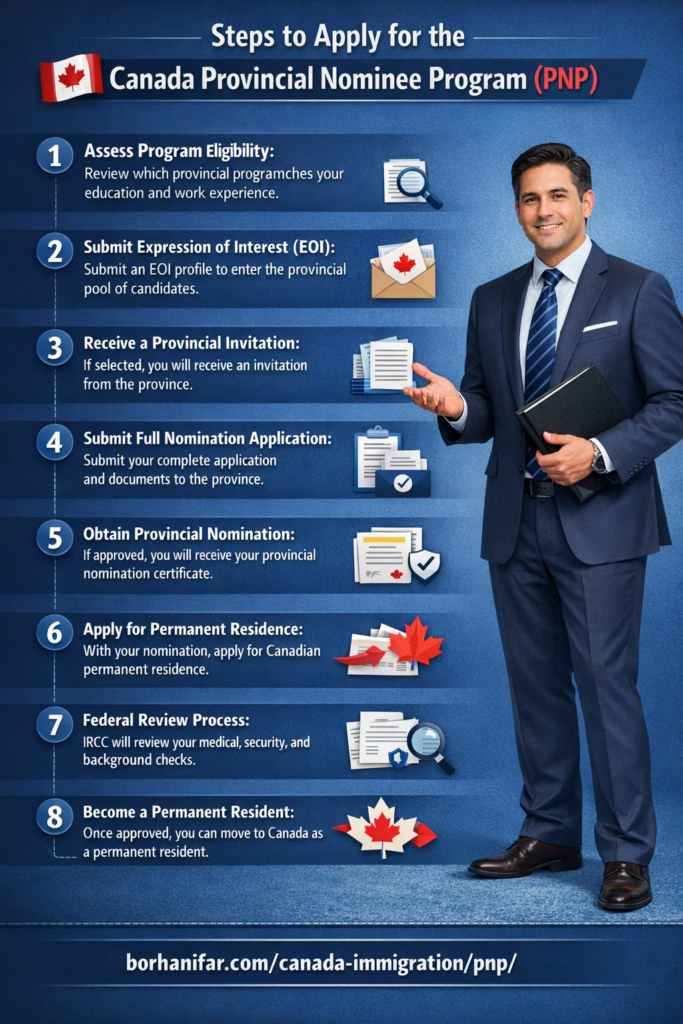
Provincial Nominee Program (PNP)
The Provincial Nominee Program (PNP) allows Canadian provinces and territories to nominate foreign workers, students, and entrepreneurs who meet specific regional labour market needs.
Each province has its own streams and selection criteria, meaning eligibility varies depending on location, occupation, and individual profile.
A provincial nomination can significantly increase your chances of receiving permanent residence, especially through Express Entry-linked streams.
How PNP Works
There are two main types of PNP pathways:
- Express Entry-aligned streams (Enhanced PNP)
- Non-Express Entry streams (Base PNP)
Enhanced streams are linked to Express Entry and offer a major advantage through additional CRS points.
Base streams operate outside Express Entry and follow a separate application process with longer processing times.
CRS Advantage of PNP
One of the biggest advantages of PNP is the additional CRS points awarded for nomination.
- Provincial nomination = +600 CRS points
- This almost guarantees an Invitation to Apply (ITA)
For many applicants with moderate CRS scores, PNP is the most reliable pathway to permanent residence.
Common Types of PNP Streams
- Skilled worker streams
- International graduate streams
- In-demand occupation streams
- Employer-driven streams
- Entrepreneur and business streams
Each stream targets specific categories of applicants based on local economic priorities.
Eligibility Requirements for PNP
Although requirements vary by province, most PNP streams assess:
- Work experience in an in-demand occupation
- Language proficiency (CLB varies by stream)
- Education level
- Connection to the province (job offer, study, or residency)
- Intent to reside in the nominating province
Do You Need a Job Offer for PNP?
Not all PNP streams require a job offer, but many do.
- Some provinces offer streams without job offers
- Most employer-driven streams require a valid job offer
- Having a job offer significantly strengthens your application
Applicants without job offers should focus on provinces that actively invite candidates from the Express Entry pool.
Documents Required for PNP
- Language test results
- Educational Credential Assessment (if required)
- Work experience documentation
- Proof of job offer (if applicable)
- Proof of settlement funds
- Provincial forms and supporting documents
Processing Time and Steps
The PNP process usually involves two main stages:
- Apply to a province and receive a nomination
- Apply for permanent residence through IRCC
Processing times vary depending on the stream and whether it is Express Entry-aligned.
Common Mistakes in PNP Applications
- Applying to a province without a genuine connection
- Submitting weak or inconsistent job offer documents
- Failing to demonstrate intent to reside in the province
- Choosing the wrong stream
- Ignoring provincial-specific criteria
Provincial officers carefully assess whether the applicant truly intends to live and work in the province.
Strategic Insight: When PNP Works Best
PNP is the strongest strategy for applicants who:
- Have moderate CRS scores
- Have work experience in in-demand occupations
- Can secure a job offer in a specific province
- Have studied or worked in Canada
In many real cases, PNP is the deciding factor between waiting in the pool and successfully receiving an ITA.
Officer Perspective: How PNP Applications Are Assessed
Officers focus on whether the nomination is genuine and whether the applicant aligns with provincial economic priorities.
- Is the job offer legitimate and sustainable?
- Does the applicant meet the stream requirements?
- Is there a clear intent to reside in the province?
- Are documents consistent and credible?
Weak alignment with provincial needs is one of the most common reasons for refusal.
Express Entry compared with other immigration pathways
The best immigration route depends on your personal situation. The table below offers a quick comparison between Express Entry and other common pathways to Canada.
| Immigration Pathway | Speed | Points Required | Risk Level | Best For |
|---|---|---|---|---|
| Express Entry | Fast | High (CRS) | Moderate | Skilled workers |
| Provincial PNP | Moderate | Lower | Lower | Applicants with lower CRS scores |
| Work permit | Moderate | No | Employer-dependent | Fast entry to the labour market |
Explore Canada's Provincial Nominee Program (PNP) and discover immigration pathways offered by provinces and territories across Canada.
→ Explore our Latest Canada PNP Draws Tracker for recent draw results, invitation numbers, and minimum scores across major Provincial Nominee Programs.
How does category-based selection work in Express Entry?
In addition to general draws, IRCC also runs category-based selection under Express Entry. This allows candidates with specific skills or backgrounds to receive invitations even with lower CRS scores.
These draws are usually based on Canada’s labour market needs, French-language ability, or work experience in targeted occupations. If you fall into one of these categories, your chances of receiving an ITA may increase significantly.
Below are some of the main categories announced by IRCC and examples of occupations included under Express Entry category-based selection:
French-speaking candidates (high priority)
Requirements:
- At least CLB 7 in all four French language abilities
- Eligibility under one of the Express Entry programs
This has become one of Canada’s top immigration priorities in recent years and often receives invitations at lower CRS scores. → See official IRCC instructions
Healthcare and social services occupations
| Occupation | NOC | TEER |
|---|---|---|
| Dentists | 31110 | 1 |
| Registered nurses | 31301 | 1 |
| General practitioners and family physicians | 31102 | 1 |
| Pharmacists | 31120 | 1 |
| Physiotherapists | 31202 | 1 |
| Psychologists | 31200 | 1 |
| Occupational therapists | 31203 | 1 |
| Medical laboratory technicians | 32120 | 2 |
| Nurse aides | 33102 | 3 |
| Social workers | 41300 | 1 |
This list covers only some in-demand roles and may change based on labour market needs.
STEM occupations
| Occupation | NOC | TEER |
|---|---|---|
| Architecture and science managers | 20011 | 0 |
| Civil engineering technologists and technicians | 22300 | 2 |
| Civil engineers | 21300 | 1 |
| Cybersecurity specialists | 21220 | 1 |
| Electrical and electronics engineering technologists | 22310 | 2 |
| Electrical engineers | 21310 | 1 |
| Geological engineers | 21331 | 1 |
| Industrial engineers | 21321 | 1 |
| Insurance agents and brokers | 63100 | 3 |
| Mechanical engineering technologists and technicians | 22301 | 2 |
| Mechanical engineers | 21301 | 1 |
Trades occupations
| Occupation | NOC | TEER |
|---|---|---|
| Welders and related machine operators | 72106 | 2 |
| Water well drillers | 72501 | 2 |
| Sheet metal workers | 72102 | 2 |
| Roofers and shinglers | 73110 | 3 |
| Plumbers | 72300 | 2 |
| Painters and decorators | 73112 | 3 |
| Other technical trades and related occupations | 72999 | 2 |
| Machinists and machining inspectors | 72100 | 2 |
| Industrial electricians | 72201 | 2 |
| Home building and renovation managers | 70011 | 0 |
| Heavy-duty equipment mechanics | 72401 | 2 |
| Heating, refrigeration and air conditioning mechanics | 72402 | 2 |
| Gas fitters | 72302 | 2 |
| Floor covering installers | 73113 | 3 |
| Construction and non-industrial electricians | 72200 | 2 |
| Electrical mechanics | 72422 | 2 |
| Oil and gas well drilling contractors and supervisors | 82021 | 2 |
| Millwrights and industrial mechanics | 72400 | 2 |
| Construction managers | 70010 | 0 |
| Construction estimators | 22303 | 2 |
| Concrete finishers | 73100 | 3 |
| Carpenters | 72310 | 2 |
| Cabinetmakers | 72311 | 2 |
| Retail and wholesale butchers | 63201 | 3 |
| Bricklayers | 72320 | 2 |
Education occupations
| Occupation | NOC | TEER |
|---|---|---|
| Elementary and secondary school teacher assistants | 43100 | 3 |
| Instructors of persons with disabilities | 42203 | 2 |
| Early childhood educators and assistants | 42202 | 2 |
| Elementary school and kindergarten teachers | 41221 | 1 |
| Secondary school teachers | 41220 | 1 |
Transport occupations
| Occupation | NOC | TEER |
|---|---|---|
| Pilots, flight engineers and flying instructors | 72600 | 2 |
| Automotive service technicians, truck and bus mechanics, and mechanical repairers | 72410 | 2 |
| Aircraft mechanics and inspectors | 72404 | 2 |
| Aircraft instrument, electrical and avionics mechanics, technicians and inspectors | 22313 | 2 |
Physicians with Canadian work experience
| Occupation | NOC | TEER |
|---|---|---|
| General practitioners and family physicians | 31102 | 1 |
| Specialists in surgery | 31101 | 1 |
| Specialists in clinical and laboratory medicine | 31100 | 1 |
Senior managers with Canadian work experience
| Occupation | NOC | TEER |
|---|---|---|
| Senior managers in construction, transportation, production and utilities | 00015 | 0 |
| Senior managers in trade, broadcasting and other services | 00014 | 0 |
| Senior managers in health, education, social and community services, and membership organizations | 00013 | 0 |
| Senior managers in financial, communications and other business services | 00012 | 0 |
Researchers with Canadian work experience
| Occupation | NOC | TEER |
|---|---|---|
| Post-secondary teaching and research assistants | 41201 | 1 |
| University professors and lecturers | 41200 | 1 |
Skilled military occupations
| Occupation | NOC | TEER |
|---|---|---|
| Operational members of the Canadian Armed Forces | 43204 | 3 |
| Specialist members of the Canadian Armed Forces | 42102 | 2 |
| Commissioned officers of the Canadian Armed Forces | 40042 | 0 |
If your work experience falls under one of these categories, or if you have strong French-language ability, you may still have a good chance of receiving an ITA through category-based draws even with a lower CRS score.
How do you create an Express Entry profile?
To apply through Canada Express Entry, you must first create an online profile. This profile includes your education, work history, language results, and personal details. Once your profile is complete, it enters the Express Entry pool. Candidates in the pool are then ranked based on their CRS score.
Steps to create an Express Entry profile
- Prepare your key documents, such as your passport and language test results
- Create an account on the official IRCC website
- Enter your personal, education, and work history details
- Add your language results and ECA report
- Submit your profile and enter the Express Entry pool
Do you need to update your Express Entry profile?
Yes. Important changes must be updated in your profile. These may include marriage, the birth of a child, a new language test result, or more work experience. Any of these changes may improve your CRS score and increase your chances of receiving an invitation.
Important profile updates include
- A new language test result
- A new educational credential
- More skilled work experience
- A change in marital status
- A provincial nomination (PNP)
Watch a video guide on how to create an Express Entry profile
This video shows the profile creation process step by step and helps make the system easier to understand.
Watch directly on YouTube: Video link
What is the minimum CRS score for Express Entry?
There is no fixed minimum CRS score in Express Entry. The cut-off changes from one draw to another based on the number of candidates in the pool and the type of draw. Some draws have higher cut-offs, while others are lower. The draw type matters a lot. General draws, program-specific draws, and category-based draws often have very different CRS thresholds.
Examples of CRS cut-offs in some 2026 Express Entry draws
The minimum CRS score depends on the type of draw. The table below shows sample score ranges from different draw categories.
| Draw Type | Typical CRS Range | Notes |
|---|---|---|
| Canadian Experience Class | 430 to 500 | For candidates with Canadian work experience |
| Category-based (French) | 380 to 430 | For candidates with strong French ability |
| Healthcare Occupations | 420 to 480 | Healthcare-focused draws |
| STEM Occupations | 470 to 520 | Technology and engineering occupations |
| General Draw | 490 to 550 | General selection rounds |
| Provincial Nominee Program | 600+ | Candidates with a provincial nomination |
Recent Express Entry draws show that CRS cut-offs can vary widely depending on the draw type.
For example, CEC draws often fall in the low 500s, while PNP draws are much higher because nominated candidates receive an extra 600 points.
Latest Express Entry draws in Canada
The table below shows 25 recent Express Entry draws, including the draw date, draw type, number of invitations issued, and minimum CRS score. → See the full Express Entry draws table
Analysis of recent Express Entry draws
Recent draw results show that CRS cut-offs depend heavily on draw type. For example, Canadian Experience Class draws usually require scores above 500, while French-language draws have issued invitations at much lower scores. PNP draws are naturally much higher because nominated candidates receive an extra 600 CRS points. That is why cut-offs above 700 in PNP rounds are completely normal and should not be compared directly to CEC or general draws.
Quick summary:
- CEC draws have often ranged from 507 to 531
- French draws have recently been held at lower scores, including 393 and 397
- Some category-based draws, such as physicians with Canadian work experience, have invited candidates at much lower scores
- PNP draws usually require scores above 700
What do these numbers mean for you?
If your CRS score is between 470 and 500, your chances depend strongly on draw type. In that range, improving your language score, gaining more work experience, increasing your spouse’s score, or exploring provincial options may be the better strategy. If you have strong French ability or your occupation fits a targeted category, you may still receive an invitation at a lower CRS score. That is why draw type often matters more than the score alone.
General estimate based on CRS score range:
- Below 400: Low chance in general draws, but still possible in some targeted streams
- 400 to 450: Moderate chance in some category-based draws or with Canadian work experience
- 450 to 480: Competitive range, with better chances in selected draws
- 480 and above: Stronger chance in many draw types
→ To track recent draws and scores, see the latest Express Entry draws table.
How can you improve your Express Entry CRS score?
Many candidates can improve their CRS score with a few focused changes. This becomes even more important when competition is high and your score is below the recent cut-off range.
Common ways to improve your CRS score
- Increase your English or French language score
- Complete a higher level of education
- Gain more skilled work experience
- Get Canadian work experience
- Receive a provincial nomination (PNP)
- Improve your spouse’s score if you are applying together
- Add French-language results
CRS score distribution in the Express Entry pool
IRCC regularly publishes score distribution data for the Express Entry pool. This helps candidates understand how many people are competing within each score band. The table below shows the score distribution in the Express Entry pool as of March 15, 2026.
| CRS Score Range | Number of Candidates |
|---|---|
| 601–1200 | 360 |
| 501–600 | 13,039 |
| 451–500 | 72,558 |
| 401–450 | 64,638 |
| 351–400 | 53,565 |
| 301–350 | 18,903 |
| 0–300 | 8,299 |
| Total | 231,362 |
This data shows that the largest group of candidates falls in the 451 to 500 range. That is why many applicants focus on language, work experience, or provincial nomination to move higher.
Best strategies to improve your CRS score
In many cases, the right combination of language, education, work history, spouse factors, and provincial nomination can change the final result. That is why strategy matters just as much as profile submission.
| Strategy | Impact Level | Why It Matters |
|---|---|---|
| Improve language score | Very high | Reaching CLB 9 or above can create a major jump in points |
| Get a provincial nomination (PNP) | Extremely high | Adds 600 points to your CRS score |
| Gain more work experience | Moderate to high | More experience, especially in Canada, can improve your score |
| Complete a higher education level | Moderate | More education often improves both core and transferability points |
| Add French language results | High | French can create a major advantage in some categories |
| Improve spouse factors | Moderate | Your spouse’s education, language, and work experience can add points |
Which actions usually bring faster results?
- Retaking the language test to reach CLB 9
- Exploring provincial pathways linked to your occupation
- Updating your profile after gaining more work experience
- Adding a spouse’s new language result or educational credential
- Using French as a competitive advantage where possible
What are your chances in Express Entry?
Your chances in Express Entry depend on your CRS score, the type of draw, and the number of candidates currently in the pool. In general, candidates with higher scores have better chances of receiving an ITA.
In recent years, candidates with Canadian work experience, stronger language scores, French ability, or provincial nominations have usually had better outcomes. That is why reviewing recent draws and pool distribution data can be very useful.
If your CRS score is lower than expected, you may still have options. Improving language, gaining more work experience, increasing your spouse’s score, or receiving a provincial nomination can all improve your chances.
What is an Express Entry draw and how does it work?
An Express Entry draw is the process through which IRCC selects candidates from the pool and invites them to apply for permanent residence. In each draw, candidates with the highest CRS scores receive an Invitation to Apply (ITA).
Each draw has a minimum score, known as the cut-off score. Only candidates above that threshold are invited to submit a permanent residence application.
Types of Express Entry draws
IRCC runs several types of draws under Express Entry. Each type serves a different policy goal.
1. General Draw: Candidates from the main Express Entry programs compete together, and the highest CRS scores are invited.
2. Program-Specific Draw: IRCC invites candidates from a specific program only, such as the Provincial Nominee Program or Canadian Experience Class.
3. Category-Based Selection: Candidates are selected based on targeted skills, occupations, or characteristics, such as healthcare, technology, transport, or strong French-language ability.
What happens after you receive an ITA?
If you are selected in an Express Entry draw, you will receive an Invitation to Apply (ITA) in your IRCC account. After receiving an ITA, you must submit your full permanent residence application online.
The invitation is usually valid for 60 days, so you must complete your forms, upload your documents, and pay the required fees within that period.
Steps after receiving an ITA
Your permanent residence application is submitted through your IRCC account. Accuracy matters a lot at this stage.
- Complete the immigration forms online
- Upload identity, education, and work documents
- Include valid English or French language results
- Provide police certificates and proof of funds where required
- Pay the processing and permanent residence fees
Incorrect or incomplete information may lead to refusal. That is why a final document review is very important.
How is an Express Entry application reviewed?
Your application goes through several review stages, including document review, eligibility assessment, security screening, and medical checks. First, IRCC checks whether the file is complete. If something is missing, the application may be refused or additional documents may be requested.
The next stages may include background checks, medical exams, and biometrics. In many cases, processing takes about 6 months after a complete application is submitted.
Accuracy of information in Express Entry
All information in your Express Entry profile and PR application must be accurate and truthful. Incorrect or incomplete information can lead to refusal, inadmissibility, or even a 5-year ban for misrepresentation.
If your application is approved, you must make sure all required fees have been paid, including the Right of Permanent Residence Fee. After final approval, you will receive your Confirmation of Permanent Residence (COPR). If your application is refused, you must create a new profile and re-enter the pool to be considered again in future draws.
How much does Express Entry cost?
In 2026, the main government fees for Express Entry include a CAD 950 processing fee, a CAD 575 Right of Permanent Residence Fee, and a CAD 85 biometrics fee for the principal applicant.
Express Entry permanent residence fees
| Fee Type | Amount | Details |
|---|---|---|
| Principal applicant | CAD 1,525 | CAD 950 processing fee + CAD 575 Right of Permanent Residence Fee |
| Spouse or partner | CAD 1,525 | CAD 950 processing fee + CAD 575 Right of Permanent Residence Fee |
| Dependent child | CAD 260 | For each dependent child |
| Biometrics | CAD 85 | Per person |
| Family biometrics | Up to CAD 170 | For the whole family application |
| Immigration lawyer or consultant fee | About CAD 4,000 to 6,000 | If you use professional representation |
In addition to government fees, most applicants also pay for language tests, ECA reports, document translation, and medical exams.
How Long Does Express Entry Processing Take?
Express Entry processing usually takes about 6 months after a complete permanent residence application is submitted. This timeline begins after you receive an ITA and upload all required documents to your IRCC account.
Main stages of application processing
After you submit your PR application, IRCC reviews it in several stages:
- R10 completeness check: A first review to confirm that forms and documents are complete
- Eligibility review: Assessment of whether you meet the program requirements
- Background check: Security, criminality, and immigration review
- Medical review: Health assessment of the applicant
- Final decision: Approval or refusal of permanent residence
What can delay processing?
Some files take longer than 6 months. Common reasons include:
- Missing documents or the need for extra review
- Requests for additional documents from the officer
- Complex work or education history
- Longer background checks
- High volume of applications at IRCC
- Changes to your information after submission
How can you check your Express Entry application status?
You can check your application through your IRCC account, where status updates and document requests will appear. You can also use the Application Status Tracker for more detailed updates.
Can you make processing faster?
There is no direct way to speed up processing, but you can reduce delays by:
- Submitting complete and accurate documents from the start
- Providing truthful and well-supported information
- Responding quickly to IRCC requests
- Updating your file if something changes
In general, the more complete and accurate your application is, the smoother the process tends to be.
What Happens After You Arrive in Canada?
After becoming a permanent resident and arriving in Canada, there are several practical steps to complete. These steps help you work legally, access government services, and prepare for future citizenship.
Get your Social Insurance Number (SIN)
One of the first things most newcomers do is apply for a Social Insurance Number. This number is required to work in Canada, pay taxes, and access certain government services.
Receive your PR card
After entering Canada, your Permanent Resident Card is issued. This card is your official proof of permanent resident status and is important for travel and re-entry.
Apply for Canadian citizenship later
Permanent residents may become eligible for Canadian citizenship after spending enough time in Canada and meeting the legal requirements. Citizenship offers benefits such as voting rights, a Canadian passport, and permanent security of status.
What Are the Most Common Mistakes and Refusal Reasons in Express Entry?
If your Express Entry file is incomplete or does not meet program requirements, your application may be refused. Understanding the most common refusal reasons can help you submit a stronger file.
Main reasons Express Entry applications are refused
- Incorrect or incomplete information in the Express Entry profile
- Insufficient proof of work experience
- Expired language test results at the time of submission
- Mismatch between education documents and the ECA report
- Insufficient proof of funds
- Security or criminality concerns
- Failure to complete required medical exams
- Failure to submit full documents within the deadline after receiving an ITA
Most common Express Entry mistakes
- Choosing the wrong NOC code that does not match your real job duties
- Claiming work experience without enough supporting documents
- Calculating CRS points incorrectly
- Failing to update the profile after major changes, such as more work experience
- Submitting inconsistent or incomplete documents after receiving an ITA
- Ignoring the importance of proof of funds
- Not checking the validity of language test results and ECA reports
Why do these mistakes matter?
Some of these mistakes can lead directly to refusal, while others may reduce your CRS score and cause you to miss an invitation.
In more serious cases, inaccurate information may be considered misrepresentation and lead to legal consequences.
How can you avoid these mistakes?
- Match your NOC code carefully to your actual job duties
- Prepare detailed and complete work reference documents
- Calculate your CRS score using reliable tools
- Update your profile regularly when your situation changes
- Review all forms and documents carefully before submission
Accuracy and consistency across your documents are among the most important parts of a successful Express Entry application.
How can you avoid an Express Entry refusal?
Some Express Entry files are refused because of simple mistakes, incorrect information, or missing documents. A careful review before submission can significantly reduce this risk.
Key ways to reduce refusal risk
- Make sure all profile information matches your official documents
- Provide complete work documents, including reference letters, contracts, and pay slips
- Use language test results that are still valid
- Obtain your ECA from an approved organization
- Show sufficient proof of funds based on the official requirement
- Submit all required documents within the 60-day ITA deadline
- Respond quickly if IRCC asks for additional documents
It is also wise to review your full application more than once before submission. Careful preparation can greatly improve your chances of approval.
What should you do if your Express Entry application is refused?
If your permanent residence application is refused, re-submitting the same file without changes usually will not help. A new application should be based on a careful review of the refusal reason.
Options after refusal
1. Order GCMS Notes: One of the best ways to understand a refusal is by ordering GCMS Notes. These notes include the immigration officer’s comments and show which part of the file was not convincing.
2. Correct the weak parts of the file: After reviewing the refusal reason, you may need to improve work documents, add explanations, correct profile details, or provide stronger financial evidence.
3. Submit a new application: In many cases, you can apply again after correcting the issues. For more detail, see our guide on reapplying after a Canada visa refusal.
4. Request reconsideration: If you believe the officer misunderstood your documents, you may request reconsideration.
5. Seek judicial review: If you believe the decision was unfair or legally flawed, you may consider judicial review in Federal Court.
Conclusion: Complete guide to Canada Express Entry
Express Entry remains one of the fastest and most popular ways to immigrate to Canada through an economic pathway. Candidates are ranked using the CRS system based on factors such as age, education, language ability, and work experience.
To succeed in Express Entry, you need to understand the program rules, improve your CRS score where possible, and prepare your documents carefully. A strong strategy and accurate file can greatly improve your chances of receiving an ITA.
If you plan to immigrate through Express Entry, good preparation and a clear understanding of the process can make a major difference.
Example of a successful Express Entry case
One successful case involved a 32-year-old applicant with a master’s degree and CLB 9 language results. The initial CRS score was about 470, which was considered weak for invitation.
After improving language results and receiving a provincial nomination, the score increased to more than 1,050, and the applicant received an ITA in the next draw.
Frequently asked questions about Canada Express Entry
This section answers common questions about age, profile validity, tie-breaking rules, ITA decisions, and CRS-related details.
Is there an age limit for Express Entry?
There is no absolute age limit for creating an Express Entry profile. However, younger candidates usually receive more CRS points.
How long is an Express Entry profile valid?
An Express Entry profile is usually valid for 12 months. If you do not receive an ITA, you can create a new one.
Can I apply without Canadian work experience?
Yes. Many applicants qualify through the Federal Skilled Worker Program without Canadian work experience.
Do I need to be in Canada to create an Express Entry profile?
No. You can create your profile from outside Canada.
What is the minimum CRS score for Express Entry?
There is no fixed minimum. The score changes from one draw to another.
What is the tie-breaking rule in Express Entry?
If two candidates have the same CRS score, the profile submitted earlier gets priority.
What happens if my language test or ECA expires?
These documents must remain valid at the required stages. If they expire, you may lose points or become ineligible.
Do I get points for having a sibling in Canada?
Yes, if you can provide valid supporting documents.
Does French help in Express Entry?
Yes. French can improve your CRS score and increase your chances in category-based draws.
Can my spouse improve our CRS score?
Yes. A spouse’s education, language results, and work experience can add points.
What happens if I decline an ITA?
If your profile is still valid, it may remain in the pool after you decline the invitation.
Does entering the pool mean I am approved?
No. It only means you are eligible to compete for an invitation.
How long does Express Entry processing take?
In many cases, about 6 months after a complete PR application is submitted.
Which programs are included in Express Entry?
Express Entry includes FSW, CEC, and FST.
Is a job offer required for Express Entry?
No. It is not required in most cases, though it may still matter for some pathways.
Can I improve my CRS score?
Yes. You may improve it through language, education, work experience, or provincial nomination.
How much does a provincial nomination affect CRS?
A provincial nomination adds 600 CRS points.
Can I change information after receiving an ITA?
Yes, but the information must remain accurate and supported by documents.
How much does Express Entry cost?
The cost includes processing fees, biometrics, and the Right of Permanent Residence Fee.
Do I have to live in the same province after landing?
Federal programs do not create the same obligation as provincial streams, but PNP applicants are generally expected to settle in the nominating province.
Have questions?
If you have questions about Express Entry eligibility, your CRS score, or your supporting documents, feel free to contact us. Send a message on WhatsApp →
Immigration services for Express Entry Canada
If you are planning to apply through Express Entry, you can start by using our assessment form to review your basic eligibility. If you have questions about your CRS score, documents, or application strategy, you can also contact us through WhatsApp.
In this article:
About Borhanifar Immigration
Borhanifar Immigration provides professional Canadian immigration services and strategic guidance for temporary and permanent residence applications, including business immigration and individual immigration pathways. Professional memberships include CICC, CBA, OBA, and CAPIC.
Our practice is supervised by a licensed Canadian immigration professional (RCIC) and focuses on practical immigration solutions, strategic case preparation, and clear guidance based on current Canadian immigration laws and IRCC policies.
This content is provided for general informational purposes only and should not be interpreted as individualized legal advice or a guarantee of approval or immigration results.