
 EN
ENCanada Provincial Nominee Program (PNP) Guide 2026
The Provincial Nominee Program (PNP) is one of Canada's main immigration pathways, allowing provinces and territories to nominate skilled workers and other eligible candidates for permanent residence.
At a Glance
- The Provincial Nominee Program (PNP) allows provinces and territories to nominate eligible immigrants for permanent residence
- Most provinces and territories operate their own Provincial Nominee Program streams
- Many PNP streams are aligned with Express Entry
- A provincial nomination may add 600 CRS points to an Express Entry profile
- PNP streams target skilled workers, international graduates, entrepreneurs, and in-demand occupations
- Eligibility requirements vary by province, occupation, and immigration stream
- Provincial nomination can significantly improve the chances of receiving an invitation for permanent residence
- Successful applicants may obtain Canadian permanent residence
Canada's Provincial Nominee Program consists of multiple immigration streams operated by provinces and territories across the country. Each program is designed to address local labour market shortages, economic priorities, and regional population growth objectives.
Provincial Nominee Program Comparison by Province and Territory
| Province / Territory | Program | Express Entry Streams | Primary Focus |
|---|---|---|---|
| Ontario | OINP | Yes | Skilled workers, healthcare, technology, trades, and graduates |
| British Columbia | BC PNP | Yes | Skilled workers, technology occupations, entrepreneurs, and graduates |
| Alberta | AAIP | Yes | In-demand occupations, healthcare, agriculture, tourism, and technology |
| Saskatchewan | SINP | Yes | Skilled workers and occupations experiencing labour shortages |
| Manitoba | MPNP | Yes | Workers with provincial connections, graduates, and skilled workers |
| Nova Scotia | NSNP | Yes | Targeted labour market needs and priority occupations |
| New Brunswick | NBPNP | Yes | Skilled workers, graduates, and strategic recruitment initiatives |
| Newfoundland and Labrador | NLPNP | Yes | Workforce shortages and regional economic growth |
| Prince Edward Island | PEI PNP | Yes | Labour market priorities, business, and skilled workers |
| Yukon | YNP | Limited | Employer-driven immigration and regional workforce needs |
| Northwest Territories | NTNP | Limited | Employer-driven streams and critical labour shortages |
Table of Contents

What Is the Provincial Nominee Program (PNP)?
The Provincial Nominee Program (PNP) is one of Canada's primary economic immigration pathways. It allows participating provinces and territories to nominate foreign nationals for permanent residence based on local labour market needs, economic priorities, and demographic objectives.
Unlike federal immigration programs that apply the same selection criteria across Canada, Provincial Nominee Programs give provinces and territories greater flexibility to select candidates who can contribute to their regional economies and workforce demands.
Today, most provinces and territories operate their own Provincial Nominee Program streams targeting skilled workers, international graduates, entrepreneurs, healthcare professionals, trades workers, and individuals with experience in occupations facing labour shortages.
A provincial nomination does not automatically grant permanent residence. Instead, it allows a province or territory to recommend a candidate to the federal government for Canadian permanent residence.
Why Was the Provincial Nominee Program Created?
The Provincial Nominee Program was introduced to help distribute immigration more evenly across Canada and address regional economic and labour market needs. While major cities such as Toronto, Vancouver, and Montreal attract large numbers of newcomers, many provinces require additional workers and skilled professionals to support economic growth and population development.
Provincial Nominee Programs help provinces recruit individuals with the education, work experience, language skills, and professional backgrounds needed in their local economies.
Who Can Apply Through a Provincial Nominee Program?
Eligibility requirements vary significantly between provinces and immigration streams. Depending on the program, candidates may include:
- Skilled workers;
- International graduates;
- Healthcare professionals;
- Trades workers;
- Technology professionals;
- Entrepreneurs and business owners;
- Workers with Canadian employment experience;
- Individuals with family or community connections to a province.
Certain Provincial Nominee Program streams are linked to Canada's Express Entry system, while others operate independently outside Express Entry.
Which Provinces Participate in the Provincial Nominee Program?
Most Canadian provinces and territories operate Provincial Nominee Programs, including Ontario, British Columbia, Alberta, Saskatchewan, Manitoba, Nova Scotia, New Brunswick, Newfoundland and Labrador, Prince Edward Island, Yukon, and the Northwest Territories.
Each province manages its own streams, eligibility criteria, selection processes, and nomination priorities based on regional immigration goals and labour market requirements.
How Does the Provincial Nominee Program Work?
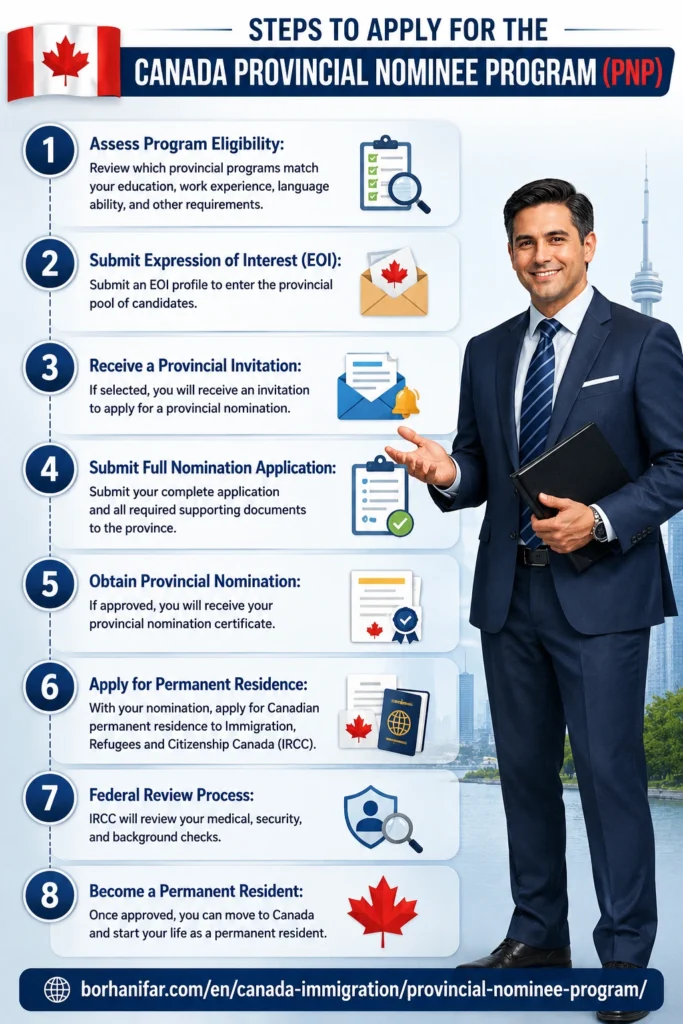
The Provincial Nominee Program (PNP) allows provinces and territories to select immigration candidates who meet their local economic and labour market needs. Although each province operates its own streams, most Provincial Nominee Programs follow a similar application process.
Applicants may apply through either a Base PNP stream or an Enhanced PNP stream linked to Canada's Express Entry system.
Step 1: Choose an Eligible Provincial Nominee Program Stream
Candidates must identify a Provincial Nominee Program stream that matches their work experience, education, language ability, occupation, and immigration goals.
Step 2: Submit a Provincial Application
Depending on the province, applicants may submit an Expression of Interest (EOI), create a provincial profile, or apply directly to a Provincial Nominee Program stream.
Step 3: Receive a Provincial Nomination
Successful candidates receive a provincial nomination certificate confirming that the province supports their application for Canadian permanent residence.
Step 4: Apply for Permanent Residence
After receiving a nomination, applicants submit a permanent residence application to Immigration, Refugees and Citizenship Canada (IRCC), which conducts medical, criminality, and security assessments.
Base PNP vs Enhanced PNP
| Feature | Base PNP | Enhanced PNP |
|---|---|---|
| Express Entry Linked | No | Yes |
| Express Entry Profile | Not required | Required |
| Additional CRS Points | No | 600 CRS points |
| PR Application Process | Outside Express Entry | Through Express Entry |
A provincial nomination obtained through an Enhanced Provincial Nominee Program stream typically results in 600 additional Comprehensive Ranking System (CRS) points, significantly increasing the likelihood of receiving an Invitation to Apply (ITA) for permanent residence.
Provincial Nominee Program Streams Linked to Express Entry
Many Provincial Nominee Program streams are aligned with Canada's Express Entry system. These streams allow provinces and territories to nominate candidates whose skills, education, and work experience match regional labour market needs.
Candidates who receive a provincial nomination through an Express Entry-aligned stream generally receive an additional 600 Comprehensive Ranking System (CRS) points, substantially increasing their chances of receiving an Invitation to Apply (ITA) for permanent residence.
Ontario Immigrant Nominee Program (OINP)
Ontario's Provincial Nominee Program includes several immigration streams targeting skilled workers, healthcare professionals, technology workers, tradespeople, international graduates, and candidates with strong human capital factors. The province regularly conducts targeted draws based on labour market needs and occupational priorities.
British Columbia Provincial Nominee Program (BC PNP)
British Columbia operates immigration streams for skilled workers, entrepreneurs, healthcare professionals, and graduates. The province is known for targeted invitations in sectors such as healthcare, technology, construction, and childcare.
Alberta Advantage Immigration Program (AAIP)
Alberta uses several nomination pathways to attract candidates who can support the province's economic development. Priority sectors often include healthcare, agriculture, construction, tourism, and technology.
Saskatchewan Immigrant Nominee Program (SINP)
Saskatchewan frequently invites candidates with experience in occupations experiencing labour shortages. Skilled workers, tradespeople, and healthcare professionals may find opportunities through Saskatchewan's nomination streams.
Manitoba Provincial Nominee Program (MPNP)
Manitoba focuses on candidates who demonstrate a connection to the province through employment, education, family relationships, or recruitment initiatives. The province operates streams for skilled workers and international graduates.
Nova Scotia Nominee Program (NSNP)
Nova Scotia regularly uses targeted immigration streams to address workforce shortages in key sectors. Healthcare workers, educators, tradespeople, and other skilled professionals may qualify depending on provincial priorities.
New Brunswick Provincial Nominee Program (NBPNP)
New Brunswick offers several pathways for skilled workers and often conducts recruitment initiatives to attract individuals who can contribute to the province's labour market and long-term economic growth.
Newfoundland and Labrador Provincial Nominee Program (NLPNP)
Newfoundland and Labrador uses immigration programs to support workforce development and regional economic growth. Skilled workers, graduates, and individuals with employment opportunities may qualify under provincial streams.
Prince Edward Island Provincial Nominee Program (PEI PNP)
Prince Edward Island targets workers who can support important sectors of the provincial economy, including healthcare, hospitality, manufacturing, transportation, and skilled trades.
Yukon Nominee Program (YNP)
Yukon's nomination program is primarily employer-driven and focuses on addressing labour shortages in the territory's relatively small workforce and remote communities.
Northwest Territories Nominee Program (NTNP)
The Northwest Territories Nominee Program helps employers recruit and retain workers in occupations experiencing ongoing labour shortages. Most streams are closely connected to local employment opportunities.
Provincial Nominee Program Eligibility Requirements
Provincial Nominee Program eligibility requirements vary by province, immigration stream, and occupation. There is no single set of requirements that applies to all Provincial Nominee Programs across Canada.
While each province establishes its own selection criteria, most Provincial Nominee Program streams assess factors such as work experience, education, language ability, employment prospects, and the applicant's ability to settle successfully in the province.
Common Provincial Nominee Program Requirements
Depending on the stream, applicants may be required to demonstrate one or more of the following:
- Relevant skilled work experience;
- Educational credentials and qualifications;
- English and/or French language proficiency;
- A valid job offer from a Canadian employer;
- Settlement funds, where required;
- An intention to live in the nominating province or territory;
- Previous work, study, or family connections to the province.
Do All Provincial Nominee Programs Require a Job Offer?
No. Some Provincial Nominee Program streams require a qualifying job offer from an employer located in the province, while others allow applicants to qualify based on their occupation, education, work experience, or Express Entry profile without a job offer.
Several provinces periodically invite candidates from the Express Entry pool even if they are not currently employed in Canada.
Language Requirements for Provincial Nominee Programs
Language requirements vary between streams and occupations. Skilled worker streams often require proof of English or French language ability through approved language tests, while some occupations may require higher language scores than others.
Can International Graduates Apply for a Provincial Nominee Program?
Yes. Many provinces operate immigration streams specifically designed for international graduates who have completed eligible studies in Canada. These streams may provide a pathway to permanent residence for graduates who meet provincial requirements.
| Eligibility Factor | Typical Provincial Considerations |
|---|---|
| Work Experience | Occupation, skill level, and relevance to provincial labour market needs |
| Education | Canadian or foreign educational credentials |
| Language Ability | English and/or French proficiency requirements |
| Job Offer | Required in some streams but not all |
| Provincial Connection | Employment, education, family, or other ties may strengthen eligibility |
| Settlement Ability | Ability and intention to establish in the nominating province |
Individuals who do not currently qualify for a Provincial Nominee Program may still be eligible through other pathways, including Express Entry, family sponsorship, study permits, or employer-supported work permit programs.
Minimum Scores for Provincial Nominee Programs
Many Provincial Nominee Program streams use a points-based selection system to assess candidates. Depending on the province, factors such as age, education, work experience, language ability, employment history, and connections to the province may influence a candidate's score.
The minimum score required for a Provincial Nominee Program varies by province, immigration stream, and draw. Some provinces use their own points grids, while others select candidates directly from the Express Entry pool using Comprehensive Ranking System (CRS) scores.
| Province | Program | Selection Method | Typical Assessment Factors |
|---|---|---|---|
| British Columbia | BC PNP | Provincial points system | Occupation, wage, education, and regional factors |
| Ontario | OINP | Express Entry and provincial selection | CRS score, occupation, education, and work experience |
| Alberta | AAIP | Express Entry and targeted invitations | Occupation, provincial priorities, and labour market needs |
| Saskatchewan | SINP | Provincial points grid | Education, language ability, age, and work experience |
| Manitoba | MPNP | Expression of Interest ranking | Provincial connections, education, language, and work experience |
| Prince Edward Island | PEI PNP | Expression of Interest system | Skills, work experience, and labour market needs |
Selection thresholds can change throughout the year based on provincial immigration targets, labour market needs, and the number of candidates available in the pool. As a result, there is no single minimum score that guarantees a provincial nomination.
Provincial Nominee Program Processing Times and Fees
Provincial Nominee Program processing times vary depending on the province, immigration stream, application volume, and whether the application is submitted through an Express Entry-aligned stream or a Base PNP stream.
Most applicants go through two separate stages: the provincial nomination stage and the federal permanent residence stage. Processing times can therefore differ significantly from one Provincial Nominee Program stream to another.
Provincial Nomination Processing
After receiving an application, the province reviews eligibility requirements, supporting documents, work experience, language results, and any applicable job offer or provincial connection. Processing may take several weeks or several months depending on the stream and provincial workload.
Permanent Residence Processing
Once a provincial nomination is issued, applicants must complete the federal immigration process. Immigration, Refugees and Citizenship Canada (IRCC) assesses admissibility requirements, including medical examinations, criminality checks, and security screening before granting permanent residence.
Provincial Nominee Program Fees
Application fees vary considerably across Canada. Some provinces charge nomination application fees, while others may have no provincial application fee for certain streams. Applicants should also budget for federal immigration fees, biometrics, language testing, educational credential assessments, medical examinations, and supporting document costs.
| Cost Category | Examples |
|---|---|
| Provincial Application Fees | Fees charged by provinces for certain Provincial Nominee Program streams |
| Federal Immigration Fees | Permanent residence processing fees and Right of Permanent Residence Fee (RPRF) |
| Language Testing | IELTS, CELPIP, TEF Canada, or TCF Canada |
| Educational Credential Assessment | ECA reports for foreign educational credentials when required |
| Medical Examination | Immigration medical examinations conducted by panel physicians |
| Biometrics | Fingerprint and photograph collection fees where applicable |
How Long Does the Provincial Nominee Program Take?
There is no standard processing time that applies to all Provincial Nominee Programs. Candidates applying through Express Entry-aligned streams may receive permanent residence more quickly than those applying through certain Base PNP streams, although actual timelines depend on the specific province, stream, and individual circumstances.
Applicants should always review the most recent provincial and federal processing information before submitting an application, as processing times and fees may change throughout the year.
Benefits of a Provincial Nomination
A provincial nomination can significantly improve an applicant's prospects of obtaining Canadian permanent residence. For many candidates, Provincial Nominee Programs provide an alternative pathway when federal immigration programs are highly competitive or when a province is actively seeking workers in a particular occupation.
Additional CRS Points Through Express Entry
One of the most significant advantages of an Express Entry-aligned Provincial Nominee Program stream is the additional 600 Comprehensive Ranking System (CRS) points awarded after receiving a provincial nomination. In most cases, this substantially increases the likelihood of receiving an Invitation to Apply (ITA) for permanent residence.
Access to Provincial Immigration Opportunities
Provincial Nominee Programs allow provinces and territories to select candidates based on regional workforce needs. As a result, applicants who may not receive an invitation through federal programs alone could qualify through a province seeking workers in their occupation or industry.
Opportunities for In-Demand Occupations
Many Provincial Nominee Program streams target occupations experiencing labour shortages. Healthcare professionals, skilled trades workers, technology specialists, transportation workers, and other in-demand occupations may benefit from province-specific immigration pathways.
Pathways for International Graduates
Several provinces operate dedicated streams for international graduates who have completed eligible studies in Canada. These pathways may provide graduates with an opportunity to transition from temporary status to permanent residence.
Entrepreneur and Business Immigration Opportunities
Certain Provincial Nominee Programs include entrepreneur and business immigration streams designed for individuals interested in establishing, purchasing, or operating a business in Canada. Eligibility requirements vary significantly between provinces.
| Benefit | How It May Help |
|---|---|
| 600 CRS Points | May substantially increase the likelihood of receiving an Express Entry invitation |
| Provincial Selection | Provides opportunities based on regional labour market needs |
| Occupation-Specific Streams | May benefit workers in targeted occupations |
| Graduate Pathways | Supports eligible international graduates seeking permanent residence |
| Business Streams | Provides options for certain entrepreneurs and investors |
| Permanent Residence | Successful applicants may become Canadian permanent residents |
For many applicants, the Provincial Nominee Program serves as a complementary pathway to Express Entry, particularly when provincial labour market priorities align with their qualifications and professional experience.
Provincial Nominee Program vs Express Entry
Many prospective immigrants compare the Provincial Nominee Program (PNP) and Express Entry when planning their move to Canada. While both pathways can lead to permanent residence, they operate differently and are designed for different types of candidates.
Express Entry is a federal immigration system that manages applications under several economic immigration programs. Provincial Nominee Programs, on the other hand, allow provinces and territories to nominate candidates who can help address local labour market and economic needs.
| Factor | Provincial Nominee Program (PNP) | Express Entry |
|---|---|---|
| Decision Maker | Province or territory nominates the candidate | Federal government selects candidates from the Express Entry pool |
| Main Purpose | Address regional labour market and economic needs | Select highly ranked economic immigration candidates |
| CRS Score Required | Depends on the stream | Usually a major factor in receiving an invitation |
| Provincial Nomination | Required | Not required |
| Additional CRS Points | Enhanced streams may provide 600 CRS points | No provincial nomination bonus unless nominated |
| Target Candidates | Candidates meeting provincial priorities | Candidates with competitive CRS scores |
| Outcome | Canadian permanent residence | Canadian permanent residence |
Can You Apply for Both?
Yes. Many candidates maintain an Express Entry profile while simultaneously pursuing Provincial Nominee Program opportunities. In fact, several provinces select candidates directly from the Express Entry pool through Enhanced PNP streams.
Which Option Is Better?
There is no single answer. A candidate with a highly competitive CRS score may receive an invitation through Express Entry without provincial support. However, individuals with lower CRS scores may benefit from Provincial Nominee Program streams that align with their occupation, education, or provincial connections.
For this reason, many applicants pursue both pathways simultaneously to maximize their chances of obtaining permanent residence in Canada.
To better understand federal selection criteria, CRS scores, and invitation rounds, see our Canada Express Entry Guide.
Canada PNP Draws Table: Latest Provincial Rounds
This table lets you search and sort the latest Provincial Nominee Program draws for Ontario, British Columbia, Manitoba, and Saskatchewan.
| Province | Date | Stream | Invitations | Minimum Score | Source |
|---|---|---|---|---|---|
| Loading data... | |||||
Provincial Nominee Program FAQ (2026)
Below are answers to some of the most common questions regarding Canada's Provincial Nominee Program, Express Entry-linked streams, eligibility requirements, processing, and permanent residence pathways.
Which province has the easiest Provincial Nominee Program?
There is no single Provincial Nominee Program that is easiest for everyone. Eligibility depends on factors such as occupation, work experience, education, language ability, and provincial labour market needs. A stream that is suitable for one applicant may not be suitable for another.
What is the difference between a Provincial Nominee Program and Express Entry?
Express Entry is a federal immigration system that manages applications for several economic immigration programs. Provincial Nominee Programs allow provinces and territories to nominate candidates who meet regional labour market and economic needs.
Can I move to another province after receiving permanent residence through a Provincial Nominee Program?
Provincial Nominee Programs are intended for individuals who genuinely plan to live and work in the nominating province. Applicants should demonstrate a sincere intention to settle in the province that nominated them.
How long does a Provincial Nominee Program application take?
Processing times vary by province, stream, application volume, and federal processing requirements. Most applicants complete both a provincial nomination stage and a federal permanent residence stage.
How much does a Provincial Nominee Program application cost?
Costs vary depending on the province and immigration stream. Applicants may incur provincial application fees, federal immigration fees, language testing fees, educational credential assessment fees, biometrics fees, and medical examination costs.
Can healthcare workers qualify for a Provincial Nominee Program?
Yes. Many provinces prioritize healthcare occupations due to ongoing labour shortages. Physicians, nurses, and other healthcare professionals may qualify through targeted Provincial Nominee Program streams. You may also wish to review our Canada Immigration for Medical Doctors Guide.
Can entrepreneurs apply through a Provincial Nominee Program?
Yes. Several provinces operate entrepreneur and business immigration streams designed for individuals interested in establishing, purchasing, or managing a business in Canada. Eligibility requirements vary by province.
Do I need an Educational Credential Assessment (ECA)?
Many Provincial Nominee Program streams require foreign educational credentials to be assessed by an approved organization. Requirements vary depending on the province and immigration pathway.
What language tests are accepted for Provincial Nominee Programs?
Accepted language tests typically include IELTS General Training, CELPIP General, TEF Canada, and TCF Canada. The required score depends on the specific Provincial Nominee Program stream.
Can my spouse and children be included in my application?
In most cases, eligible spouses, common-law partners, and dependent children may be included in a Provincial Nominee Program application for permanent residence.
Can a Provincial Nominee Program application be refused?
Yes. Applications may be refused if eligibility requirements are not met, supporting documents are insufficient, information is inaccurate, or the applicant does not satisfy provincial or federal immigration requirements.
What happens after receiving a provincial nomination?
After receiving a nomination, applicants proceed with the federal permanent residence process. IRCC reviews admissibility requirements, including medical, criminality, and security assessments.
Can I apply to more than one Provincial Nominee Program?
Provincial rules vary. Some candidates may pursue opportunities in multiple provinces; however, applicants should always be able to demonstrate a genuine intention to reside in the province that nominates them.
Which Provincial Nominee Programs are linked to Express Entry?
Many provinces operate Enhanced PNP streams linked to Express Entry, including Ontario, British Columbia, Alberta, Saskatchewan, Manitoba, Nova Scotia, New Brunswick, Newfoundland and Labrador, and Prince Edward Island.
Need Help With a Provincial Nominee Program Application?
Canada's Provincial Nominee Program includes numerous immigration streams operated by provinces and territories across the country. Eligibility requirements vary significantly depending on the province, occupation, work experience, education, language ability, and immigration pathway.
Whether you are exploring an Express Entry-aligned stream, applying as a skilled worker, international graduate, healthcare professional, entrepreneur, or seeking a pathway to Canadian permanent residence, professional guidance can help you better understand your available options and eligibility.
For personalized guidance, you can book a Canada immigration consultation or send us a message on WhatsApp.
Official Government Sources and Legal References
Provincial Nominee Program applications are governed primarily by the Immigration and Refugee Protection Act (IRPA) and the Immigration and Refugee Protection Regulations (IRPR).
Official information regarding Canada's Provincial Nominee Program, provincial nomination streams, eligibility requirements, and permanent residence pathways is available through the Government of Canada's Provincial Nominee Program (PNP) Guide.
Applicants should also review the official websites of the relevant provincial or territorial immigration authorities, as nomination criteria, stream availability, and application procedures may change throughout the year.
For additional information regarding federal economic immigration pathways, see our Canada Express Entry Guide.
In this article:
About Borhanifar Immigration
Borhanifar Immigration provides professional Canadian immigration services and strategic guidance for temporary and permanent residence applications, including business immigration and individual immigration pathways. Professional memberships include CICC, CBA, OBA, and CAPIC.
Our practice is supervised by a licensed Canadian immigration professional (RCIC) and focuses on practical immigration solutions, strategic case preparation, and clear guidance based on current Canadian immigration laws and IRCC policies.
This content is provided for general informational purposes only and should not be interpreted as individualized legal advice or a guarantee of approval or immigration results.