Buying a Business in Canada 2026: Complete Immigration Guide
Buying a business in Canada may help entrepreneurs and investors qualify for Canadian work permit and immigration pathways. Depending on the ownership structure, investment level, and active business management, applicants may pursue options such as the Canada C11 Work Permit and possible permanent residence pathways.
Depending on the business structure, ownership level, investment amount, and operational plan, applicants may qualify for work permit options such as the Canada C11 Work Permit and later explore permanent residence pathways.
Summary:
Buying a business in Canada may create immigration opportunities through LMIA-exempt entrepreneur pathways such as the Canada C11 Work Permit.
Applicants usually need to demonstrate active business management, operational control, financial capacity, and a realistic plan to operate or expand the Canadian business.
This guide explains how to buy a business in Canada for immigration purposes, including business selection, legal structure, due diligence, C11 Work Permit eligibility, investment considerations, operational planning, refusal risks, work permit extensions, and permanent residence pathways in 2026.
Buying a Business in Canada Overview
| Key Factor | Details |
|---|---|
| Primary Purpose | Entrepreneur and business ownership immigration strategy |
| Immigration Pathway | Often connected to the Canada C11 Work Permit |
| Ownership Requirement | Usually active ownership and operational management required |
| Eligible Applicants | Entrepreneurs, investors, and experienced business owners |
| Business Model | Existing operational Canadian business purchase |
| Main IRCC Focus | Business viability and significant benefit assessment |
| Financial Requirement | Financial capacity and operational planning required |
| Family Options | Spousal Open Work Permit and children’s Study Permits may be available |
| PR Pathways | Express Entry, PNP, and entrepreneur PR pathways |
Depending on the business structure, ownership level, investment amount, and operational plan, applicants may qualify for work permit options such as the Canada C11 Work Permit and later explore permanent residence pathways.
Summary:
Buying a business in Canada may create immigration opportunities through LMIA-exempt entrepreneur pathways such as the Canada C11 Work Permit.
Applicants usually need to demonstrate active business management, operational control, financial capacity, and a realistic plan to operate or expand the Canadian business.
This guide explains how to buy a business in Canada for immigration purposes, including business selection, legal structure, due diligence, C11 Work Permit eligibility, investment considerations, operational planning, refusal risks, work permit extensions, and permanent residence pathways in 2026.
Buying a Business in Canada Overview
| Key Factor | Details |
|---|---|
| Primary Purpose | Entrepreneur and business ownership immigration strategy |
| Immigration Pathway | Often connected to the Canada C11 Work Permit |
| Ownership Requirement | Usually active ownership and operational management required |
| Eligible Applicants | Entrepreneurs, investors, and experienced business owners |
| Business Model | Existing operational Canadian business purchase |
| Main IRCC Focus | Business viability and significant benefit assessment |
| Financial Requirement | Financial capacity and operational planning required |
| Family Options | Spousal Open Work Permit and children’s Study Permits may be available |
| PR Pathways | Express Entry, PNP, and entrepreneur PR pathways |
Table of Contents

What Is Buying a Business in Canada for Immigration?
Buying a business in Canada for immigration means purchasing and actively operating an existing Canadian business as part of a business immigration or work permit strategy.
This approach is commonly used by entrepreneurs, investors, and experienced business owners who want to manage a real Canadian business and potentially apply for an LMIA-exempt work permit such as the Canada C11 Work Permit.
Buying a business in Canada does not automatically guarantee immigration approval. IRCC usually assesses whether the business is genuine, commercially viable, actively managed, and capable of creating economic or operational benefit in Canada.
Summary:
Buying a business in Canada may support immigration pathways when the applicant actively manages the business, demonstrates operational control, shows financial capacity, and presents a realistic plan to continue or expand Canadian operations.
Unlike passive investment, business purchase immigration strategies usually require active ownership, management involvement, and evidence that the applicant will play a meaningful role in Canadian business operations.
Immigration officers commonly assess whether:
- The purchased business is genuine and operational
- The applicant will actively manage the company
- The business purchase structure is commercially realistic
- The applicant has sufficient financial capacity
- The applicant has relevant business or management experience
- The business may create economic, social, or operational benefit in Canada
Buying a Business vs Passive Investment
Canadian business immigration pathways generally focus on active business operation rather than passive investment alone.
Simply purchasing shares, investing capital, or becoming a silent investor is usually not enough for entrepreneur-focused work permit options. The applicant should normally show active decision-making authority, operational involvement, and a clear business role in Canada.
Why Active Management Matters
IRCC officers frequently assess whether the applicant will direct, manage, and operate the Canadian business after acquisition.
A business purchase may be stronger when the applicant can show control over staffing, finances, operations, supplier relationships, customer development, and business growth.
Common Business Purchase Structures in Canada
Entrepreneurs buying a business in Canada commonly use different legal and commercial structures depending on the target business, tax considerations, risk exposure, and immigration strategy.
| Business Purchase Structure | Typical Purpose |
|---|---|
| Share Purchase | Buying ownership shares of an existing Canadian corporation |
| Asset Purchase | Purchasing selected business assets, contracts, equipment, goodwill, or operations |
| Majority Ownership Acquisition | Obtaining operational control and management authority over the business |
| Franchise Purchase | Buying or operating a franchise model with established branding and systems |
| Partnership Structure | Operating jointly with Canadian or foreign partners while maintaining a defined management role |
Does Buying a Business Automatically Give Immigration Status?
No. Buying a business in Canada does not automatically give immigration status, a work permit, or permanent residence.
A business purchase may support an immigration application only when the applicant can demonstrate a credible business plan, active management role, sufficient funds, business viability, and compliance with Canadian immigration requirements.
IRCC may review:
- Business purchase agreement and ownership structure
- Financial records and source of funds
- Business viability and operational history
- Applicant’s management experience
- Job creation or economic contribution potential
- Temporary intent and immigration compliance
Advanced Immigration Analysis
Under current IRCC operational practices, business purchase applications are assessed based on more than the purchase price alone.
Officers often examine whether the acquired business is commercially genuine, whether the applicant can realistically operate it, and whether the business may provide measurable value to Canada through employment, investment, services, regional activity, or operational continuity.
Applications supported by active business operations, clear ownership control, due diligence records, organized financial documentation, and genuine management involvement are generally easier for officers to assess.

Buying a Business in Canada Immigration Assessment Tool
Book a Business Immigration Consultation
Discuss buying a business in Canada, C11 Work Permit eligibility, investment structure, operational planning, and possible permanent residence pathways with a licensed Canadian immigration professional.
Can Buying a Business in Canada Lead to a Work Permit?
Yes. Buying a business in Canada may lead to a work permit if the applicant actively owns, manages, and operates the business and can demonstrate a credible immigration and business strategy.
However, purchasing a business alone does not automatically create work permit eligibility. IRCC usually reviews the business purchase structure, the applicant’s management role, financial capacity, and whether the business may create economic or operational benefit in Canada.
Summary:
Buying a business in Canada may support a work permit application when the applicant has active ownership or operational control, sufficient funds, relevant experience, and a realistic plan to manage and grow the Canadian business.
For many entrepreneurs and investors, the most common work permit option after buying a business is the Canada C11 Work Permit, which is assessed under the International Mobility Program as an LMIA-exempt entrepreneur pathway.
When a Business Purchase May Support a Work Permit
A business purchase may support a Canadian work permit application when the transaction is commercially genuine and the applicant will play an active role in business operations.
IRCC may consider factors such as:
- Whether the business is already active and operational
- Whether the applicant will own or control the business
- Whether the applicant will actively manage daily operations
- Whether the business has revenue, clients, employees, or assets
- Whether the applicant has relevant business or management experience
- Whether the business can maintain or create economic activity in Canada
- Whether the applicant has sufficient funds for purchase and operations
Common Work Permit Options After Buying a Business
Depending on the business structure and immigration strategy, applicants may consider different work permit options after buying a Canadian business.
| Work Permit Option | When It May Apply |
|---|---|
| C11 Work Permit | Entrepreneurs or business owners actively managing a Canadian business with potential significant benefit |
| LMIA-Based Work Permit | Where a Canadian employer supports a foreign worker through the labour market assessment process |
| Intra-Company Transfer | Where a foreign company expands into Canada and transfers eligible executives, managers, or specialized employees |
| Provincial Business Pathway | Where a province offers an entrepreneur or business immigration stream connected to investment and business operation |
Why the C11 Work Permit Is Commonly Used
The C11 Work Permit is commonly considered when a foreign entrepreneur buys an existing Canadian business and intends to actively operate it.
This pathway may be suitable when the applicant can demonstrate:
- Active business ownership or operational control
- Relevant business or industry experience
- Financial capacity to purchase and operate the business
- A realistic business plan after acquisition
- Potential economic, social, or operational benefit for Canada
- Temporary intent and immigration compliance
Important: Buying a Business Is Not Enough by Itself
IRCC does not usually assess a business purchase based only on the purchase price.
Officers often review whether the applicant can realistically run the business, whether the business is commercially viable, and whether the proposed work in Canada is connected to measurable business activity.
A weak business plan, passive ownership structure, unclear source of funds, or limited operational evidence may create refusal concerns.
Can the Applicant Work in the Business Immediately After Purchase?
Foreign nationals generally need proper work authorization before actively working in or managing a Canadian business from inside Canada.
Business buyers should carefully separate business ownership activities from unauthorized work. Ownership alone may be possible in some situations, but active management, service delivery, staffing decisions, or daily operations may require a valid work permit.
Advanced Work Permit Analysis
In business purchase cases, IRCC commonly assesses whether the applicant’s presence in Canada is genuinely required to operate or grow the business.
A stronger application usually connects the purchase agreement, business plan, financial evidence, operational role, and expected Canadian benefit into one consistent immigration narrative.
Applicants who buy a business but cannot show active management authority, relevant experience, or a realistic post-purchase strategy may face higher refusal risks.

Best Immigration Pathways After Buying a Business in Canada
The best immigration pathway after buying a business in Canada depends on the applicant’s ownership structure, management role, business experience, investment capacity, and long-term permanent residence strategy.
For many entrepreneurs and investors, buying an existing Canadian business is most commonly connected to the C11 Work Permit, Provincial Nominee Programs, or other entrepreneur-focused immigration options.
Summary:
Business buyers may consider the C11 Work Permit, provincial entrepreneur streams, Express Entry after Canadian work experience, or other business immigration pathways depending on the purchase structure and immigration goals.
Main Immigration Pathways for Business Buyers
| Immigration Pathway | Best Suited For |
|---|---|
| Canada C11 Work Permit | Entrepreneurs buying and actively operating a Canadian business |
| Provincial Entrepreneur Streams | Applicants investing in a specific province and meeting provincial business requirements |
| Express Entry After Canadian Work Experience | Applicants who later gain qualifying Canadian work experience and meet CRS requirements |
| LMIA-Based Work Permit | Cases involving a separate Canadian employer-employee structure |
| Start-Up or Innovation Pathways | Applicants buying or scaling an innovative business with strong growth potential |
C11 Work Permit After Buying a Business
The Canada C11 Work Permit is often the most relevant option for foreign entrepreneurs who buy an existing Canadian business and plan to actively manage it.
This pathway may be considered when the applicant can show:
- Active ownership or operational control of the business
- Relevant business or industry experience
- Sufficient funds for purchase and operations
- A realistic post-acquisition business plan
- Economic, social, or operational benefit for Canada
- Temporary intent and immigration compliance
Provincial Entrepreneur Streams
Some provinces offer entrepreneur or business immigration streams for applicants who invest in, purchase, or operate a business in that province.
These programs often assess factors such as investment amount, net worth, business location, job creation, language ability, and provincial economic priorities.
Why Province Selection Matters
A business that fits one province’s economic priorities may not be equally strong in another province.
Applicants buying a business in Canada should consider local labour needs, regional demand, licensing requirements, competition, and provincial immigration options before finalizing a purchase.
Canada Express Entry After Buying a Business
Buying a business in Canada does not directly guarantee permanent residence through Express Entry.
However, some applicants may later qualify for permanent residence after gaining eligible Canadian work experience, improving language scores, and meeting program requirements under Express Entry or a Provincial Nominee Program.
Applicants may review general Express Entry options here: Canada Express Entry.
How to Choose the Right Pathway
The right immigration pathway depends on both the business acquisition and the applicant’s personal immigration profile.
Important factors include:
- Applicant’s age, education, and language ability
- Business ownership percentage and control
- Business location and province
- Investment amount and source of funds
- Business viability and operational history
- Job creation or economic benefit potential
- Timeline toward permanent residence
Advanced Pathway Strategy
A strong business purchase strategy should connect the business transaction, work permit pathway, operational plan, and permanent residence goals from the beginning.
For example, a profitable business with employees, clear payroll history, and a realistic expansion plan may support a stronger entrepreneur work permit strategy than a business with unclear revenue, weak records, or passive ownership.
Applicants should avoid choosing a business only because it is available for sale. The business should also fit the applicant’s experience, immigration pathway, financial capacity, and long-term settlement plan.
How to Buy a Business in Canada
Buying a business in Canada usually involves legal, financial, operational, and immigration considerations beyond simply signing a purchase agreement.
Foreign entrepreneurs and investors should carefully review the business structure, financial records, liabilities, licensing requirements, immigration strategy, and operational viability before completing a transaction.
Summary:
Buying a business in Canada generally involves business search, due diligence, financial review, legal structuring, immigration planning, and post-purchase operational preparation.
Step 1: Identify the Right Business Opportunity
The first step is identifying a business that aligns with the applicant’s experience, financial capacity, immigration goals, and operational abilities.
Many business buyers focus on:
- Profitable existing businesses
- Franchise opportunities
- Owner-operated businesses
- Healthcare and professional services
- Construction and trade businesses
- Hospitality and restaurant operations
- Technology and e-commerce companies
- Manufacturing or distribution businesses
The business should ideally demonstrate active operations, revenue history, operational stability, and realistic growth potential.
Step 2: Review the Business Financials
Before buying a business in Canada, applicants should carefully review the company’s financial condition and operational performance.
Financial review commonly includes:
- Corporate tax filings
- Profit and loss statements
- Balance sheets
- Payroll records
- Business bank statements
- Supplier contracts
- Commercial lease agreements
- Outstanding liabilities or debts
- Revenue consistency and cash flow
Weak accounting records, inconsistent revenue, or undisclosed liabilities may create both business and immigration risks.
Why Due Diligence Is Extremely Important
Many foreign buyers focus heavily on immigration outcomes while overlooking operational and legal risks inside the business itself.
Professional due diligence may help identify:
- Hidden liabilities
- Tax compliance problems
- Weak financial performance
- Licensing issues
- Payroll inconsistencies
- Commercial lease problems
- Pending lawsuits or disputes
- Operational instability
A weak business acquisition may negatively affect both immigration strategy and long-term financial stability in Canada.
Step 3: Structure the Business Purchase Properly
Business purchases in Canada are commonly structured either as an asset purchase or a share purchase.
| Purchase Structure | General Characteristics |
|---|---|
| Asset Purchase | Buyer purchases selected business assets while potentially limiting liability exposure |
| Share Purchase | Buyer purchases ownership shares of the corporation and may assume broader liabilities and obligations |
The correct structure depends on legal, accounting, operational, tax, and immigration considerations.
Step 4: Develop an Immigration and Business Plan
Foreign buyers should generally prepare a realistic operational and immigration strategy before applying for a work permit or relocating to Canada.
A stronger business and immigration plan may include:
- Post-purchase operational strategy
- Staffing and hiring plans
- Revenue and growth projections
- Marketing and expansion plans
- Applicant’s management responsibilities
- Source of investment funds
- Canadian economic benefit analysis
- Long-term permanent residence planning
For many entrepreneurs, this planning stage becomes highly important when pursuing a Canada C11 Work Permit.
Step 5: Prepare for Operational Transition
After buying a business in Canada, the buyer may need to manage operational transition issues before or after work permit approval.
This may involve:
- Updating corporate ownership records
- Opening Canadian business bank accounts
- Managing payroll and tax compliance
- Maintaining supplier relationships
- Reviewing employee contracts
- Updating licenses or permits
- Implementing operational improvements
- Preparing for active management in Canada
Common Mistakes When Buying a Business in Canada
- Buying a business without proper due diligence
- Focusing only on immigration without reviewing profitability
- Purchasing a business outside the applicant’s expertise
- Using unrealistic financial projections
- Ignoring licensing or regulatory requirements
- Failing to verify payroll and tax compliance
- Purchasing weak or inactive businesses
- Assuming a business purchase automatically guarantees a visa
Immigration officers increasingly assess whether the business purchase is commercially genuine and whether the applicant can realistically operate the business after arrival in Canada.
Advanced Business Purchase Analysis
Under current IRCC operational trends, business purchase applications connected to immigration are increasingly reviewed through a commercial credibility and operational realism framework.
Immigration officers may assess:
- Whether the business is genuinely active
- Whether the purchase transaction is commercially realistic
- Whether the applicant has operational authority
- Whether the applicant has sufficient business experience
- Whether the company can continue operating successfully after acquisition
- Whether the applicant’s presence in Canada is operationally necessary
Applications supported by realistic financial planning, active business operations, organized due diligence, and credible post-purchase management strategies generally demonstrate stronger immigration potential.
Best Businesses to Buy in Canada for Immigration
The best businesses to buy in Canada for immigration purposes are usually businesses with active operations, stable revenue, realistic growth potential, and a clear need for active owner management.
IRCC and provincial immigration authorities increasingly assess whether the business purchase is commercially genuine and whether the applicant can realistically operate and expand the business after arriving in Canada.
Summary:
Businesses with active operations, employees, measurable revenue, operational stability, and realistic expansion potential generally create stronger immigration and work permit opportunities for foreign entrepreneurs.
What Makes a Business Strong for Immigration?
A business that may support a stronger immigration strategy is usually operationally active and commercially credible rather than passive or speculative.
Important factors often include:
- Existing revenue and operational history
- Canadian employees or staffing structure
- Stable customer base
- Clear operational role for the buyer
- Growth or expansion potential
- Financial transparency and tax compliance
- Realistic long-term sustainability
- Alignment with the applicant’s experience
Popular Business Types for Immigration Purposes
| Business Sector | Why It May Be Strong |
|---|---|
| Healthcare and Medical Services | Strong long-term demand and operational growth potential |
| Construction and Trade Businesses | High labour demand and active operational structure |
| Restaurants and Hospitality | Operational management opportunities and staffing activity |
| Logistics and Transportation | Regional supply chain and commercial demand |
| Technology and IT Services | Scalability and specialized operational expertise |
| Franchise Businesses | Established operational systems and brand recognition |
| Manufacturing and Distribution | Operational infrastructure and employment potential |
Healthcare and Medical Businesses
Healthcare-related businesses are increasingly popular among foreign entrepreneurs because of Canada’s growing healthcare demand and aging population.
Examples may include:
- Medical clinics
- Home healthcare operations
- Healthcare staffing companies
- Rehabilitation services
- Medical administration businesses
- Senior care support services
Healthcare businesses may demonstrate strong operational necessity and long-term economic value when properly structured.
Construction and Skilled Trade Businesses
Construction and trade-related businesses often align well with Canada’s labour shortages and infrastructure demand.
These businesses commonly involve:
- Renovation companies
- General contracting businesses
- Electrical or plumbing operations
- HVAC businesses
- Commercial maintenance services
- Industrial construction support
Businesses with active contracts, employees, and measurable operational demand may create stronger business immigration positioning.
Why Active Businesses Are Usually Better Than Startups
Buying an already active business may reduce certain immigration and operational risks compared to launching a completely new startup from zero.
An existing business may already have:
- Revenue history
- Employees and payroll records
- Established supplier relationships
- Commercial lease agreements
- Existing customer base
- Operational systems and licensing
This operational history may help support work permit and long-term immigration applications when properly documented.
High-Risk Businesses for Immigration Purposes
Some businesses may create higher immigration or operational risks, especially when the business lacks commercial credibility or operational substance.
Examples of higher-risk situations may include:
- Inactive corporations without operations
- Businesses with no employees or measurable revenue
- Artificial businesses created mainly for immigration purposes
- Cash-heavy operations with weak financial transparency
- Businesses with unresolved tax or legal problems
- Industries requiring licensing the applicant cannot obtain
- Businesses outside the applicant’s experience
IRCC increasingly reviews whether the business purchase is commercially realistic and operationally sustainable rather than purely immigration-driven.
How IRCC May Assess the Business Purchase
Immigration officers frequently examine whether:
- The business is genuinely active and operational
- The applicant has realistic operational authority
- The business can financially sustain operations
- The business aligns with the applicant’s background
- The purchase supports measurable Canadian economic activity
- The applicant’s management role is commercially necessary
Businesses with strong operational history, organized financial records, staffing activity, and realistic growth plans generally create stronger immigration positioning.
Advanced Business Selection Analysis
The best business for immigration is not always the cheapest or the most profitable business on paper.
A stronger immigration-focused acquisition usually combines:
- Commercial credibility
- Operational sustainability
- Management necessity
- Financial transparency
- Long-term growth potential
- Alignment with the applicant’s expertise
Applicants who choose businesses strategically based on both operational viability and immigration compatibility generally develop stronger long-term outcomes in Canada.
How Much Money Is Needed to Buy a Business in Canada?
The amount of money needed to buy a business in Canada varies significantly depending on the industry, business size, location, profitability, staffing structure, and immigration strategy.
Some smaller owner-operated businesses may cost under CAD $100,000, while larger operational companies with employees, assets, and stable revenue may require several hundred thousand dollars or more.
Summary:
There is no fixed minimum investment amount for buying a business in Canada. Immigration officers usually assess the overall commercial credibility of the transaction, operational sustainability, financial capacity, and the applicant’s active management role rather than focusing only on the purchase price.
Typical Business Purchase Ranges in Canada
| Business Type | Approximate Purchase Range |
|---|---|
| Small owner-operated businesses | CAD $50,000 – $150,000 |
| Restaurants and hospitality businesses | CAD $100,000 – $500,000+ |
| Construction or trade businesses | CAD $150,000 – $750,000+ |
| Healthcare and medical operations | CAD $200,000 – $1 million+ |
| Technology or specialized service businesses | Highly variable depending on revenue and intellectual property |
| Franchise businesses | CAD $100,000 – $500,000+ depending on the brand |
Actual investment requirements may also include operational reserves, payroll, legal fees, accounting costs, working capital, lease deposits, and immigration preparation expenses.
Is There a Minimum Investment Requirement?
Unlike some provincial entrepreneur programs, many federal entrepreneur work permit pathways such as the Canada C11 Work Permit, do not have a strict official minimum investment amount written in legislation.
However, the investment should generally be:
- Commercially realistic
- Sufficient for business operations
- Proportionate to the business type
- Supported by lawful source of funds evidence
- Connected to active management and operations
A very low investment into a weak or inactive business may create credibility concerns during immigration assessment.
Additional Costs
Many foreign buyers underestimate the operational and transition costs after acquiring a Canadian business.
Additional costs may include:
- Legal and accounting fees
- Business valuation and due diligence
- Commercial lease deposits
- Payroll and staffing expenses
- Business licensing and insurance
- Inventory and equipment upgrades
- Marketing and operational expansion
- Immigration application and compliance costs
- Working capital reserves
In many situations, operational sustainability after the purchase becomes just as important as the initial acquisition itself.
Why Source of Funds Is Important
Immigration officers may review whether the applicant’s investment funds were obtained lawfully and are genuinely available for the business purchase and Canadian operations.
Applicants may need to provide:
- Personal or corporate bank statements
- Sale of property or assets
- Business income records
- Investment account records
- Corporate ownership documents
- Tax documentation
- Gift or inheritance records where applicable
Weak financial transparency or inconsistent source of funds explanations may create immigration concerns.
Does a Larger Investment Automatically Improve Approval Chances?
Not necessarily.
A larger investment alone does not automatically guarantee immigration approval if the business lacks operational credibility or if the applicant cannot demonstrate active management necessity.
IRCC often focuses more on:
- Commercial legitimacy of the business
- Operational viability
- Applicant’s management role
- Business sustainability
- Economic benefit for Canada
- Financial realism and transparency
A well-structured smaller business with active operations and realistic management plans may sometimes present stronger immigration positioning than a larger but poorly structured investment.
Common Financial Mistakes When Buying a Business
- Using unrealistic revenue projections
- Buying a business without operational reserves
- Failing to verify financial statements
- Ignoring payroll and tax liabilities
- Underestimating working capital needs
- Purchasing businesses outside the applicant’s expertise
- Focusing only on immigration rather than profitability
A business acquisition should remain commercially reasonable even without the immigration component.
Advanced Investment Analysis
Under current IRCC operational trends, immigration officers increasingly review whether the proposed investment amount realistically matches the business model, operational needs, staffing plans, and expansion strategy.
Applications supported by:
- Transparent source of funds
- Realistic operational budgeting
- Strong due diligence records
- Active business operations
- Commercially reasonable purchase pricing
- Long-term operational sustainability
generally demonstrate stronger credibility under entrepreneur and business immigration pathways.
Free Business Immigration Assessment
Complete our immigration assessment form to receive a preliminary review of your business purchase plans, investment structure, management strategy, and possible Canadian immigration pathways through business ownership.
Due Diligence Before Buying a Business in Canada
Due diligence is one of the most important steps before buying a business in Canada, especially when the purchase is connected to immigration or a work permit strategy.
A proper review helps confirm whether the business is financially healthy, legally compliant, operationally active, and suitable for the applicant’s immigration plan.
Summary:
Before buying a business in Canada, applicants should review financial records, tax filings, payroll, contracts, leases, licenses, liabilities, employee records, and operational risks.
Financial Due Diligence
Financial due diligence helps determine whether the business is profitable, stable, and accurately represented by the seller.
- Profit and loss statements
- Balance sheets
- Corporate tax returns
- Bank statements
- Payroll records
- Accounts receivable and payable
- Outstanding loans or debts
- Revenue consistency and cash flow
Legal and Corporate Due Diligence
Legal review helps identify ownership issues, corporate compliance problems, contracts, disputes, and liabilities that may affect the transaction.
- Corporate registration records
- Shareholder agreements
- Asset ownership documents
- Commercial contracts
- Pending lawsuits or disputes
- Business licenses and permits
- Lease agreements
- Insurance documents
Immigration Due Diligence
A business may be profitable but still weak for immigration purposes if it does not support active management, economic benefit, or operational credibility.
Immigration-focused due diligence should examine:
- Whether the applicant can actively manage the business
- Whether the business aligns with the applicant’s experience
- Whether the business has employees or hiring potential
- Whether the business can support a C11 Work Permit strategy
- Whether the purchase structure gives enough operational control
- Whether the business can demonstrate economic benefit in Canada
Why Business Profit Alone Is Not Enough
A profitable business does not automatically create immigration eligibility.
IRCC may still assess whether the applicant has a genuine management role, sufficient ownership control, relevant experience, and a realistic operational plan after acquisition.
Operational Due Diligence
Operational due diligence helps confirm whether the business can continue functioning smoothly after the buyer takes control.
- Employee roles and staffing stability
- Supplier relationships
- Customer contracts
- Inventory and equipment condition
- Lease continuity
- Licensing requirements
- Operational systems and procedures
- Owner dependency risk
A business that depends heavily on the previous owner may require a stronger transition plan to avoid operational disruption.
Red Flags Before Buying a Business
Some warning signs may create business, financial, or immigration risks.
- Unverified revenue claims
- Cash-heavy business with weak records
- Unpaid taxes or payroll liabilities
- Unclear ownership or asset records
- Pending lawsuits or disputes
- Expired licenses or permits
- Unrealistic seller projections
- High employee turnover
- No clear role for the buyer
- Business outside the buyer’s experience
Advanced Due Diligence Analysis
For immigration-related business purchases, due diligence should connect the commercial transaction with the applicant’s work permit strategy.
A stronger file usually shows that the buyer reviewed the business carefully, understood operational risks, confirmed financial capacity, and prepared a realistic post-purchase management plan.
Weak due diligence may lead to business failure, refusal concerns, or difficulty extending a work permit later.
Professional Checklist Before Buying a Business in Canada
Buying a business in Canada without proper financial, legal, and operational review may create significant commercial and immigration risks.
Before purchasing a Canadian business, applicants should carefully assess the company’s financial performance, operational structure, legal obligations, and immigration viability.
- Review at least three years of financial statements
- Analyze actual revenue and cash flow performance
- Review tax liabilities and legal obligations
- Evaluate leases, licenses, and operational contracts
- Assess market conditions, competitors, and location
- Review whether the business aligns with the applicant’s background
- Evaluate job creation and business growth potential
- Review the purchase structure (Asset Purchase vs Share Purchase)
- Analyze immigration risks and application defensibility
- Prepare a professional business plan before purchase
This checklist is often one of the most important stages of buying a business in Canada and may help reduce financial, operational, and immigration risks.
4 Ways to Start or Buy a Business in Canada
For business immigration to Canada, there are generally four main pathways: starting a new business, buying an existing business, purchasing shares in an active company, or buying a franchise.
The best option depends on the applicant’s investment capacity, management experience, business goals, risk tolerance, and long-term immigration strategy.
| Option | Key Advantage |
|---|---|
| Start a New Business | Full control over the business structure and operations |
| Buy an Existing Business | Faster market entry with an operational structure already in place |
| Purchase Company Shares | Shared ownership and partnership opportunities |
| Buy a Franchise | Access to an established brand and operating system |
30 Popular Businesses to Buy in Canada + Estimated Purchase Prices
View Popular Businesses for Sale in Canada
| Business Type | Approximate Starting Price |
|---|---|
| Restaurant or Café | $150,000 to $600,000 |
| Convenience Store | $200,000 to $500,000 |
| Small Supermarket | $300,000 to $800,000 |
| Hair Salon or Beauty Business | $80,000 to $250,000 |
| Cleaning Company | $50,000 to $200,000 |
| Digital Marketing Agency | $30,000 to $150,000 |
| E-Commerce Business | $20,000 to $200,000 |
| Construction or Renovation Company | $100,000 to $500,000 |
| Accounting or Bookkeeping Firm | $50,000 to $250,000 |
| Senior Care Services | $100,000 to $350,000 |
| Daycare Business | $200,000 to $700,000 |
| Fast Food Franchise | $300,000 to $1,000,000+ |
| Automotive Repair Shop | $150,000 to $500,000 |
| Trucking or Transportation Company | $150,000 to $700,000 |
| IT Services Business | $50,000 to $300,000 |
Business prices may vary significantly depending on the province, location, annual revenue, profitability, lease terms, brand value, staffing structure, and market conditions.
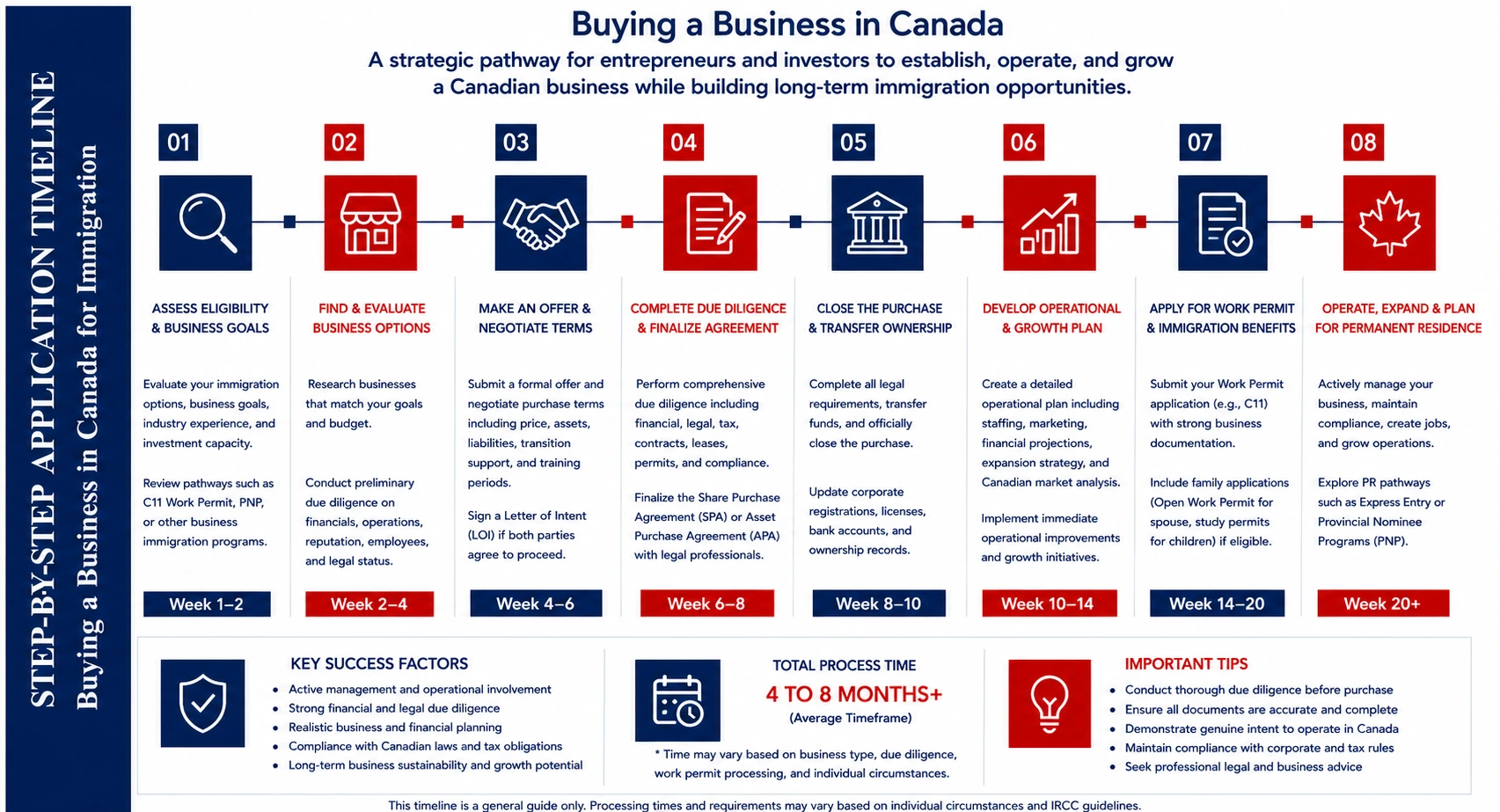
Step-by-Step Process for Buying a Business in Canada
Buying a business in Canada for immigration purposes usually involves both commercial and immigration planning stages.
Applicants often need to coordinate business negotiations, legal due diligence, financial planning, corporate structuring, and work permit preparation at the same time.
Before purchasing a business in Canada, some applicants may first enter Canada through a Business Visitor Visa or a Canada Visitor Visa to explore the market, review potential business opportunities, attend meetings, and conduct preliminary due diligence activities.
Summary:
The business purchase process commonly includes identifying a suitable business, conducting due diligence, negotiating the transaction, preparing operational plans, structuring ownership, and applying for a work permit or immigration pathway.
Step 1: Define Your Immigration and Business Goals
Before searching for a business, applicants should first clarify:
- Desired immigration pathway
- Investment budget
- Preferred province or city
- Industry experience and management background
- Long-term permanent residence goals
- Operational involvement expectations
A business that fits the applicant’s experience and operational capacity usually presents stronger immigration credibility.
Step 2: Search for Suitable Canadian Businesses
Businesses may be found through:
- Business brokers
- Commercial real estate agents
- Private business sales
- Industry contacts
- Franchise opportunities
- Online business marketplaces
The focus should not only be profitability, but also operational strength, staffing potential, and realistic management opportunities.
Step 3: Conduct Due Diligence
Before signing a final agreement, buyers should carefully review:
- Financial statements
- Corporate tax filings
- Payroll records
- Commercial leases
- Contracts and liabilities
- Employee structure
- Licenses and permits
- Operational risks
Immigration-focused due diligence should also assess whether the business can realistically support a work permit strategy.
Step 4: Negotiate the Purchase Structure
The transaction structure may significantly affect taxation, liability, operational control, and immigration strategy.
Common transaction structures may include:
- Asset purchase agreements
- Share purchase agreements
- Partial ownership acquisition
- Majority ownership structures
- Staged acquisition agreements
For many immigration pathways, operational control and active management involvement are often important factors.
Why Ownership Structure Matters for Immigration
In many work permit strategies, immigration officers may assess whether the applicant has sufficient authority to actively direct and manage the business.
Minor passive ownership without operational control may weaken some business immigration applications.
Step 5: Prepare the Business and Operational Plan
A strong operational plan often becomes one of the most important parts of the immigration file.
The business plan may explain:
- Business activities
- Market opportunity
- Operational structure
- Revenue projections
- Staffing plans
- Canadian economic benefit
- Management responsibilities
- Expansion strategy
Generic business plans without operational detail may increase refusal risks.
Step 6: Complete the Business Purchase
Once legal, financial, and operational reviews are complete, the transaction may move toward closing.
This stage may include:
- Final purchase agreements
- Transfer of ownership
- Banking arrangements
- Corporate registration updates
- Lease assignments
- Licensing transfers
- Operational transition planning
Step 7: Apply for a Work Permit or Immigration Pathway
After the transaction structure and operational planning are finalized, applicants may proceed with the immigration stage.
Depending on the situation, this may involve:
- Canada C11 Work Permit
- Business visitor strategies
- Provincial entrepreneur pathways
- Permanent residence planning
- Future Express Entry strategies
Immigration officers often review whether the transaction is commercially genuine and whether the applicant will actively operate the business in Canada.
Advanced Strategic Analysis
Successful business immigration strategies usually combine commercial planning with immigration planning from the beginning of the transaction.
Stronger applications commonly demonstrate:
- Real business acquisition activity
- Operational readiness
- Financial transparency
- Active management involvement
- Industry experience
- Long-term operational sustainability
Applications become weaker when the transaction appears structured mainly for immigration purposes without genuine commercial substance.
C11 Work Permit After Buying a Business in Canada
Many foreign entrepreneurs and investors use the Canada C11 Work Permit after buying a business in Canada to actively manage and operate their investment.
The C11 Work Permit is an LMIA-exempt pathway under the International Mobility Program (IMP) that may apply when a foreign national can demonstrate significant economic, social, or cultural benefit to Canada through active business operations.
Summary:
After buying a business in Canada, some applicants may qualify for a C11 Work Permit if they actively manage the business, maintain operational control, and demonstrate significant benefit to Canada.
What Is the C11 Work Permit?
The C11 Work Permit is designed for entrepreneurs, self-employed individuals, and business owners who intend to actively operate a Canadian business.
Unlike many employer-sponsored work permits, the C11 category does not usually require an LMIA if the applicant can demonstrate that their business activities may create measurable benefits for Canada.
Common benefit factors may include:
- Job creation
- Economic contribution
- Regional development
- Innovation or specialized expertise
- Business expansion
- Investment into the Canadian economy
Can Buying a Business Support a C11 Application?
Yes. Purchasing an existing Canadian business may support a C11 Work Permit application if the applicant will actively direct and manage operations.
Immigration officers commonly assess:
- Ownership percentage
- Operational control
- Business viability
- Financial capacity
- Management experience
- Economic benefit to Canada
- Long-term operational sustainability
Passive investment without active management involvement may weaken eligibility.
Ownership and Control Requirements
Although there is no fixed minimum ownership percentage written in law, many stronger C11 applications involve majority ownership or substantial operational control over the business.
Immigration officers may evaluate whether the applicant has real authority to:
- Direct business operations
- Make management decisions
- Control staffing and hiring
- Manage finances and operations
- Implement business expansion plans
Applications involving weak operational authority may face increased scrutiny.
Does the Business Need to Be Fully Purchased Before Applying?
Not always.
Some applicants apply after signing conditional purchase agreements, letters of intent, or staged acquisition structures, depending on the transaction and immigration strategy.
However, the application should still demonstrate serious commercial commitment, operational planning, and financial capacity.
Important Documents for C11 Applications
Supporting documentation may vary depending on the business structure and industry.
Common documents may include:
- Business purchase agreement
- Letter of intent or conditional acquisition documents
- Business plan and operational strategy
- Financial statements
- Proof of investment funds
- Corporate ownership records
- Payroll and staffing plans
- Commercial lease agreements
- Industry experience evidence
- Revenue and operational records
How IRCC Commonly Assesses C11 Applications
Under current IRCC operational trends, immigration officers increasingly focus on commercial realism and operational credibility.
Officers may examine:
- Whether the business is genuinely active
- Whether the applicant has relevant experience
- Whether the operational plan is realistic
- Whether the investment funds are legitimate
- Whether the business may create economic benefit
- Whether the applicant will actively manage operations
Strong operational planning and realistic business activities generally improve approval potential.
Can C11 Work Permit Lead to Permanent Residence?
Yes. Many business owners later explore permanent residence pathways after operating the business in Canada and gaining Canadian management experience.
Potential pathways may include:
- Canada Express Entry
- Provincial Nominee Programs (PNP)
- Entrepreneur immigration pathways
- Canadian work experience strategies
Long-term operational success and business credibility may strengthen future immigration opportunities.
Advanced C11 Strategic Analysis
Successful C11 applications usually demonstrate that the business acquisition is commercially genuine and not primarily structured for immigration purposes alone.
Stronger applications commonly include:
- Active operational involvement
- Realistic staffing and growth plans
- Industry experience
- Financial transparency
- Operational readiness in Canada
- Long-term business sustainability
Applications supported by organized financial records, measurable operational planning, and genuine management activity generally present stronger approval potential under current IRCC review standards.
Buying a Franchise in Canada for Immigration
Some foreign entrepreneurs consider buying a franchise in Canada instead of purchasing an independent business because franchise models may offer existing branding, operational systems, supplier relationships, and established business procedures.
In some situations, franchise ownership may also support Canadian immigration strategies if the applicant actively manages operations and the business demonstrates genuine commercial activity.
Summary:
Buying a franchise in Canada may support certain business immigration pathways if the applicant actively operates the business, maintains management control, and demonstrates economic benefit and operational credibility.
Why Some Investors Choose Franchise Businesses
Compared to starting a new business from zero, franchise businesses may provide:
- Established brand recognition
- Existing operational systems
- Supplier and inventory networks
- Training and operational support
- Existing customer base
- Structured business procedures
For some applicants, these factors may reduce operational uncertainty during the early stages of Canadian business ownership.
Can a Franchise Support a Work Permit Application?
Possibly.
A franchise business may support a work permit strategy if the applicant can demonstrate active operational involvement and a genuine management role.
Immigration officers may still assess:
- Whether the business is commercially active
- Whether the applicant will actively manage operations
- Whether the business creates economic benefit
- Whether the ownership structure is genuine
- Whether the applicant has operational authority
- Whether the business can realistically sustain operations
Passive investment into a franchise without management involvement may create immigration concerns.
Common Franchise Industries in Canada
| Industry | Examples |
|---|---|
| Food and restaurant franchises | Restaurants, cafés, fast-food operations |
| Retail businesses | Convenience stores, specialty retail |
| Service businesses | Cleaning, maintenance, repair services |
| Fitness and wellness | Gyms, wellness centers, health services |
| Education and childcare | Tutoring centers and childcare services |
Important Immigration Risks With Franchise Purchases
Not every franchise automatically creates a strong immigration case.
Some franchise situations may face higher scrutiny if:
- The applicant acts mainly as a passive investor
- The business has weak profitability
- The applicant lacks operational experience
- The ownership structure limits management authority
- The business has no staffing or expansion potential
- The operational plan is unrealistic
Immigration officers generally expect active business management rather than passive financial investment alone.
Are Restaurant Franchises Good for Immigration?
Restaurant franchises are commonly purchased by foreign investors, but they may receive higher operational scrutiny under immigration assessment.
IRCC may evaluate:
- Actual profitability
- Operational involvement of the owner
- Staffing and payroll activity
- Lease stability
- Financial sustainability
- Long-term business viability
Applicants who actively manage operations and demonstrate realistic operational planning may present stronger credibility.
Documents Often Required for Franchise-Based Applications
Supporting documentation may include:
- Franchise agreement
- Business purchase agreement
- Operational business plan
- Proof of investment funds
- Financial statements
- Payroll and staffing plans
- Commercial lease agreements
- Franchise disclosure documents
- Industry experience evidence
Can Franchise Ownership Lead to Permanent Residence?
Possibly.
Some applicants later explore permanent residence pathways after actively operating the franchise business and gaining Canadian management experience.
Potential pathways may include:
- Canada Express Entry
- Provincial Nominee Programs (PNP)
- Entrepreneur pathways
- Canadian work experience strategies
Long-term operational success and active business management may strengthen future immigration opportunities.
Advanced Franchise Immigration Analysis
Under current IRCC operational trends, franchise applications are increasingly assessed based on operational realism, management involvement, and commercial credibility.
Immigration officers frequently examine whether:
- The applicant will actively operate the business
- The franchise has realistic operational potential
- The business can sustain staffing and payroll
- The investment structure is commercially genuine
- The applicant has sufficient management authority
- The business may create measurable economic benefit
Applications supported by realistic operational planning, active management roles, and organized financial documentation generally present stronger approval potential.
Cost of Buying a Business in Canada for Immigration
The cost of buying a business in Canada may vary significantly depending on the industry, location, profitability, operational size, staffing level, and immigration strategy involved.
For immigration purposes, applicants should also consider operational expenses, working capital, legal fees, accounting costs, and business expansion requirements in addition to the purchase price itself.
Summary:
Buying a business in Canada for immigration may involve business acquisition costs, operational capital, legal and accounting expenses, staffing costs, and ongoing business management expenses beyond the initial purchase price.
How Much Does a Canadian Business Cost?
Business prices in Canada range widely depending on the sector and operational size.
| Business Type | Estimated Price Range |
|---|---|
| Small service business | CAD $50,000 – $200,000 |
| Restaurant or café | CAD $100,000 – $500,000+ |
| Construction or trade business | CAD $150,000 – $1 million+ |
| Technology company | Varies significantly depending on revenue and IP |
| Healthcare-related business | CAD $200,000 – multi-million range |
Major cities such as Toronto and Vancouver often involve higher business acquisition costs compared to smaller regional markets.
Additional Costs Beyond the Purchase Price
Many investors underestimate the operational expenses required after the acquisition closes.
Additional costs may include:
- Commercial lease deposits
- Payroll and staffing expenses
- Working capital reserves
- Inventory purchases
- Insurance and licensing
- Legal and accounting fees
- Marketing and operational setup
- Corporate registration costs
- Tax obligations and compliance costs
Immigration officers may also review whether the applicant has enough funds to sustain operations after purchasing the business.
Is There a Minimum Investment Amount for Immigration?
There is no universal minimum investment amount written into the C11 Work Permit regulations.
However, the investment should generally be commercially reasonable based on:
- The industry
- The size of the business
- The operational plan
- The staffing structure
- The intended economic benefit
- The location of the business
Very small investments without operational credibility may create higher refusal risks.
Can I Buy a Cheap Business for Immigration Purposes?
Possibly, but lower-cost businesses often face higher operational scrutiny if they have limited revenue, weak staffing, or minimal commercial activity.
Immigration officers may focus more on operational realism and economic benefit than the purchase price alone.
Working Capital and Financial Stability
Buying the business is only one part of the financial requirement.
Applicants may also need sufficient working capital to:
- Maintain payroll
- Pay operational expenses
- Expand the business
- Support marketing activities
- Manage lease obligations
- Handle unexpected operational costs
Weak post-purchase financial capacity may create concerns regarding long-term business sustainability.
How IRCC May Assess Financial Capacity
Immigration officers commonly review whether the applicant has legitimate financial resources and a realistic operational budget.
Supporting financial evidence may include:
- Bank statements
- Proof of savings
- Investment records
- Business purchase agreements
- Corporate financial statements
- Source of funds documentation
- Revenue projections
- Payroll planning
Transparent financial planning generally improves credibility under business immigration review.
Advanced Financial Planning Analysis
Under current IRCC operational trends, officers increasingly assess whether the applicant’s investment and operational budget are commercially realistic.
Stronger applications commonly demonstrate:
- Reasonable acquisition pricing
- Sufficient working capital
- Transparent source of funds
- Operational sustainability
- Realistic revenue projections
- Long-term staffing and growth planning
Applications with weak financial planning, unrealistic projections, or insufficient operating reserves may face increased scrutiny or refusal concerns.
Return on Investment (ROI) When Buying a Business in Canada
Professional ROI and Profitability Analysis
Return on investment (ROI) when buying a business in Canada depends on the business type, operational costs, geographic location, market conditions, and management performance.
In many small and medium-sized businesses, ROI is commonly estimated between 2 and 4 years, although some businesses may require 5 years or longer depending on profitability and operational conditions.
Businesses such as restaurants, cafés, and retail stores often have higher operational costs including rent, payroll, inventory, and utilities. As a result, net profit margins in these industries may range between approximately 10% and 20%.
In comparison, service-based businesses such as cleaning companies, IT services, consulting firms, or digital businesses may operate with lower overhead costs and sometimes achieve higher profit margins ranging from approximately 20% to 40%.
Example Scenario:
If a business is purchased for approximately $300,000 CAD and generates an annual net profit of around $90,000 CAD, the estimated ROI period may be approximately 3 to 3.5 years before taxes, assuming stable business performance.
However, from an immigration perspective, profitability alone is usually not sufficient.
IRCC may also examine whether the business creates employment opportunities, demonstrates operational growth potential, and provides measurable economic benefit to Canada.
As a result, some businesses with reasonable profit margins may still present immigration challenges if the operational structure or economic contribution is weak.
Key Factors Affecting ROI
- Actual and verifiable business revenue
- Operational expense and rent control
- Location and target market conditions
- The applicant’s management experience in the same industry
- Business expansion and sales growth potential
- Staffing efficiency and operational scalability
In many successful cases, business buyers improve ROI timelines by optimizing operations, improving marketing, reducing unnecessary expenses, or expanding revenue streams after acquisition.
On the other hand, poor management decisions or purchasing the wrong business model may significantly increase the investment recovery period.
Before buying a business in Canada, it is generally recommended to complete a detailed financial review, analyze at least three years of financial statements, and prepare a realistic business plan based on actual operational data rather than assumptions.
Documents Required for Buy a Business in Canada and Immigration Applications
Buy a business in Canada for immigration purposes usually requires both commercial transaction documents and immigration-related supporting evidence.
Strong documentation helps demonstrate business legitimacy, financial transparency, operational planning, ownership control, and the applicant’s active management role in Canada.
Summary:
Business immigration applications commonly require corporate records, financial documents, purchase agreements, operational plans, ownership evidence, payroll records, and proof of investment funds.
Business Purchase Documents
Core transaction documents often help prove that the acquisition is commercially genuine and legally structured.
- Business purchase agreement
- Letter of intent (LOI)
- Share purchase agreement
- Asset purchase agreement
- Conditional acquisition documents
- Corporate ownership transfer records
- Closing documents
- Commercial lease assignment agreements
The exact documents may vary depending on whether the transaction involves assets, shares, or partial ownership acquisition.
Corporate and Legal Documents
Immigration officers commonly review whether the business is properly registered and operationally legitimate.
Supporting corporate documents may include:
- Articles of incorporation
- Business registration certificates
- Corporate shareholder records
- Corporate minute books
- Business licenses and permits
- GST/HST registration
- Commercial contracts
- Insurance documentation
Financial Documents
Financial transparency is often one of the most important factors in business immigration applications.
Financial documents may include:
- Corporate financial statements
- Corporate tax filings
- Bank statements
- Payroll records
- Revenue reports
- Profit and loss statements
- Accounts receivable and payable
- Source of funds documentation
IRCC may assess whether the business has realistic financial capacity and operational sustainability after the acquisition.
Operational and Staffing Documents
Applicants should usually demonstrate that the business is actively operating or realistically capable of expansion.
- Employee records
- Payroll summaries
- Organizational charts
- Supplier agreements
- Client contracts
- Inventory records
- Marketing plans
- Operational activity reports
Businesses with active staffing and measurable commercial activity generally present stronger operational credibility.
Why Source of Funds Documents Matter
Immigration officers may review how the investment funds were obtained and whether the financial resources are legitimate and accessible.
Clear banking history and transparent financial records generally help strengthen credibility.
Immigration and Personal Documents
In addition to business records, applicants commonly submit personal and immigration-related documents.
- Passport copies
- Resume or CV
- Industry experience evidence
- Educational documents
- Previous business ownership records
- Travel history
- Family identity documents
- Immigration forms and supporting declarations
Relevant business or management experience may strengthen operational credibility under business immigration review.
Business Plan and Operational Strategy
A professionally prepared business plan often becomes a central document in the immigration application.
The operational plan may explain:
- Business activities
- Revenue strategy
- Staffing plans
- Canadian economic benefit
- Operational growth projections
- Management responsibilities
- Expansion objectives
- Financial forecasts
Generic or unrealistic business plans may increase refusal risks.
Common Documentation Problems
Applications may become weaker when documentation is incomplete, inconsistent, or poorly organized.
- Missing financial records
- Unclear ownership structure
- Weak payroll documentation
- Generic operational plans
- Limited proof of management authority
- Insufficient source of funds evidence
- Conflicting corporate information
- Weak operational activity evidence
Strong organization and consistency across the application package may significantly improve officer review efficiency.
Advanced Documentation Strategy Analysis
Under current IRCC operational trends, business immigration applications are increasingly reviewed through a commercial credibility framework.
Immigration officers frequently evaluate whether:
- The business transaction is commercially genuine
- The applicant has real management authority
- The operational plan is realistic
- The company can financially sustain operations
- The applicant has sufficient industry experience
- The business demonstrates measurable economic activity
Applications supported by organized corporate records, financial transparency, realistic operational planning, and active business activity generally present stronger approval potential.
Permanent Residence Pathways After Buying a Business in Canada
Many entrepreneurs and investors who buy a business in Canada eventually explore long-term permanent residence options after establishing active business operations and gaining Canadian management experience.
Although buying a business in Canada does not automatically guarantee permanent residence, successful business operations may strengthen eligibility under several Canadian immigration pathways.
Summary:
Business owners who actively operate Canadian businesses may later pursue permanent residence through Express Entry, Provincial Nominee Programs (PNP), entrepreneur pathways, or Canadian work experience strategies.
Can Buying a Business Lead to PR in Canada?
Possibly.
Permanent residence eligibility usually depends on multiple factors such as:
- Canadian work experience
- Operational management role
- Language scores
- Age and education
- Business performance
- Provincial immigration criteria
- Long-term economic contribution
Immigration officers and provincial authorities often assess whether the business became genuinely operational and commercially sustainable after acquisition.
Express Entry After Buying a Business
Some business owners later pursue permanent residence through Canada Express Entry after obtaining qualifying Canadian work experience.
Potential Express Entry pathways may include:
- Canadian Experience Class (CEC)
- Federal Skilled Worker Program (FSW)
- Provincial Nominee Programs linked to Express Entry
Canadian management or executive experience may improve CRS scores depending on the applicant’s overall profile.
Provincial Nominee Programs (PNP)
Several provinces operate entrepreneur or business-focused immigration pathways connected to regional economic development goals.
Eligibility requirements vary by province and may depend on:
- Business investment amount
- Operational performance
- Job creation
- Active management involvement
- Net worth requirements
- Length of business operation
- Regional economic contribution
Some provincial pathways may eventually lead to provincial nomination and permanent residence.
Canadian Work Experience and Management Roles
Business owners who actively manage operations in Canada may accumulate qualifying Canadian work experience depending on the work permit structure and immigration pathway involved.
Immigration authorities may review whether the applicant:
- Actively directed operations
- Managed employees and staffing
- Maintained payroll compliance
- Oversaw financial management
- Participated in operational decision-making
- Maintained active business activities
Passive investment without operational involvement may weaken long-term immigration options.
How Long Should the Business Operate Before PR Planning?
There is no universal timeline applicable to all immigration pathways.
However, many business owners
Buying a Business in Canada: Government Fees, Business Costs, and Processing Time
Buying a business in Canada for immigration purposes may involve several categories of costs, including business acquisition expenses, legal and accounting fees, government immigration fees, operational setup costs, and post-arrival business expenses.
The total investment and timeline usually depend on the business type, purchase structure, immigration pathway, province, staffing plan, and operational complexity.
Summary:
Applicants buying a business in Canada commonly pay for the business purchase itself, legal and accounting services, immigration government fees, corporate setup costs, and ongoing operational expenses after arrival in Canada.
Government Immigration Fees
Government fees may vary depending on the immigration category, family members included in the application, biometrics, and work permit type.
| Government Fee | Estimated Cost (CAD) |
|---|---|
| Work Permit Application | Approximately $155 |
| Open Work Permit Holder Fee (Spouse) | Approximately $100 |
| Biometrics Fee | Approximately $85 per person |
| Study Permit for Children | Approximately $150 |
| Medical Examination | Varies by country and clinic |
Government fees may change over time, and applicants should verify current amounts directly through official IRCC sources before submission.
Business Purchase Costs
The cost of buying a business in Canada varies significantly depending on the industry, location, annual revenue, profitability, staffing structure, and operational assets.
In many immigration-related business purchases, applicants may invest anywhere from:
- Approximately CAD $100,000 to CAD $250,000 for smaller owner-operated businesses
- CAD $250,000 to CAD $1 million or more for larger operational businesses
Some industries such as healthcare, logistics, transportation, manufacturing, and franchise operations may require significantly higher investment levels.
Common Additional Costs
Applicants may also face several operational and professional expenses beyond the business purchase itself.
- Business lawyers and immigration legal fees
- Corporate accounting and tax review
- Business valuation and due diligence
- Commercial lease deposits
- Payroll and staffing costs
- Corporate incorporation or restructuring fees
- Insurance and licensing costs
- Marketing and operational setup expenses
- Working capital for Canadian operations
- Relocation and settlement expenses
How Long Does the Process Usually Take?
The timeline for buying a business in Canada and applying for a work permit may vary depending on the business acquisition process, document preparation, immigration strategy, and IRCC processing times.
| Stage | Estimated Timeline |
|---|---|
| Business Search and Evaluation | 1 to 3 months |
| Due Diligence and Purchase Negotiation | 1 to 2 months |
| Immigration and Work Permit Preparation | Several weeks to a few months |
| IRCC Processing Time | Varies by visa office and country |
| Business Operational Setup After Arrival | Ongoing after entering Canada |
Processing timelines may increase if additional document requests, security checks, financial reviews, or operational clarifications are required by IRCC.
Financial Planning Considerations Before Buying a Business
Many applicants focus only on the purchase price while underestimating operational and immigration-related expenses after entering Canada.
Before purchasing a Canadian business, applicants commonly review:
- Working capital requirements
- Payroll and staffing expenses
- Commercial rent obligations
- Tax compliance costs
- Business insurance requirements
- Personal settlement expenses in Canada
- Cash flow during the first operational months
- Expansion and marketing budgets
Strong financial planning may significantly improve both business sustainability and immigration application credibility.
Common Refusal Risks When Buying a Business in Canada for Immigration
Buying a business in Canada for immigration purposes may involve significant legal, financial, operational, and immigration risks if the business structure or operational strategy is weak.
In recent years, IRCC has increased scrutiny on business-related immigration applications involving purchased businesses, especially where officers suspect passive investment, unrealistic operations, artificial business structures, or immigration-driven transactions without genuine commercial activity.
Summary:
Weak operational activity, unrealistic business purchases, passive ownership structures, poor financial records, and unclear management involvement are among the most common refusal risks in business immigration applications connected to buying a business in Canada.
Most Common Immigration Concerns
Immigration officers frequently assess whether:
- The business purchase is commercially genuine
- The applicant will actively manage operations
- The company has realistic operational capacity
- The business generates real commercial activity
- The investment structure is financially credible
- The proposed operations can realistically support the work permit
- The applicant has sufficient management experience
- The business was purchased primarily for immigration purposes
Applications with weak operational evidence or unrealistic expansion plans may face significantly higher refusal risks.
High-Risk Business Purchase Scenarios
Certain business acquisition models may trigger additional IRCC scrutiny.
Higher-risk situations may include:
- Inactive businesses with minimal revenue
- Businesses with no employees or operational activity
- Artificial ownership structures
- Purchases completed without operational due diligence
- Businesses with unclear financial records
- Generic consulting businesses with limited activity
- Overvalued businesses purchased primarily for immigration purposes
- Businesses with unrealistic expansion projections
Immigration officers increasingly evaluate whether the purchased business demonstrates genuine commercial viability under Canadian market conditions.
Common Mistakes Made by Business Buyers
- Buying a business without proper financial review
- Relying only on immigration advice without business due diligence
- Using unrealistic business plans
- Failing to verify payroll and tax compliance
- Purchasing businesses with declining operations
- Failing to demonstrate active management involvement
- Weak source of funds documentation
- Submitting inconsistent ownership documents
Many refusal risks begin long before the immigration application itself and often relate to weak business acquisition planning.
Financial and Operational Scrutiny
Business-related immigration applications often involve detailed review of:
- Business bank statements
- Corporate tax filings
- Payroll records
- Commercial lease agreements
- Revenue history
- Employee structures
- Operational contracts
- Source of investment funds
Weak accounting compliance or inconsistent financial records may significantly reduce application credibility.
Operational Necessity and Active Management
One of the most important immigration factors is whether the applicant will actively direct and manage the Canadian business after purchase.
Immigration officers often examine:
- The applicant’s operational authority
- Day-to-day management responsibilities
- Industry experience and background
- Canadian staffing plans
- Revenue generation strategy
- Business growth objectives
Passive investment alone may not support many business immigration pathways.
How to Reduce Refusal Risks
Applicants may strengthen their business immigration strategy by:
- Purchasing operationally active businesses
- Completing proper financial and legal due diligence
- Preparing realistic business plans
- Maintaining organized accounting records
- Demonstrating active management involvement
- Preparing clear operational timelines
- Showing long-term commercial sustainability
- Providing detailed source of funds documentation
Applications supported by realistic operational planning and measurable commercial activity generally present stronger approval potential.
Reapplying After a Refusal
Some applicants later receive approval after restructuring the business strategy and strengthening operational evidence.
Depending on the refusal reasons, applicants may:
- Purchase a stronger operational business
- Improve financial documentation
- Expand staffing and operations
- Strengthen business plans
- Clarify ownership structures
- Provide additional management evidence
- Request GCMS notes for detailed officer analysis
A stronger re-application strategy often requires both immigration and business restructuring analysis.
Advanced Legal and Operational Analysis
Under current IRCC operational practices, business immigration applications connected to purchased Canadian businesses are increasingly assessed through a commercial credibility framework rather than ownership documents alone.
Immigration officers frequently evaluate:
- Whether the business acquisition is commercially realistic
- Whether the company has genuine operational activity
- Whether the applicant has real management authority
- Whether the financial structure is credible and sustainable
- Whether the business can realistically support Canadian operations
- Whether the applicant’s long-term operational intentions are genuine
Applications supported by active business operations, organized financial reporting, operational staffing, and realistic commercial planning generally demonstrate stronger approval potential under current business immigration review standards.
C11 vs ICT vs Buying a Business in Canada
Canada offers several business immigration pathways for entrepreneurs, investors, multinational companies, and business owners. The best option depends on the applicant’s corporate structure, business ownership, operational goals, and long-term immigration strategy.
| Factor |
C11 Work Permit |
ICT Work Permit |
Buying a Business in Canada |
|---|---|---|---|
| Primary Purpose | Entrepreneurship and significant benefit | Multinational employee transfer | Business acquisition and active operation |
| Ownership Requirement | Usually majority ownership | Not always required | Usually active ownership and management |
| Corporate Relationship | Not required | Required between foreign and Canadian entities | Depends on business structure |
| Typical Applicant | Entrepreneurs and investors | Executives, managers, specialized employees | Business buyers and operators |
| Main IRCC Focus | Significant benefit and business viability | Operational necessity and corporate legitimacy | Commercial credibility and active operations |
| LMIA Requirement | Usually exempt | Usually exempt | Depends on immigration pathway |
| PR Potential | Possible through business and work experience pathways | Possible through Canadian work experience and executive pathways | Possible through business operation and long-term management |
Business Purchase Case Examples in Canada
Buying a business in Canada for immigration purposes may involve different operational structures, industries, investment strategies, and management models depending on the applicant’s background and long-term business goals.
Summary:
Successful business purchase cases usually involve active management, realistic operational planning, organized financial records, and a commercially viable Canadian business.
Example 1: Purchasing a Healthcare Business in Ontario
An experienced healthcare professional purchases an existing healthcare-related management business in the Greater Toronto Area to actively operate and expand services in Ontario.
The applicant enters Canada through a business immigration strategy involving active operational management and long-term business expansion planning.
The business purchase structure may include:
- Share purchase agreement
- Commercial lease assignment
- Existing operational revenue records
- Canadian payroll and staffing structure
- Business bank account and accounting records
- Operational transition planning
- Business expansion projections
- Active day-to-day management involvement
Applications supported by operational continuity, realistic financial planning, and active management involvement are generally easier for officers to assess.
Example 2: Buying an Established Logistics Company in British Columbia
An international business owner purchases an existing logistics and transportation company in British Columbia to support North American supply chain operations and Canadian market expansion.
The applicant actively manages Canadian staffing, operational contracts, supplier relationships, and regional business development after the acquisition.
The business acquisition may include:
- Asset or share purchase agreement
- Commercial transportation contracts
- Employee payroll records
- Existing Canadian client relationships
- Fleet or operational equipment records
- Financial statements and tax filings
- Warehouse or office lease agreements
- Canadian operational growth plans
Immigration officers may review whether the purchased company demonstrates genuine operational activity, sustainable revenue, and realistic long-term business growth in Canada.
Buying a Business in Canada: Final Analysis
Buying a business in Canada remains one of the most strategic business immigration pathways for entrepreneurs, investors, and experienced business owners seeking to actively operate and expand a Canadian business.
Depending on the business structure, ownership model, operational plan, and level of active management, purchasing a Canadian business may support work permit options such as the C11 Work Permit and possible long-term permanent residence pathways.
Recent IRCC operational trends have increased scrutiny on business immigration applications, particularly regarding:
- Commercial legitimacy of the purchased business
- Active management involvement by the applicant
- Realistic operational and financial planning
- Source of investment funds and financial capacity
- Long-term business sustainability in Canada
- Job creation and economic contribution potential
- Operational credibility and implementation activities
- Compliance with Canadian corporate and tax obligations
Strong business purchase applications are commonly supported by:
- Established and active Canadian businesses
- Clear ownership and purchase documentation
- Commercially realistic operational plans
- Professional financial and legal records
- Active management and operational involvement
- Business revenue and staffing evidence
- Industry experience connected to the business
- Long-term Canadian expansion strategy
For many applicants, buying a business in Canada is not only a business investment decision, but also part of a broader long-term strategy involving Canadian market expansion, operational growth, family relocation, and possible permanent residence planning.
Because every business acquisition structure, immigration strategy, and operational model is different, proper legal, financial, and operational planning is often important before purchasing a Canadian business or submitting an immigration application.
Buying a Business in Canada FAQ
This section answers common questions about buying a business in Canada for immigration purposes, including ownership requirements, work permits, investment structure, business operations, family applications, and permanent residence pathways.
Can buying a business in Canada help with immigration?
Yes. Buying a business in Canada may support certain business immigration pathways if the applicant actively manages and operates the business in Canada.
Can I get a work permit by buying a business in Canada?
In some situations, applicants may qualify for business immigration work permits such as the Canada C11 Work Permit depending on ownership, operational control, and business viability.
Do I need to actively manage the business?
Yes. Many business immigration pathways require active management and operational involvement rather than passive investment only.
How much money do I need to buy a business in Canada?
There is no universal minimum investment amount. The required investment usually depends on the business type, location, operational costs, staffing needs, and expansion strategy.
Can I buy an existing business instead of starting a new one?
Yes. Many applicants purchase existing operational businesses because they may already have staff, clients, revenue history, and operational infrastructure.
What types of businesses are commonly purchased for immigration purposes?
Common industries include healthcare services, logistics, transportation, retail, technology, hospitality, manufacturing, and professional service businesses.
Can my spouse receive an Open Work Permit?
In many business immigration cases, spouses may qualify for an Open Work Permit depending on the applicant’s work permit category and immigration status.
Can my children study in Canada?
Yes. Dependent children may generally attend school in Canada through study permits or accompanying minor status if eligible.
Can buying a business in Canada lead to permanent residence?
Potentially yes. Some applicants later pursue permanent residence through Express Entry, Provincial Nominee Programs (PNP), or business-related immigration pathways after establishing active Canadian operations.
What are common refusal concerns in business immigration applications?
Common concerns may include unrealistic business plans, weak financial evidence, passive investment structures, lack of operational involvement, and insufficient commercial credibility.
Can I buy a franchise business in Canada?
Yes. Some applicants purchase franchise businesses if they can actively manage operations and meet immigration and business requirements.
Is legal and financial due diligence important before buying a business?
Yes. Proper legal, accounting, operational, and immigration review may help identify financial risks, operational liabilities, and immigration concerns before purchasing a Canadian business.
Can I buy a business while outside Canada?
Yes. Some foreign buyers complete business acquisitions remotely before applying for a Canadian work permit or entering Canada.
Do I need previous business experience?
Previous management, industry, or business ownership experience may significantly strengthen business immigration applications and operational credibility.
What documents are commonly required when buying a business in Canada?
Typical documents may include purchase agreements, financial statements, tax records, payroll records, lease agreements, corporate documents, and operational business plans.
Legal and Business Support for Buying a Business in Canada
If you are planning to buy a business in Canada for immigration purposes, you may begin by completing our online immigration assessment form to review your business goals, investment structure, operational strategy, and possible immigration pathways.
For questions regarding business acquisition strategy, work permits, operational planning, refusal risks, or permanent residence pathways, you may also contact us through WhatsApp.
Official Government Sources and Legal References
Entrepreneurs and foreign business owners purchasing a business in Canada commonly apply under LMIA-exempt pathways processed through the International Mobility Program (IMP).
The Canada C11 Work Permit is generally assessed under IRPR section 205(a),
which allows certain LMIA-exempt work permits where significant economic, social, or cultural benefits to Canada may exist.
Official operational guidance regarding LMIA-exempt work permits and entrepreneur pathways is available through the Government of Canada immigration resources.
Current work permit processing times may vary depending on the responsible visa office, biometrics, security screening, and application complexity. Applicants may verify updated timelines through the official IRCC processing time tool.
Business buyers may also need to comply with provincial and federal corporate registration requirements. Federal incorporation guidance is available through Corporations Canada.
Editorial and Professional Notice
This article was prepared for general informational purposes based on publicly available Canadian immigration laws, IRCC operational guidance, and current immigration policies.
At Borhanifar Immigration, we provide professional Canadian immigration services focused on clarity, strategy, and practical immigration solutions tailored to each client’s situation and long-term objectives.
Content on this page is reviewed under the supervision of a licensed Canadian immigration professional (RCIC). Immigration laws, policies, processing trends, and eligibility requirements may change over time, and readers should verify important information directly through official Government of Canada sources.
This article does not constitute individualized legal advice and should not be interpreted as a guarantee of approval, processing time, or immigration outcome.