ICT Work Permit Canada 2026: Intra-Company Transfer Guide
ICT Work Permit Canada allows executives, senior managers, and specialized employees to transfer to a Canadian branch, subsidiary, or affiliate without an LMIA, with possible pathways to permanent residence (PR).
This pathway is commonly used by international businesses expanding into Canada or transferring key personnel to support Canadian operations and business growth.
In Summary:
An intra-company transferee allows multinational companies to transfer executives, managers, and specialized employees to Canadian operations without requiring an LMIA under GATS.
GATS and WTO-Based ICT Work Permit Eligibility
Some ICT applicants may also benefit from provisions under the General Agreement on Trade in Services (GATS).
Applicants may verify WTO membership eligibility through the official World Trade Organization (WTO) member list.
GATS allows certain business professionals from eligible WTO member countries to work temporarily in Canada without requiring an LMIA.
Eligible applicants may include citizens or permanent residents of certain countries such as:
- WTO member countries
- Australia
- New Zealand
- Switzerland
- Armenia
Applicants may verify WTO membership eligibility through the
official World Trade Organization (WTO) member list
.
GATS-based ICT applications must still satisfy Canadian ICT eligibility requirements, including qualifying corporate relationships and active multinational business operations.
This guide explains ICT eligibility requirements, corporate relationships, processing considerations, required documents, refusal risks, extensions, family applications, and possible PR pathways in 2026.
Table of Contents
ICT Work Permit Canada Overview
| Key Factor | Details |
|---|---|
| Program Type | LMIA-exempt work permit under the ICT category |
| Immigration Program | International Mobility Program (IMP) |
| Eligible Applicants | Executives, senior managers, and specialized knowledge employees |
| Initial Validity | Usually 12 to 18 months depending on the transfer category |
| Corporate Relationship | Parent company, subsidiary, branch office, or affiliate relationship required |
| Business Requirements | Active foreign operations and genuine Canadian business activities required |
| Family Options | Spousal open work permits and study permits for dependent children may be available |
| Permanent Residence Pathways | Possible pathways through Express Entry, PNPs, and Canadian work experience |
Book an ICT Work Permit Consultation
Discuss your multinational business structure, Canadian expansion strategy, ICT eligibility, and possible immigration pathways with a licensed Canadian immigration professional.

What Is ICT Work Permit Canada?
ICT Work Permit Canada is an LMIA-exempt work permit for multinational companies transferring executives, managers, or specialized employees to Canada.
The transfer must usually involve a Canadian parent company, subsidiary, branch, or affiliate relationship.
Quick Answer:
ICT Work Permit Canada allows multinational companies to transfer key personnel to Canadian operations without requiring an LMIA.
This pathway is also known as the Intra-Company Transfer or C12 Work Permit under Canada’s International Mobility Program (IMP).
ICT applications are generally assessed under
IRPR section 205(a)
.
To strengthen eligibility, multinational companies should generally demonstrate active revenue-generating operations in at least two countries before expanding into Canada.
Both the foreign company and Canadian entity should actively conduct ongoing business operations through goods or services.
Main ICT Work Permit requirements
- Qualifying corporate relationship between the foreign and Canadian companies
- Active foreign business operations outside Canada
- Executive, managerial, or specialized knowledge position
- Operational Canadian business activities or expansion plans
- Genuine business need for the transfer
- Temporary business transfer purpose
ICT Work Permit Canada is commonly used by technology companies, consulting firms, manufacturers, logistics businesses, and international service providers.
Common business uses of ICT Work Permit Canada
- Opening a new Canadian branch office
- Expanding Canadian operations
- Managing a Canadian subsidiary or affiliate
- Transferring executives or senior managers
- Bringing specialized technical expertise into Canada
- Supporting long-term Canadian business growth
Family and permanent residence options
- Spouses may qualify for open work permits
- Dependent children may study in Canada
- Canadian work experience may support PR pathways
- Possible PR options may include Express Entry and PNPs
In recent years, ICT applications have faced increased review, especially for new Canadian businesses and smaller corporate structures.
Applications are generally stronger when supported by active operations, financial capacity, corporate records, organizational charts, and realistic expansion plans.
Advanced ICT Work Permit legal analysis
IRCC officers commonly assess whether the multinational structure is genuine and commercially active.
- Whether the foreign company actively operates outside Canada
- Whether the Canadian entity has a genuine business purpose
- Whether the applicant truly occupies a qualifying role
- Whether the Canadian operation can support the transfer
- Whether the expansion plan appears commercially realistic
- Whether the applicant’s presence is operationally necessary
Shell companies, weak financial evidence, or unrealistic expansion plans may increase refusal risks.
Latest ICT Work Permit Canada policy focus in 2026
Recent ICT applications have faced greater focus on corporate legitimacy, operational readiness, and realistic Canadian expansion planning.
2026 Express Entry considerations for executives and managers
Some ICT workers may later use Canadian executive or management experience to support permanent residence planning.
This may become relevant under Express Entry, Provincial Nominee Programs, or Canadian work experience pathways.
Major ICT review factors in 2025 and 2026
- Qualifying relationship between the foreign and Canadian companies
- Active foreign operations outside Canada
- Operational readiness of the Canadian entity
- Executive, managerial, or specialized knowledge duties
- Financial capacity for Canadian operations
- Realistic staffing and business growth plans
Important operational trends affecting ICT applications
IRCC may place stronger emphasis on operational readiness and measurable commercial activity outside Canada.
- Active international operations
- Commercial activity outside Canada
- Corporate relationship documents
- Canadian office or staffing evidence
- Financial capacity for expansion
- Genuine operational need for the transfer
If the structure does not fit ICT requirements, other pathways such as the
Canada C11 Work Permit
may also be considered.
ICT Work Permit Canada Eligibility Assessment Tool
ICT Work Permit Canada Eligibility Requirements
To qualify for an ICT Work Permit Canada in 2026, the applicant and the company must show a valid intra-company transfer relationship and a genuine need to transfer key personnel to Canada.
Summary: ICT Work Permit Canada generally requires a qualifying corporate relationship, active foreign business operations, an eligible executive, senior managerial, or specialized knowledge role, and a genuine Canadian business purpose.
Additional scrutiny risk: Companies operating only in their home country, without broader multinational or international business activities, may face closer review under the ICT program.
Important: In some situations where the business structure does not align well with ICT requirements, the Canada C11 Work Permit may be a more appropriate pathway for establishing a business in Canada.
Immigration officers assess the foreign company, Canadian entity, corporate structure, applicant’s role, work history, financial capacity, and operational need for the transfer.
Main ICT Work Permit Canada requirements
- Qualifying relationship between the foreign company and Canadian entity
- Active and ongoing business operations outside Canada
- Eligible executive, senior managerial, or specialized knowledge position
- At least one year of qualifying employment with the foreign company
- Canadian branch, subsidiary, parent, or affiliate structure
- Genuine business expansion or operational need in Canada
- Financial capacity to support Canadian operations
- Temporary intent and immigration compliance
Qualifying corporate relationship
The foreign company and the Canadian entity must have a qualifying corporate relationship, such as a parent company, subsidiary, branch office, or affiliate relationship.
Legal insight: corporate relationship
IRCC officers commonly review ownership records, corporate registration documents, share structures, organizational charts, and operational control between the foreign and Canadian entities.
Active foreign business operations
The foreign company should demonstrate active and ongoing operations outside Canada. Officers may review revenue records, tax filings, payroll, employees, contracts, business premises, and commercial activities.
Officer perspective
A paper company, inactive business, or weak commercial activity may create refusal risks. The foreign company should demonstrate genuine and ongoing operations.
Executive, senior manager, or specialized knowledge role
The applicant should be transferring in an executive, senior managerial, or specialized knowledge capacity. The Canadian role should be consistent with the applicant’s experience, authority, and responsibilities.
- Executives primarily direct the organization or major business functions
- Senior managers supervise departments, teams, or essential operations
- Specialized knowledge workers provide advanced company-specific expertise
ICT Work Permit Validity Rules: ICT work permits are commonly issued for up to 3 years for specialized knowledge employees and up to 5 years for executives or managers.
Extensions may be possible in increments of up to 2 years.
- Maximum stay for specialized knowledge workers: 5 years
- Maximum stay for executives and managers: 7 years
Specialized knowledge requirements
Specialized knowledge employees generally must demonstrate advanced expertise and proprietary company-specific knowledge.
This may include proprietary knowledge related to:
- Products or services
- Research and development
- Equipment or technology
- Operational techniques
- Management systems
At least one year of qualifying employment
Applicants should generally show at least one year of full-time qualifying employment with the foreign company within the relevant qualifying period.
Employment records, payroll evidence, tax documents, reference letters, and detailed job descriptions may help support this requirement.
Canadian business operations or expansion plan
The Canadian entity should demonstrate a genuine business purpose for the transfer. For new Canadian operations, IRCC may assess whether the company has a realistic expansion plan, financial resources, and operational capacity.
- Canadian incorporation documents
- Office lease or physical premises planning
- Business expansion strategy
- Hiring and staffing plans
- Financial projections
- Client, supplier, or partnership evidence
Financial capacity of the company
The company should show sufficient financial capacity to support Canadian operations and the transferred employee. Officers may review bank statements, financial statements, tax records, revenue history, payroll, and operating capital.
Financial evaluation insight
For ICT applications, officers often focus on corporate financial strength rather than only the applicant’s personal funds. The business should appear capable of operating successfully in Canada.
Operational need for the transfer
The application should clearly explain why the applicant’s physical presence in Canada is necessary for Canadian business growth, management, technical operations, or knowledge transfer.
Temporary intent requirement
ICT applicants must demonstrate temporary intent and compliance with Canadian immigration laws. Even if the applicant may later pursue permanent residence, the work permit application should still meet temporary resident requirements.
Operational readiness in Canada
IRCC generally expects ICT applications to show practical preparation for Canadian operations.
Examples of strong operational readiness evidence
- Canadian incorporation
- Office or premises planning
- Canadian business banking preparation
- Supplier or client discussions
- Hiring or staffing plans
- Canadian website or branding preparation
Why readiness matters
Operational readiness helps demonstrate that the Canadian entity is commercially genuine rather than speculative or artificial. It also supports the argument that the transfer is operationally necessary.
Advanced legal analysis of ICT Work Permit Canada requirements
ICT applications are assessed under the International Mobility Program and rely heavily on the officer’s evaluation of corporate legitimacy, operational necessity, and transfer purpose.
Unlike standard employer-sponsored work permits, ICT applications require strong evidence from both the foreign company and the Canadian entity.
- Whether the foreign company is active and financially stable
- Whether the Canadian entity is properly established or realistically planned
- Whether the corporate relationship is genuine and documented
- Whether the applicant’s role is truly executive, managerial, or specialized
- Whether the transfer is necessary for Canadian operations
- Whether the business expansion plan is commercially realistic
A strong ICT Work Permit Canada application generally combines corporate documentation, financial evidence, organizational charts, employment records, business expansion planning, and a clear legal submission explaining why the transfer qualifies under the ICT category.

ICT Work Permit Canada Eligibility Requirements
To qualify for an ICT Work Permit in Canada in 2026, the applicant and company must show a valid transfer relationship.
They must also show a genuine need to transfer key personnel to Canada.
Summary: ICT Work Permit Canada generally requires a qualifying corporate relationship, active foreign operations, an eligible role, and a genuine Canadian business purpose.
Additional scrutiny risk: Companies operating only in their home country may face closer review under the ICT program.
Important: If the business structure does not fit ICT requirements, the Canada C11 Work Permit may be more appropriate.
Immigration officers assess the foreign company, Canadian entity, corporate structure, applicant’s role, finances, and transfer need.
Main ICT Work Permit Canada requirements
- Qualifying relationship between the foreign company and Canadian entity
- Active and ongoing business operations outside Canada
- Eligible executive, senior manager, or specialized knowledge position
- At least one year of qualifying employment with the foreign company
- Canadian branch, subsidiary, parent, or affiliate structure
- Genuine business expansion or operational need in Canada
- Financial capacity to support Canadian operations
- Temporary intent and immigration compliance
Qualifying corporate relationship
The foreign company and Canadian entity must have a qualifying relationship, such as a parent, subsidiary, branch, or affiliate.
Legal insight: corporate relationship
IRCC officers commonly review ownership records, corporate documents, share structures, organizational charts, and operational control.
Active foreign business operations
The foreign company should show active operations outside Canada. Officers may review revenue, tax, payroll, employees, contracts, premises, and commercial activity.
Officer perspective
A paper company, inactive business, or weak commercial activity may create refusal risks.
Executive, senior manager, or specialized knowledge role
The applicant should transfer in an executive, senior manager, or specialized knowledge role.
- Executives direct the organization or major business functions
- Senior managers supervise departments, teams, or essential operations
- Specialized knowledge workers provide advanced company-specific expertise
ICT Work Permit Validity Rules: ICT work permits may be issued for up to 3 years for specialized knowledge workers.
Managers and executives may receive work permits for up to 5 years.
- Maximum stay for specialized knowledge workers: 5 years
- Maximum stay for executives and managers: 7 years
ICT Executive, Managerial, and Specialized Knowledge Requirements
One of the most important parts of an ICT application is demonstrating that both the applicant’s role and the corporate structure genuinely qualify under the intra-company transfer category.
IRCC officers commonly assess operational authority, organizational hierarchy, specialized expertise, and the legitimacy of the relationship between the foreign company and the Canadian entity.
Summary: ICT applications are heavily assessed based on executive authority, managerial responsibilities, specialized knowledge, and the legitimacy of the corporate relationship supporting the transfer to Canada.
Weak organizational structures, inflated job titles, inconsistent reporting lines, or unclear operational responsibilities may increase refusal risks.
Executive Transfer Requirements
Executive transfers are generally appropriate where the applicant directs the company, a major division, or strategic business operations with broad decision-making authority.
A strong executive application usually demonstrates operational leadership, strategic responsibility, and authority over business direction.
- Executive organizational authority
- Strategic operational control
- Senior leadership responsibilities
- Authority over budgets and business direction
- Oversight of senior managers or departments
IRCC Executive Transfer Analysis
IRCC officers commonly evaluate whether the applicant genuinely functions at an executive level rather than performing routine operational duties.
Titles alone are usually insufficient. Officers increasingly assess actual authority, strategic responsibility, staffing oversight, and operational control.
Senior Manager Transfer Requirements
Senior managers may qualify where they supervise departments, teams, projects, operational units, or essential business functions.
Stronger managerial applications often include organizational charts, reporting structures, payroll records, and operational management evidence.
- Direct supervision responsibilities
- Operational or departmental authority
- Decision-making power
- Management of staff or projects
- Experience leading business operations
IRCC may also assess whether the applicant primarily manages people and operations rather than performing day-to-day technical work.
Specialized Knowledge Transfer Requirements
Specialized knowledge applications often face increased scrutiny because officers must determine whether the claimed expertise is genuinely advanced and company-specific.
Applicants are generally expected to demonstrate knowledge that is important to Canadian operations and difficult to replace within the Canadian labour market.
- Advanced technical expertise
- Company-specific systems knowledge
- Proprietary operational processes
- Specialized product implementation experience
- Critical technical or operational functions
- Non-public internal methodologies or systems
Why Specialized Knowledge Cases Face Additional Scrutiny
IRCC officers increasingly assess whether the claimed knowledge is genuinely unique, company-specific, and operationally important to Canadian business activities.
Generic technical skills, common industry experience, or standard software knowledge alone may not satisfy specialized knowledge requirements.
Parent, Subsidiary, Branch, and Affiliate Relationships
The foreign company and Canadian entity must generally maintain a qualifying corporate relationship.
Officers commonly review ownership records, share structures, operational control, and corporate documentation to confirm the relationship.
- Parent company relationships
- Subsidiary ownership structures
- Branch office operations
- Affiliate company relationships under common ownership or control
Branch Office Expansion Requirements
Many ICT applications involve opening a new Canadian branch office or expanding existing operations in Canada.
New office applications often face closer review because the Canadian operation may not yet have active revenue, staffing, or an established commercial history.
- Canadian incorporation documents
- Business expansion plans
- Office lease or premises planning
- Financial forecasts
- Hiring and staffing plans
- Business activity projections
IRCC may assess whether the Canadian business expansion plan appears commercially realistic and operationally credible.
Organizational Charts and Corporate Control
Organizational charts are often among the most important supporting documents in ICT applications.
They help officers understand the ownership structure, reporting hierarchy, and operational relationship between the foreign and Canadian entities.
- Corporate ownership structure
- Management hierarchy
- Operational reporting lines
- Executive or managerial authority
- Relationship between the foreign and Canadian entities
Weak or inconsistent organizational structures may create concerns regarding the legitimacy of the transfer.
Common Corporate Structure Concerns
Some ICT applications face refusal because the overall corporate structure appears weak, artificial, or commercially unrealistic.
- Shell companies without genuine business activity
- Inactive foreign operations
- Unclear ownership records
- Inflated executive titles
- Weak organizational charts
- Lack of operational necessity for the transfer
- Insufficient Canadian business planning
Advanced IRCC Corporate Structure Analysis
In recent years, IRCC has increased scrutiny on ICT corporate structures, particularly for newly created Canadian companies and smaller international businesses.
Officers commonly evaluate whether the transfer reflects a genuine multinational business operation rather than a structure created primarily for immigration purposes.
Stronger ICT applications generally combine:
- Clear ownership and control documentation
- Active foreign commercial operations
- Realistic Canadian expansion planning
- Operational financial capacity
- Genuine executive, managerial, or specialized knowledge roles
- Detailed organizational and reporting structures
Applications supported by strong operational evidence and commercially credible expansion plans may present stronger approval potential.
ICT Work Permit Canada Financial Requirements
ICT Work Permit Canada does not have an officially published minimum investment requirement.
However, applicants and multinational companies should demonstrate sufficient financial capacity to establish, expand, and operate Canadian business activities realistically.
Summary: ICT Work Permit Canada applications are commonly assessed based on corporate financial strength, operational readiness, business expansion funding, and the company’s ability to support Canadian operations.
Immigration officers commonly evaluate whether the proposed Canadian expansion appears commercially realistic, operationally sustainable, and financially credible.
Financial concerns may become more significant in cases involving:
- New Canadian branch offices
- Small or recently established companies
- Limited foreign operational history
- Aggressive expansion projections
- Weak revenue documentation
- Unclear operational funding sources
Stronger ICT applications generally combine corporate financial records, operational planning, realistic budgets, and evidence of active commercial operations.
Minimum Investment Requirement
Unlike some entrepreneur immigration programs, ICT Work Permit Canada does not establish a fixed minimum investment threshold.
Instead, financial expectations typically depend on the proposed Canadian business activities and operational scale.
- Industry type and business model
- Canadian operational costs
- Business expansion scale
- Commercial infrastructure requirements
- Staffing and payroll planning
- Nature of the transferred position
Larger operational plans generally require stronger financial evidence and more detailed expansion planning.
Why Financial Scale Matters
IRCC officers commonly assess whether the proposed Canadian operation can realistically function based on the company’s available operational resources and business scale.
Canadian Business Expansion Costs
ICT applications commonly require evidence that the company can financially support Canadian expansion activities.
- Canadian incorporation expenses
- Office lease and commercial premises costs
- Technology infrastructure and operational systems
- Payroll and staffing expenses
- Marketing and business development costs
- Professional legal and accounting services
Applications supported by realistic operational budgets may present stronger credibility during officer review.
Operational Readiness Funding
Many ICT applications now include evidence of operational readiness before work permit approval.
Applicants may strengthen their file by demonstrating allocated funding for:
- Office establishment
- Canadian staffing preparation
- Operational launch activities
- Supplier and partnership development
- Technology systems implementation
- Initial working capital
Why Operational Readiness Matters
IRCC officers increasingly evaluate whether the Canadian entity can realistically begin operations shortly after approval rather than remaining inactive or speculative.
Office, Staffing, and Operational Costs
Many ICT applications involve hiring employees, establishing office space, or building Canadian operational infrastructure.
Officers may assess whether the proposed operational costs are commercially realistic for the business model and industry.
| Operational Area | Typical Financial Consideration |
|---|---|
| Office Lease | Commercial rent, deposits, and setup expenses |
| Staffing | Payroll, recruitment, and employee expenses |
| Technology Infrastructure | Software, systems, and operational technology |
| Marketing | Branding, advertising, and market development |
| Professional Services | Compliance, legal, and accounting expenses |
Personal and Family Settlement Funds
Transferred employees and executives may also need to demonstrate sufficient personal financial resources for initial settlement in Canada.
Officers may assess whether applicants can reasonably support themselves and accompanying family members during the Canadian establishment period.
- Housing and accommodation costs
- Family living expenses
- Temporary settlement costs
- Education expenses for dependent children
- Emergency financial reserves
Corporate Financial Capacity
The financial strength of the foreign company is often one of the most important factors in ICT applications.
- Corporate revenues and profitability
- Active operational history
- Business growth and stability
- Banking and financial statements
- Tax compliance records
- Ability to support Canadian expansion activities
Weak financial records or inconsistent operational evidence may increase refusal risks.
Officer Perspective on Corporate Financial Strength
For ICT applications, officers often focus more heavily on the company’s operational financial strength than the applicant’s personal savings alone.
Source of Funds Analysis
IRCC officers may also review whether operational and expansion funds are legitimate, traceable, and lawfully obtained.
- Corporate bank statements
- Business tax returns
- Corporate ownership records
- Audited or internal financial statements
- Commercial contracts and invoices
- Investment and operational funding documentation
Financial Transparency and Refusal Risk
Unclear financial records, unexplained transfers, inconsistent revenue reporting, or weak operational evidence may increase refusal risks in ICT applications.
Common Financial Refusal Risks
Financial concerns remain one of the most common refusal factors in ICT applications.
- Weak corporate revenues
- Insufficient operational funding
- Inactive foreign business operations
- Unclear source of funds
- Unrealistic expansion budgets
- Insufficient staffing capacity
- Weak operational readiness evidence
- Insufficient settlement funding
Financial Planning Strategies
Strong ICT applications generally combine realistic financial planning with operational evidence and commercially credible expansion strategies.
- Strong corporate financial history
- Realistic Canadian expansion budgets
- Operational readiness funding
- Commercial lease preparation
- Staffing and payroll planning
- Traceable and legitimate funding sources
- Active commercial business operations
Advanced Financial Assessment Analysis
In modern ICT applications, IRCC increasingly evaluates whether the proposed Canadian expansion appears commercially sustainable rather than theoretical or speculative.
Officers commonly assess whether the business has sufficient operational resources to realistically establish, maintain, and grow Canadian operations over time.
Applications supported by financial transparency, operational credibility, and realistic expansion planning may present stronger approval potential.
Required Documents for ICT Work Permit Canada
ICT applications require corporate, operational, financial, and employment documentation.
Immigration officers commonly assess whether the foreign company, Canadian entity, and transferred employee genuinely qualify under the ICT category.
Summary:
Strong ICT applications usually combine corporate ownership records, operational evidence, financial documents, organizational charts, employment records, and a realistic Canadian expansion plan.
Important:
Incomplete or generic documentation may increase refusal risks. Strong ICT files usually present one consistent operational and corporate narrative.
Under current ICT requirements, both the foreign enterprise and the Canadian entity should generally be actively doing business.
IRCC commonly expects evidence showing ongoing commercial activities through the provision of goods or services.
A physical office location in Canada alone is usually insufficient without operational business activities.
Corporate and Business Documents
Applicants generally need documents proving the qualifying relationship between the foreign company and the Canadian entity.
- Articles of incorporation
- Corporate ownership records
- Share certificates
- Business registration documents
- Affiliate or subsidiary agreements
- Business licenses
- Corporate tax records
IRCC officers also commonly review whether the foreign company is actively operating outside Canada.
- Commercial contracts
- Business invoices
- Supplier agreements
- Payroll records
- Office lease agreements
- Corporate bank statements
- Financial statements and tax filings
Canadian Entity and Expansion Documents
Where a Canadian company already exists, applicants usually submit evidence of active or planned Canadian operations.
- Canadian incorporation records
- Business number registration
- Commercial lease agreements
- Business bank accounts
- Operational contracts
- Marketing materials and website
- Provincial registrations
Many ICT applications also include a detailed Canadian business expansion plan.
- Canadian market strategy
- Operational timelines
- Staffing plans
- Revenue projections
- Expansion objectives
- Executive transfer necessity
- Long-term operational planning
Employment and Organizational Documents
Applicants usually need to demonstrate qualifying employment history with the foreign company.
- Employment contracts
- Payroll records
- HR confirmation letters
- Position descriptions
- Tax and salary records
- Internal organizational records
Organizational charts are often among the most important ICT documents.
- Corporate hierarchy
- Executive authority
- Managerial responsibilities
- Reporting structures
- Relationship between foreign and Canadian operations
Weak or inconsistent organizational charts may create legitimacy concerns.
Financial and Operational Evidence
Financial capacity is closely reviewed in ICT applications.
- Corporate bank statements
- Business financial statements
- Tax returns
- Profit and loss statements
- Revenue records
- Payroll summaries
- Expansion budget projections
Officers commonly assess whether the company can realistically support Canadian expansion activities.
Weak financial documentation or inconsistent operational evidence may increase refusal risks.
Specialized Knowledge and Executive Evidence
Executive and managerial ICT applications generally require evidence showing real authority and operational leadership.
- Executive job descriptions
- Decision-making authority records
- Department supervision evidence
- Operational management documents
- Internal reporting structures
Specialized knowledge applicants usually require more detailed technical and operational evidence.
- Technical certifications
- Internal proprietary systems training
- Specialized operational manuals
- Advanced technical project involvement
- Company-specific expertise documentation
Generic technical experience alone is usually insufficient for specialized knowledge cases.
Family, Translation, and Compliance Documents
Applicants with accompanying family members may also require supporting personal documentation.
- Passports
- Marriage certificates
- Birth certificates
- Educational records for children
- Immigration history documents
- Temporary resident status records
Documents not issued in English or French generally require certified translations.
Incomplete or inconsistent translations may create processing delays or refusal concerns.
Common ICT Documentation Mistakes
- Weak corporate ownership evidence
- Inactive foreign company records
- Inconsistent organizational charts
- Weak financial documentation
- Insufficient employment evidence
- Generic expansion plans
- Missing operational proof
- Poorly documented specialized knowledge claims
ICT applications are usually stronger when all documents support one consistent multinational business narrative.
Free ICT Eligibility Assessment
Complete our immigration assessment form to receive a preliminary review of your multinational business structure, Canadian expansion strategy, and potential ICT Work Permit Canada eligibility.
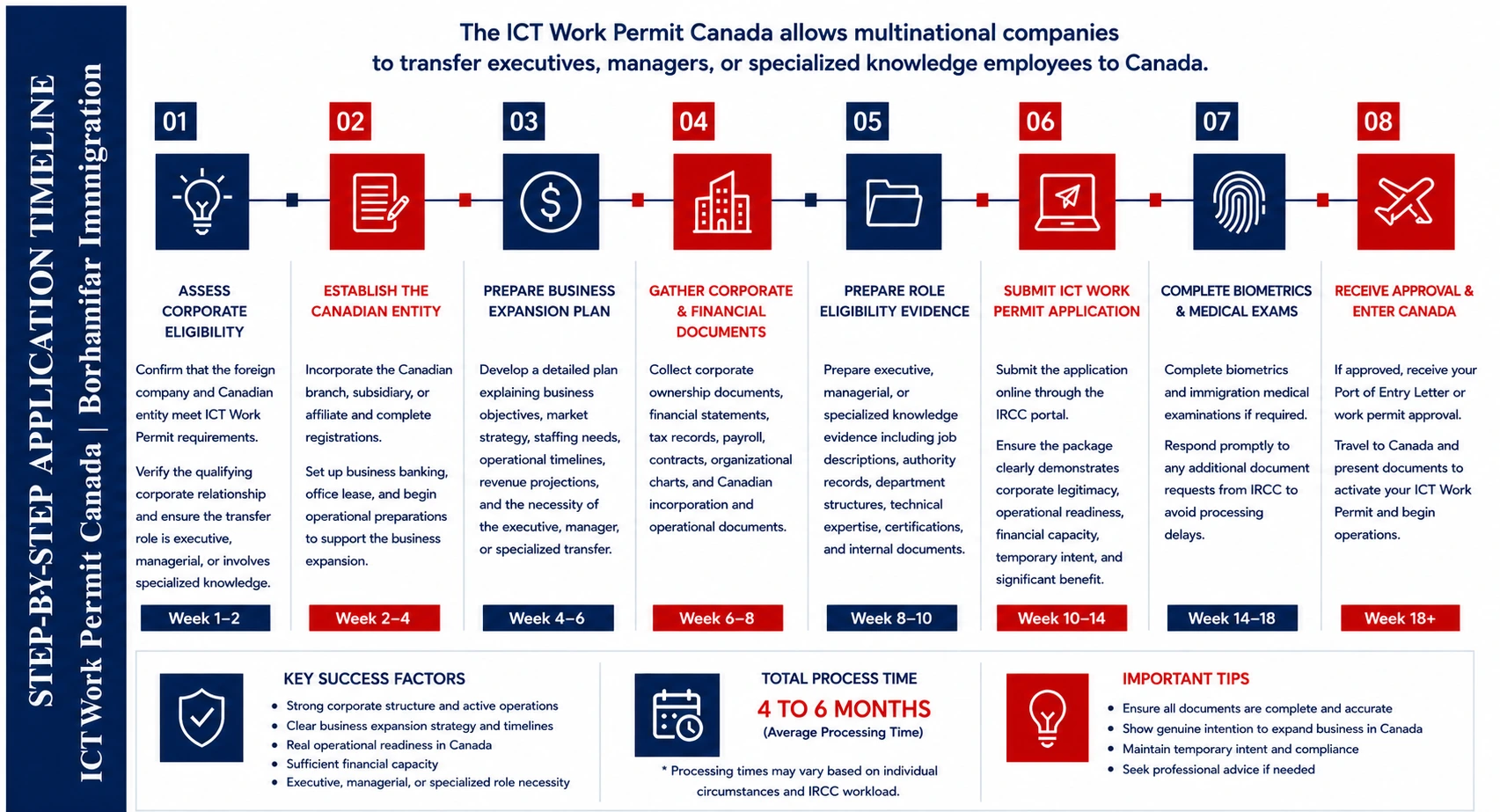
How to Apply for ICT Work Permit Canada
Applying for ICT Work Permit Canada requires corporate planning, operational preparation, and strong supporting documentation.
IRCC officers commonly assess whether the transfer is genuine, operationally necessary, and supported by active business operations.
Summary:
Strong ICT applications usually combine active foreign operations, a qualifying corporate structure, financial stability, operational readiness, and clear executive, managerial, or specialized knowledge evidence.
Step 1: Assess Corporate Eligibility
The first step is confirming whether both companies qualify under ICT requirements.
IRCC generally expects:
- Active foreign business operations
- A qualifying corporate relationship
- Operational business activities in Canada
- Executive, managerial, or specialized knowledge eligibility
- Realistic Canadian expansion planning
The foreign and Canadian enterprises should generally maintain a parent, subsidiary, branch, or affiliate relationship.
Both companies should usually be actively doing business through ongoing goods or services activities.
Step 2: Establish the Canadian Entity
Many ICT applications involve creating a Canadian branch, subsidiary, or affiliate.
- Canadian incorporation
- Business registration
- Office lease planning
- Business banking setup
- Operational preparation
- Provincial registrations
Applicants opening a new office should generally demonstrate operational readiness before applying.
Step 3: Prepare the Business Expansion Plan
A detailed business expansion plan is often a major part of ICT applications.
- Canadian business objectives
- Market strategy
- Operational timelines
- Staffing plans
- Revenue projections
- Transfer necessity explanation
- Long-term Canadian growth plans
Step 4: Gather Corporate and Financial Documents
Applicants usually prepare extensive corporate and operational documentation before submission.
- Corporate ownership documents
- Financial statements
- Tax records
- Business licenses
- Operational contracts
- Payroll records
- Organizational charts
- Canadian incorporation records
Step 5: Prepare Role and Employment Evidence
Applicants must clearly demonstrate executive, managerial, or specialized knowledge eligibility.
- Employment contracts
- Executive job descriptions
- Organizational authority evidence
- Department supervision records
- Technical certifications
- Company-specific expertise documentation
Strong role documentation may significantly improve approval potential.
Step 6: Submit the ICT Application
Most ICT applications are submitted online through the IRCC portal.
The application package should clearly demonstrate:
- Corporate legitimacy
- Qualifying relationship
- Operational readiness
- Financial capacity
- Operational need for the transfer
- Executive or specialized role eligibility
- Temporary intent compliance
Step 7: Complete Biometrics and Medical Requests
Applicants may need to complete biometrics, medical examinations, or additional document requests.
Processing delays commonly occur when applicants respond slowly to IRCC procedural requests.
Step 8: Receive Approval and Enter Canada
Approved applicants usually receive a Port of Entry Letter of Introduction or work permit approval.
Border officers may still review:
- Corporate documents
- Business expansion plans
- Financial records
- Role eligibility evidence
- Canadian operational plans
- Family supporting documents
Advanced ICT Application Analysis
Under current IRCC operational practices, ICT applications are increasingly assessed based on operational credibility.
Officers commonly expect evidence showing realistic Canadian expansion activities before application submission.
Applications supported only by weak expansion concepts may face higher refusal risks.
Stronger ICT applications usually combine:
- Active foreign operations
- Clear corporate ownership structures
- Realistic Canadian expansion planning
- Strong financial documentation
- Operational readiness evidence
- Executive or specialized knowledge necessity
- Commercial credibility and long-term viability
IRCC officers also commonly assess whether the transfer is genuinely necessary for Canadian operations.
ICT Work Permit Costs and Government Fees in 2026
The total cost of an ICT Work Permit application depends on company size, transfer complexity, and Canadian expansion plans.
Companies should budget for IRCC fees, corporate setup, legal support, accounting, office costs, payroll, and compliance.
Summary: ICT applications involve both immigration costs and real business expansion expenses. Officers may assess whether the company can financially support active Canadian operations.
Government Fees for ICT Work Permit Canada
| Fee Type | Estimated Cost |
|---|---|
| Work Permit Processing Fee | CAD $155 |
| Employer Compliance Fee | CAD $230 |
| Biometrics Fee | CAD $85, or CAD $170 for a family |
| Open Work Permit Holder Fee for Spouse | CAD $100 |
| Medical Examination | Approximately CAD $200–$500 per person |
Typical Canadian Expansion Costs
ICT applicants should also plan for real business costs in Canada.
| Expense | Estimated Cost Range |
|---|---|
| Canadian Incorporation and Registration | CAD $300–$3,000+ |
| Office Lease and Deposit | CAD $5,000–$50,000+ |
| Office Setup and Equipment | CAD $10,000–$100,000+ |
| Payroll and Initial Staffing | CAD $50,000–$500,000+ |
| Website, Branding, and Marketing | CAD $3,000–$20,000+ |
| Accounting and Compliance | CAD $3,000–$15,000+ annually |
Recommended Financial Capacity
ICT Work Permit Canada does not require a fixed minimum investment amount.
However, stronger applications usually show enough liquidity to support Canadian operations, payroll, office setup, and expansion.
| Expansion Type | Typical Financial Capacity |
|---|---|
| Small Canadian Expansion | Approximately CAD $100,000–$250,000+ |
| Medium Operational Expansion | Approximately CAD $250,000–$750,000+ |
| Large Corporate Expansion | May exceed CAD $1 million |
Hidden Operational Costs Many Companies Ignore
- Canadian payroll taxes
- Corporate tax compliance
- Office insurance
- Employee benefits
- Commercial legal compliance
- Annual accounting obligations
- Provincial licensing costs
- Operational cash flow reserves
Advanced Financial Analysis of ICT Work Permit Canada
IRCC officers increasingly analyze whether the foreign company can support Canadian expansion beyond the initial application stage.
Applications may face higher refusal risks when revenues are weak, budgets are unrealistic, or projections lack credibility.
Strong ICT applications usually include realistic budgets, financial stability, and evidence of sustainable expansion capacity.
ICT Work Permit Processing Times in 2026
ICT Work Permit Canada processing times may vary depending on the applicant’s country of residence, visa office workload, corporate structure complexity, biometrics, background checks, and the quality of the supporting corporate documents.
Applications supported by organized corporate evidence, realistic expansion plans, and complete organizational documentation may help reduce processing delays.
Important: ICT processing times frequently change and are never guaranteed. Applicants should verify current timelines through the official IRCC processing time tool before applying.
Estimated ICT Work Permit Processing Times by Country
| Country | Approximate Processing Time |
|---|---|
| India | Approximately 6 to 10 weeks |
| United Arab Emirates (UAE) | Approximately 5 to 9 weeks |
| Turkey | Approximately 5 to 8 weeks |
| Iran | May vary significantly depending on background checks and processing conditions |
| United States | Approximately 3 to 5 weeks |
| United Kingdom | Approximately 4 to 7 weeks |
Processing times may change based on IRCC workload, visa office capacity, biometrics, background checks, and application volume.
Applicants should verify current timelines directly through the
official IRCC processing time tool
.
Factors That Commonly Affect ICT Work Permit Processing
IRCC officers often review both the foreign company and the Canadian entity during ICT application assessments.
Processing may take longer when corporate structures, financial records, or operational evidence require additional review.
- Corporate ownership complexity
- Verification of foreign business operations
- Security and background screening
- Biometrics or medical examination delays
- Weak organizational charts
- Insufficient corporate financial records
- Incomplete expansion plans
- Additional document requests from IRCC
- High application volume at the responsible visa office
What Can Delay an ICT Work Permit Canada Application?
- Weak evidence of active foreign operations
- Unclear corporate relationship between entities
- Generic or unrealistic expansion plans
- Insufficient executive or specialized knowledge evidence
- Payroll or staffing inconsistencies
- Incomplete incorporation or registration records
- Weak proof of operational readiness in Canada
- Large gaps in financial documentation
- Extended security screening
How to Help Reduce ICT Processing Delays
- Submit a complete and organized application package
- Provide detailed corporate ownership documents
- Include clear organizational charts
- Demonstrate active foreign business operations
- Provide realistic Canadian expansion plans
- Submit complete financial and payroll records
- Clearly explain the executive or specialized knowledge role
- Respond quickly to IRCC document requests
- Include a clear legal submission letter if applicable
Advanced Processing Analysis for ICT Work Permit Canada
ICT processing is often affected by how clearly the application connects the foreign company, Canadian entity, transferred employee, and business expansion plan.
Immigration officers may review whether:
- The foreign company is genuinely operational
- The Canadian entity can realistically support expansion
- The transferred employee is operationally necessary
- The executive or specialized role is genuine
- The expansion plan is commercially realistic
- The company has long-term operational sustainability
Applications supported by organized corporate records, active revenue-generating operations, and realistic Canadian expansion plans are generally easier for officers to assess.
Realistic ICT Work Permit Canada Timeline
ICT applications usually involve several corporate, operational, and immigration stages before final approval.
Actual timelines vary depending on the visa office, corporate complexity, biometrics, medicals, and security screening.
Summary:
Many ICT applications require weeks or months of corporate preparation before IRCC processing officially begins.
Typical ICT Work Permit Canada Timeline
| Stage | Estimated Timeline |
|---|---|
| Initial corporate eligibility assessment | 1–2 weeks |
| Canadian entity setup or corporate structuring | 1–4 weeks |
| Business expansion plan preparation | 2–6 weeks |
| Corporate and financial documentation | 1–4 weeks |
| Operational setup activities in Canada | 2–8 weeks |
| Application submission and biometrics | 1–4 weeks |
| IRCC processing and officer review | 1–6 months |
| Travel to Canada and work permit activation | After final approval |
Why Some ICT Applications Move Faster
- Clear corporate relationship documentation
- Active foreign operations and revenue
- Properly established Canadian entity
- Realistic business expansion planning
- Complete financial and payroll records
- Strong executive or specialized knowledge evidence
- Well-organized application package
Common Reasons for ICT Processing Delays
- Unclear corporate relationship between entities
- Weak proof of active foreign operations
- Missing financial or payroll records
- Generic expansion plans
- Weak specialized knowledge evidence
- Additional document requests from IRCC
- Security or background screening
- Medical examination delays
- High visa office processing volumes
In many cases, the preparation stage is just as important as IRCC processing itself.
Strategic Legal Analysis of ICT Processing Timelines
IRCC officers increasingly review operational readiness, corporate structure, and expansion credibility during ICT assessments.
Officers commonly assess:
- Whether the foreign company is actively operating
- Whether the Canadian entity is genuinely established
- Whether the transfer supports Canadian operations
- Whether the corporate relationship is properly documented
- Whether the expansion plan appears commercially realistic
Applications supported by organized records and realistic operational planning are generally easier for officers to assess.
What Happens After Applying for ICT Work Permit Canada?
After submission, IRCC reviews the corporate structure, foreign operations, financial capacity, and the applicant’s role.
Officers assess whether the transfer is commercially necessary and supported by active multinational business operations.
Summary:
ICT applications often undergo detailed review of business operations, expansion credibility, and executive or specialized knowledge requirements.
Initial Corporate and Immigration Review
During the first review stage, IRCC commonly assesses:
- Corporate ownership and qualifying relationship
- Active foreign business operations
- Canadian expansion plans
- Organizational charts and reporting structure
- Financial and payroll records
- Executive or specialized knowledge evidence
- Temporary intent and immigration compliance
Weak operational evidence or inconsistent records may increase refusal risks or processing delays.
Biometrics, Medical Exams, and Additional Requests
Most ICT applicants must complete biometrics after submission.
Some applicants may also require immigration medical examinations depending on the work activities and intended stay.
IRCC may request additional documents such as:
- Updated financial statements
- Payroll and employee records
- Business tax filings
- Commercial lease agreements
- Updated organizational charts
- Proof of active foreign operations
- Canadian incorporation records
- Revised expansion plans
Fast and organized responses may help reduce processing delays.
If the ICT Work Permit Is Approved
Approved applicants usually receive a Port of Entry Letter of Introduction or work permit approval.
CBSA officers may still review documents at the Canadian border before issuing the final work permit.
Border officers may assess:
- Corporate ownership documents
- Business expansion plans
- Executive or specialized role evidence
- Financial capacity
- Temporary intent and admissibility
- Family accompanying documents
The final work permit decision is generally made at the port of entry.
After Entering Canada Under ICT Work Permit
After arrival, companies are generally expected to actively implement Canadian operations.
This may include:
- Opening Canadian business bank accounts
- Finalizing office lease arrangements
- Hiring Canadian employees
- Launching revenue-generating operations
- Managing payroll and tax compliance
- Expanding Canadian market activities
- Maintaining active foreign operations
Operational progress may later become important for work permit extensions or permanent residence pathways.
Bringing Family Under ICT Work Permit
Many ICT applicants may bring their spouse and dependent children to Canada.
Family members may qualify for work permits, study permits, or visitor status.
Family Options May Include
- Open Work Permit for the spouse
- Study Permit or school access for children
- Combined family applications
- Future permanent residence pathways together
Family applications usually require marriage certificates, birth certificates, passports, and proof of financial support.
If the ICT Work Permit Application Is Refused
IRCC usually provides written refusal reasons explaining the officer’s concerns.
Common refusal concerns may include:
- Weak foreign operational evidence
- Unclear corporate relationship
- Weak executive or specialized knowledge evidence
- Insufficient financial capacity
- Generic expansion plans
- Operational credibility concerns
- Weak temporary intent explanations
- Inconsistent corporate documentation
Depending on the case, applicants may:
- Submit a stronger re-application
- Strengthen operational evidence
- Improve financial documentation
- Restructure the expansion strategy
- Request GCMS notes
- Seek legal reassessment
Many successful ICT approvals occur after applicants improve documentation and operational planning following an earlier refusal.
Advanced Legal Analysis of ICT Post-Application Assessment
IRCC increasingly assesses ICT applications based on operational credibility and commercial realism.
Officers commonly examine:
- Whether the foreign company is genuinely active
- Whether the Canadian expansion appears realistic
- Whether the applicant’s role is operationally necessary
- Whether the corporate relationship is properly documented
- Whether the Canadian entity can sustain operations
- Whether temporary intent remains credible
Applications supported by active operations, realistic planning, and organized records are generally easier for officers to assess.
Recent ICT Work Permit Approval Trends and Application Volumes
Recent IRCC operational trends show increased scrutiny on ICT Work Permit Canada applications.
Officers increasingly assess operational credibility, active foreign operations, financial capacity, and realistic Canadian expansion plans.
According to IRCC and industry-reported trends, LMIA-exempt work permits under the International Mobility Program (IMP) experienced approval rate reductions during recent years as Canada increased review standards for temporary resident applications.
- IRCC reported approximately 69% approval rates for certain IMP work permit categories during parts of 2025
- ICT applications with active multinational operations and realistic expansion planning generally present stronger approval potential
- Applications supported only by weak corporate structures or theoretical business plans may face higher refusal risks
- Specialized knowledge ICT applications often receive additional scrutiny regarding operational necessity and replacement difficulty
Industry reports and legal practitioners also indicate that stronger ICT applications commonly involve measurable foreign revenue, active staffing, organized financial records, and commercially credible Canadian operations.
Recent operational trends also show increasing IRCC focus on whether the Canadian entity is genuinely operational rather than existing only on paper.
Sources: IRCC International Mobility Program statistics, official IRCC operational guidance, and recent Canadian business immigration analysis.
ICT Work Permit to Permanent Residence (PR)
Many executives, senior managers, and specialized knowledge employees use ICT Work Permit Canada as a long-term pathway toward permanent residence.
Although ICT is a temporary work permit category, Canadian work experience and active business operations may later support permanent residence eligibility.
Summary:
ICT Work Permit Canada may later support permanent residence pathways through Canadian work experience, executive employment, and provincial immigration programs.
Business Operations After Arrival
After arriving in Canada, companies are generally expected to actively establish or expand Canadian operations.
Typical activities may include:
- Opening Canadian corporate bank accounts
- Finalizing office or lease arrangements
- Hiring Canadian employees and contractors
- Launching operational and marketing activities
- Managing payroll and tax compliance
- Expanding Canadian business operations
- Maintaining active foreign operations
IRCC and provincial authorities may later assess whether the Canadian operation became genuinely active.
Can ICT Lead to Permanent Residence?
Yes. Many ICT Work Permit holders later qualify for permanent residence after gaining Canadian work experience.
Potential pathways may include:
- Canada Express Entry
- Canadian Experience Class (CEC)
- Provincial Nominee Programs (PNP)
- Executive and senior management pathways
- Provincial business expansion streams
Executives working under NOC Major Group 00 may benefit from executive-focused immigration trends.
Express Entry After ICT
Many ICT applicants later pursue permanent residence through Express Entry after gaining qualifying Canadian work experience.
Canadian work experience may improve CRS scores under:
- Canadian Experience Class (CEC)
- Federal Skilled Worker Program (FSW)
- Provincial Nominee Programs linked to Express Entry
Eligibility may depend on:
- Canadian work experience duration
- English or French language scores
- Age and education
- NOC classification
- Executive or managerial role
- Overall CRS score
Executive PR Trends in 2026
Recent IRCC trends show increased focus on executives and senior managers under NOC Major Group 00.
This may improve permanent residence opportunities for multinational executives already operating in Canada through ICT.
Provincial Nominee Programs (PNP)
Some ICT applicants may later qualify for provincial immigration pathways depending on:
- Province of employment
- Canadian business operations
- Executive or managerial role
- Canadian staffing activities
- Length of Canadian work experience
- Economic contribution within the province
Several provinces actively support multinational expansion and executive immigration pathways.
How Long Before Applying for PR?
There is no universal timeline for permanent residence after ICT Work Permit Canada.
However, many applicants operate Canadian businesses for at least one year before qualifying for certain pathways requiring Canadian work experience.
Maintaining active operations, payroll compliance, and business growth may strengthen future immigration applications.
Can Family Members Also Become Permanent Residents?
Yes. Spouses and dependent children may later become part of the permanent residence application.
Spouses may gain Canadian work experience through Open Work Permits, while children may benefit from Canadian education pathways.
Factors That Strengthen PR Opportunities
- Maintaining active Canadian business operations
- Strong payroll and tax compliance
- Executive or managerial Canadian work experience
- Proper NOC classification planning
- Generating measurable economic activity
- Improving English or French scores
- Maintaining legal immigration status
- Building long-term business credibility
Dual Intent Under ICT
Canadian immigration law allows applicants to have both temporary intent and long-term immigration intentions at the same time.
This principle is known as dual intent.
ICT applicants may pursue permanent residence while still complying with temporary work permit conditions.
Advanced Legal Analysis
IRCC increasingly views ICT Work Permit Canada as part of broader corporate and immigration planning.
Officers and provincial authorities may later assess:
- Whether the Canadian business became operationally active
- Whether the applicant maintained executive responsibilities
- Whether payroll and tax obligations were properly maintained
- Whether qualifying Canadian work experience was accumulated
- Whether the business expansion remained commercially credible
Applicants who maintain active operations and strong compliance may later strengthen their permanent residence opportunities.
Long-term immigration planning under ICT often requires coordination between business operations, immigration compliance, and permanent residence strategy.
ICT Work Permit Extension Rules
ICT Work Permit Canada is initially issued for a temporary period.
Many applicants may later qualify for extensions if Canadian and foreign business operations remain active and compliant.
Summary:
ICT extensions usually require active Canadian operations, continued multinational business activity, payroll compliance, and proof that the transfer remains necessary.
Maximum ICT Extension Periods
Extension periods may vary depending on the applicant’s role and work permit category.
In many cases:
- Executives and senior managers may receive extensions up to a cumulative maximum of 7 years
- Specialized knowledge employees may receive extensions up to a cumulative maximum of 5 years
Final decisions remain discretionary and depend on IRCC assessment of ongoing business activity and compliance.
Key Requirements for ICT Extensions
IRCC generally expects applicants and companies to demonstrate that Canadian operations became genuinely active after the initial approval.
Common extension requirements may include:
- Active Canadian business operations
- Continued foreign company operations
- Updated corporate ownership documents
- Canadian payroll and tax compliance
- Commercial revenue or business activity
- Canadian employee hiring evidence
- Office or commercial premises evidence
- Updated organizational charts
- Proof that the applicant still occupies a qualifying role
Common Reasons for ICT Extension Refusals
- Inactive or weak Canadian operations
- Failure to maintain foreign business operations
- Weak payroll or accounting compliance
- Insufficient commercial activity evidence
- Failure to prove continued need for the role
- Weak specialized knowledge justification
- Inconsistent corporate documentation
- Corporate restructuring concerns
Many refusals occur when companies fail to demonstrate that the Canadian operation became genuinely active after the initial approval.
Documents Commonly Required for ICT Extensions
Typical supporting documents may include:
- Corporate tax filings
- Payroll records and employee documents
- Business bank statements
- Commercial lease agreements
- Invoices and commercial contracts
- Corporate ownership updates
- Financial statements
- Updated business activity reports
- Organizational charts
- Proof of ongoing foreign operations
Transitioning From ICT to Permanent Residence
Many ICT Work Permit holders later pursue permanent residence instead of repeatedly extending temporary status.
Potential pathways may include:
- Canada Express Entry
- Provincial Nominee Programs (PNP)
- Canadian work experience pathways
- Executive and managerial immigration categories
Long-term immigration planning is often important before cumulative ICT limits are reached.
Advanced Legal Analysis
IRCC extension assessments increasingly focus on real business activity rather than theoretical expansion plans.
Immigration officers frequently examine:
- Whether the Canadian company became genuinely operational
- Whether the foreign entity remains commercially active
- Whether the applicant continues to occupy a qualifying role
- Whether payroll and tax compliance were maintained
- Whether the expansion generated measurable business activity
- Whether the corporate structure remains legitimate
Applications supported by active staffing, accounting compliance, and realistic business growth are generally easier for officers to assess.
ICT Work Permit Canada Case Examples and Trends
ICT applications are highly fact-specific and depend on the company’s structure, operations, financial capacity, and expansion credibility.
Recent IRCC trends show increased focus on operational realism, active foreign business activity, and genuine Canadian expansion plans.
Summary:
Strong ICT applications usually combine active foreign operations, realistic Canadian expansion plans, clear corporate relationships, and a genuine operational need for the transfer.
Note:
The following examples are illustrative only. Actual ICT eligibility depends on the company’s operations, financial records, corporate structure, and the applicant’s role.
Example: UAE Software Company Expanding Into Toronto
A UAE software company with international staff establishes a Canadian subsidiary in Toronto.
The company transfers its Regional Operations Director to manage hiring and operational setup in Canada.
Supporting evidence may include:
- Foreign payroll records
- International client contracts
- Corporate ownership records
- Canadian incorporation documents
- Office lease negotiations
- Planned Canadian hiring activities
- Operational financial projections
- International revenue records
Applications supported by measurable operations and realistic expansion activities are generally easier for officers to assess.
Example: Manufacturing Expansion Into Ontario
A manufacturing company operating in Turkey opens a Canadian branch in Ontario.
The company transfers a senior operations manager to oversee logistics and warehouse setup.
Supporting evidence may include:
- International supplier contracts
- Foreign revenue records
- Warehouse planning documents
- Canadian business registration
- Staffing projections
- Transportation agreements
- Evidence of active foreign operations
Officers may assess whether the expansion plan is commercially realistic and financially sustainable.
Example: Specialized Knowledge ICT Application
A multinational cybersecurity company transfers a technical employee with proprietary infrastructure knowledge.
The employee supports Canadian enterprise implementation projects.
The company may provide:
- Internal technical certifications
- Specialized training records
- Proprietary systems documentation
- Canadian implementation contracts
- Operational transfer necessity evidence
- Evidence showing difficulty replacing the employee locally
Specialized knowledge cases often face additional scrutiny because officers assess whether the expertise is advanced and company-specific.
Example: Higher-Risk ICT Scenario
A newly incorporated consulting company applies under the ICT category with weak operational evidence.
The application may involve:
- No measurable payroll records
- No active international contracts
- Generic business plans
- No realistic Canadian operational setup
- Weak executive necessity evidence
- Limited operational history
Applications relying on shell corporations or weak operational structures may face higher refusal risks.
Major ICT Work Permit Trends
Recent ICT trends show increased focus on commercial credibility and operational readiness.
Immigration officers increasingly examine:
- Whether the foreign company is genuinely active
- Whether Canadian operations are commercially realistic
- Whether the transfer is operationally necessary
- Whether staffing and payroll structures are credible
- Whether financial projections are realistic
- Whether implementation activities started before applying
Applications supported by operational preparation and measurable business activity are generally easier for officers to assess.
What Strong ICT Applications Commonly Include
- Active international operations
- Foreign payroll and staffing records
- Realistic Canadian expansion plans
- Organizational charts and reporting structures
- Canadian incorporation and setup activities
- Financial statements and tax records
- Supplier or client agreements
- Detailed executive or specialized knowledge explanations
Advanced IRCC Assessment Trends
IRCC increasingly assesses ICT applications based on commercial credibility rather than paperwork alone.
Immigration officers frequently evaluate:
- Whether the multinational structure is commercially genuine
- Whether the Canadian expansion appears operationally realistic
- Whether the transferred employee has genuine executive authority or advanced expertise
- Whether the company has sufficient staffing and financial capacity
- Whether the Canadian operation can realistically become sustainable
- Whether measurable international business activity exists
Applications supported by realistic planning, active operations, and organized corporate records are generally easier for officers to assess.
ICT Work Permit Conclusion
ICT Work Permit Canada remains one of the most important LMIA-exempt business immigration pathways for multinational companies expanding into Canada.
The program allows qualifying companies to transfer executives, managers, and specialized employees to Canadian operations.
Recent IRCC operational trends show increased scrutiny regarding:
- Corporate legitimacy and active foreign operations
- Commercial realism of Canadian expansion plans
- Operational necessity of the transferred employee
- Executive, managerial, or specialized knowledge credibility
- Financial sustainability and staffing capacity
- Long-term operational viability in Canada
Strong ICT applications are commonly supported by:
- Established multinational operational history
- Active foreign payroll and staffing evidence
- Clear corporate ownership structures
- Realistic Canadian expansion planning
- Professional operational documentation
- Commercially credible implementation activities
- Detailed executive or specialized role explanations
- Organized financial and legal records
For many multinational companies, ICT Work Permit Canada is not only a temporary transfer solution.
It may also support long-term Canadian expansion, executive relocation, and future permanent residence planning.
Because every ICT structure and expansion strategy is different, legal and operational preparation is often important before applying.
If your business structure may not fully align with ICT operational expectations, alternative pathways such as the Canada C11 Work Permit or buying an existing Canadian business may also be considered depending on your long-term business and immigration strategy.
ICT Work Permit FAQ
This section answers common questions about ICT Work Permit Canada, including eligibility, processing, family applications, refusals, extensions, and permanent residence pathways.
What is ICT Work Permit Canada?
ICT Work Permit Canada is an LMIA-exempt work permit allowing multinational companies to transfer executives, managers, and specialized employees to Canadian operations.
Does ICT Work Permit Canada require an LMIA?
No. ICT Work Permit Canada is generally LMIA-exempt under the International Mobility Program (IMP).
Who can apply for ICT Work Permit Canada?
Executives, senior managers, and specialized employees working for multinational companies with qualifying corporate relationships may qualify.
What corporate relationship is required for ICT?
The foreign company and Canadian entity generally must have a parent, subsidiary, branch, or affiliate relationship.
Can a new Canadian branch qualify for ICT?
Yes. Companies may establish a new Canadian branch or subsidiary if the expansion plan is commercially realistic and operationally credible.
What is specialized knowledge under ICT?
Specialized knowledge generally refers to advanced company-specific expertise or operational experience necessary for Canadian operations.
How long is ICT Work Permit Canada valid?
ICT Work Permits are commonly issued for one to three years initially depending on the role and expansion structure.
Can ICT Work Permit Canada be extended?
Yes. Extensions may be possible if Canadian operations remain active and the company continues to meet ICT requirements.
Can my spouse receive an Open Work Permit?
Yes. In many ICT applications, spouses may qualify for an Open Work Permit.
Can children study in Canada under ICT?
Yes. Dependent children may generally attend school in Canada if eligible.
Can ICT Work Permit Canada lead to permanent residence?
Yes. Many ICT applicants later pursue permanent residence through
Canada Express Entry,
Provincial Nominee Programs (PNP), or executive immigration pathways.
How long does ICT Work Permit processing take?
Processing times vary depending on the visa office, country of residence, application complexity, and background screening.
What are common ICT refusal reasons?
Common refusal reasons include weak corporate structures, inactive foreign operations, unrealistic expansion plans, and insufficient operational evidence.
Can I reapply after an ICT refusal?
Yes. Many applicants later reapply after strengthening operational evidence, financial planning, and corporate documentation.
Can small businesses qualify for ICT Work Permit Canada?
Yes. Smaller multinational businesses may qualify if they demonstrate active international operations and realistic Canadian expansion plans.
Do I need to own the company to apply for ICT?
No. Many ICT applicants are transferred employees rather than business owners.
Can I apply for ICT Work Permit Canada from outside Canada?
Yes. Most ICT applications are submitted from outside Canada through the IRCC online portal.
Is legal representation important for ICT applications?
Professional preparation may help organize the application and address current IRCC scrutiny regarding operational credibility and commercial legitimacy.
Legal and Business Support for ICT Work Permit
For questions regarding multinational expansion, ICT eligibility, refusal risks, specialized transfers, family applications, or permanent residence planning, you may also contact us through WhatsApp.
Official Government Sources and Legal References
ICT Work Permit Canada is primarily processed under the International Mobility Program (IMP).
Official operational guidance is available through the
official IRCC Intra-Company Transferee (ICT) guidance
.
ICT applications are generally assessed under
IRPR section 205(a)
.
Current processing times may vary depending on the visa office, biometrics, background checks, and application complexity.
Applicants may verify updated timelines through the
official IRCC processing time tool
.
According to the Government of Canada
Immigration Levels Plan 2025–2027
,
Canada plans to reduce portions of temporary resident volumes, including some IMP categories.
This may increase operational scrutiny on LMIA-exempt work permit categories such as ICT Work Permit Canada.
Companies establishing Canadian operations may also need to comply with federal or provincial corporate registration requirements.
Official federal incorporation guidance is available through
Corporations Canada
.
Editorial and Professional Notice
This article was prepared for general informational purposes based on publicly available Canadian immigration laws, IRCC operational guidance, and current immigration policies.
At Borhanifar Immigration, we provide professional Canadian immigration services focused on clarity, strategy, and practical immigration solutions tailored to each client’s situation and long-term objectives.
Content on this page is reviewed under the supervision of a licensed Canadian immigration professional (RCIC). Immigration laws, policies, processing trends, and eligibility requirements may change over time, and readers should verify important information directly through official Government of Canada sources.
This article does not constitute individualized legal advice and should not be interpreted as a guarantee of approval, processing time, or immigration outcome.