C11 Work Permit Canada 2026: Complete Application Guide
The Canada C11 Work Permit is an LMIA-exempt work permit for eligible entrepreneurs and self-employed business owners whose proposed work may create or maintain significant social, cultural, or economic benefits or opportunities for Canadian citizens or permanent residents.
Table of Contents
C11 Work Permit Canada Overview
| Key Factor | Details |
|---|---|
| Work Permit Type | Temporary, employer-specific, LMIA-exempt work permit for qualifying business owners |
| Immigration Framework | International Mobility Program (IMP) |
| Legal Basis | Paragraph 205(a) of the Immigration and Refugee Protection Regulations (IRPR), using LMIA exemption code C11 |
| LMIA Requirement | No LMIA is required where the applicant qualifies for the C11 exemption |
| Eligible Applicants | Qualifying business owners seeking temporary entry to Canada to actively operate their own business |
| Ownership & Control | For business owners seeking temporary residence under the current C11 instructions, generally at least 51% ownership and control of the Canadian business |
| Significant Benefit | The proposed work must be expected to create or maintain significant social, cultural, or economic benefits or opportunities for Canadian citizens or permanent residents |
| Temporary Residence | Applicants must satisfy the officer that they meet the requirements for temporary residence, including that they will leave Canada by the end of the period authorized for their stay |
| Initial Work Permit | May be issued for up to 18 months under the current C11 instructions, subject to the application and officer assessment |
| Business Funds | Applicants should demonstrate sufficient financial capacity to establish, purchase, and/or operate the proposed Canadian business, as applicable |
| Personal Funds | Applicants should demonstrate sufficient funds to support themselves and accompanying family members during their authorized stay in Canada |
| Family Members | Accompanying family members may apply for immigration status appropriate to their circumstances; eligibility for a spousal open work permit or a study permit must be assessed under the applicable rules |
| Permanent Residence | C11 does not provide permanent residence. A business owner may separately qualify for a federal or provincial permanent residence program if they meet that program’s requirements |
Book a Canada C11 Consultation
Discuss your business background, investment strategy, and possible C11 approval pathway with a licensed Canadian immigration professional.

What is the C11 Work Permit? The C11 Work Permit is an LMIA-exempt work permit for qualifying business owners who intend to temporarily enter Canada to operate their own business. C11 is an LMIA exemption code under Canada’s International Mobility Program (IMP) and is assessed under paragraph 205(a) of the Immigration and Refugee Protection Regulations (IRPR), where the proposed work is expected to create or maintain significant social, cultural, or economic benefits or opportunities for Canadian citizens or permanent residents.
Under the current C11 requirements, a business owner seeking temporary residence must generally control at least 51% of the Canadian business, demonstrate sufficient funds for both the business and personal support, establish a credible temporary purpose, and provide evidence showing how the proposed business activities and the applicant’s work in Canada will create a significant benefit.
The C11 Work Permit is a temporary residence pathway and does not provide permanent residence by itself. A business owner may later qualify for a separate permanent residence program if they independently meet that program’s eligibility requirements.
This guide explains the C11 Work Permit requirements in 2026, including business ownership and control, significant benefit, financial capacity, business planning and supporting evidence, the application process, work permit duration and extensions, common refusal risks, and potential permanent residence options.
C11 Work Permit Eligibility Assessment Tool
C11 Work Permit Canada Eligibility Requirements
To qualify for a C11 Work Permit, a business owner must meet the applicable requirements for an LMIA-exempt work permit under paragraph 205(a) of the Immigration and Refugee Protection Regulations (IRPR). A central part of the assessment is whether the applicant’s proposed work is expected to create or maintain significant social, cultural, or economic benefits or opportunities for Canadian citizens or permanent residents.
Summary: A C11 applicant should generally demonstrate qualifying ownership and control of the Canadian business, relevant experience and ability to operate it, sufficient business and personal funds, meaningful progress toward implementing the business, a credible significant-benefit case, and compliance with the requirements for temporary residence in Canada.
A C11 application is assessed on the circumstances of the individual applicant and the proposed business. Business ownership alone is not sufficient. The supporting evidence should establish that the business is credible, the applicant is capable of implementing and operating it, and the applicant’s work in Canada is expected to produce the significant benefit relied upon in the application.
Key factors in a C11 assessment may include:
- Ownership and control of the Canadian business
- Relevant business, entrepreneurial, managerial, or industry experience
- The expected significant benefit of the applicant’s work in Canada
- Business viability and implementation progress
- Sufficient and available funds for the proposed business
- Sufficient personal funds for the applicant and accompanying family members
- The applicant’s role and active involvement in the business
- Compliance with temporary residence and work permit requirements
The weight given to each factor depends on the nature of the business, the applicant’s role, the proposed benefit, and the evidence submitted with the application.
Business Ownership and Operational Control
Under the current C11 instructions for business owners seeking temporary residence, the applicant should generally own and control at least 51% of the Canadian business. The ownership structure should demonstrate that the applicant has genuine control of the enterprise and will actively operate the business in Canada rather than participate only as a passive investor.
Corporate records, shareholder information, purchase or investment documents, organizational records, and evidence describing the applicant’s proposed role may be relevant to establishing ownership and operational control.
Business and Entrepreneurial Experience
The applicant should demonstrate that they have the experience, skills, and background necessary to carry out the proposed work and realistically operate the Canadian business.
Relevant evidence may include previous business ownership, management experience, industry experience, financial responsibility, staffing and operational oversight, business development, or other experience directly connected to the proposed Canadian operation.
Legal Insight: Experience and Ability to Operate the Business
The relevance of an applicant’s experience should be assessed in relation to the proposed business and the role they intend to perform in Canada. A strong application connects the applicant’s previous experience to specific operational responsibilities rather than relying only on job titles or general management history.
Significant Benefit to Canada
Significant benefit is central to a C11 application. Under paragraph 205(a) of the IRPR, the proposed work must be expected to create or maintain significant social, cultural, or economic benefits or opportunities for Canadian citizens or permanent residents.
Understanding Significant Benefit
Key Point: Investment or business ownership alone does not establish significant benefit. The application should explain the specific benefit expected from the applicant’s work and support that benefit with evidence relevant to the particular business, industry, and location.
The significance of a proposed benefit is assessed in context. Depending on the business, relevant considerations may include employment opportunities, regional or local economic development, innovation, specialized products or services, market expansion, support for Canadian suppliers, or social and cultural contributions.
For example, the location and local market conditions may affect the significance of a proposed business. A business operating in an underserved community may present different benefits from a similar business entering a market where comparable services are already widely available. The analysis should therefore be specific to the proposed operation rather than based on general claims about investment or entrepreneurship.
Examples of Potential Economic Benefits
- Creating or maintaining employment opportunities for Canadians or permanent residents
- Supporting regional or local economic activity
- Introducing innovation, specialized expertise, products, or services
- Addressing a demonstrated market or service gap
- Creating opportunities for Canadian suppliers or business partners
- Contributing to business expansion or access to new markets
Examples of Potential Social or Cultural Benefits
- Providing services that address identified community needs
- Contributing specialized knowledge or professional expertise
- Supporting educational, cultural, artistic, or community activities
- Providing services that improve access or outcomes for particular communities
Evidence of Significant Benefit
The evidence required depends on the benefit being claimed. It may include market research, employment projections, financial forecasts, supplier or partnership communications, industry evidence, letters from relevant organizations, evidence of local demand, or other documentation that supports the anticipated benefit of the applicant’s work in Canada.
Business Viability and Implementation
The proposed business should be sufficiently developed to demonstrate that it is credible and capable of implementation. The evidence required will depend on whether the applicant is establishing a new business, purchasing an existing business, or developing an operation that has already begun.
Relevant implementation evidence may include:
- Canadian incorporation and corporate records
- Business acquisition or purchase documentation, where applicable
- Market and industry research
- Premises or commercial lease arrangements
- Licensing or regulatory preparation, where applicable
- Supplier, distributor, or partnership communications
- Website, branding, or operational development
- Recruitment and staffing plans
- Financial forecasts and implementation timelines
Not every business will require the same pre-application steps. The evidence should be proportionate to the business model and demonstrate genuine progress toward implementing the proposed operation.
Financial Capacity
Applicants should demonstrate sufficient financial capacity to implement and operate the proposed business and to support themselves and accompanying family members during their authorized stay in Canada.
The appropriate level of business funding depends on the nature, location, scale, and operating requirements of the proposed business. C11 does not impose a single investment amount that applies to every applicant.
Business and Personal Funds
The application should clearly distinguish between:
- Funds available for the acquisition, establishment, implementation, and operation of the Canadian business; and
- Personal funds available to support the applicant and accompanying family members in Canada.
Financial Evidence
Financial evidence should allow an officer to assess the availability and source of the funds relied upon in the application. Depending on the circumstances, relevant documents may include bank records, investment records, business financial statements, asset-sale documentation, corporate records, transaction documents, and other evidence establishing the source and availability of funds.
Temporary Residence Requirements
A C11 Work Permit is a temporary resident work permit. The applicant must therefore satisfy the applicable requirements for temporary entry to Canada, including the requirement to leave Canada by the end of the period authorized for their stay.
An intention to pursue permanent residence in the future does not necessarily prevent a person from having temporary resident intent. Canadian immigration law recognizes dual intent, but the applicant must still satisfy the officer that they will comply with the conditions of temporary residence if permanent residence is not obtained.
Language Ability
There is no universal IELTS, CELPIP, TEF, or other standardized language-test score prescribed specifically for a C11 Work Permit. However, the applicant must be able to demonstrate that they can realistically perform the proposed work and operate the business described in the application.
Where language ability is relevant to the proposed role or business operations, appropriate evidence may help establish the applicant’s ability to communicate with customers, employees, suppliers, regulators, or business partners. The relevance and weight of language evidence will depend on the circumstances of the application.
Overall C11 Assessment
A C11 application should be assessed as a complete business and immigration case rather than as a checklist of isolated requirements. Ownership, experience, financial capacity, business implementation, significant benefit, and temporary residence considerations should be supported by consistent evidence and should collectively explain why the applicant’s proposed work qualifies for the C11 LMIA exemption.
Practical Note: A business plan can be important evidence, but statements in a business plan should be supported where possible by independent or objective documentation. The strength of a C11 application depends on the facts of the individual case and the quality, consistency, and relevance of the supporting evidence.

Who Is Eligible for the C11 Work Permit in Canada?
The C11 Work Permit is primarily intended for qualifying business owners who seek temporary entry to Canada to actively operate their own business. Depending on the circumstances, this may include an entrepreneur establishing a new business, an individual purchasing an existing Canadian business, or a self-employed business owner developing their own commercial or professional operation in Canada.
Eligibility is not based simply on an applicant being an entrepreneur, investor, executive, or self-employed professional. The applicant must meet the applicable C11 requirements, including the current ownership and control requirements, demonstrate that they will actively operate the Canadian business, and establish that their proposed work is expected to create or maintain significant social, cultural, or economic benefits or opportunities for Canadian citizens or permanent residents.
Key Point: C11 is not a general work permit category for investors, executives, or managers. An applicant’s business or executive experience may support the application, but the applicant must qualify as a business owner under the applicable C11 framework and meet the significant-benefit and temporary residence requirements.
Common C11 business-owner scenarios may include:
- Entrepreneurs establishing a new business in Canada
- Business owners purchasing an existing Canadian business
- Self-employed business owners establishing or expanding their own operation in Canada
- Experienced executives or managers who acquire or establish a qualifying business that they will own, control, and actively operate
Entrepreneurs Establishing a New Business
An entrepreneur may seek a C11 Work Permit to establish and actively operate a new Canadian business. The application should demonstrate that the proposed business is credible, that the applicant has the ability and financial capacity to implement it, and that the applicant will exercise genuine ownership and operational control.
The proposed work must also satisfy the significant-benefit requirement. Depending on the business, relevant benefits may include employment opportunities, innovation, regional economic activity, specialized products or services, or other economic, social, or cultural benefits or opportunities for Canadians or permanent residents.
Purchasers of an Existing Canadian Business
A business owner may also seek a C11 Work Permit in connection with the purchase of an existing Canadian business. Purchasing a business does not, by itself, establish eligibility for C11.
The application should address the applicant’s ownership and control, their proposed operational role, the viability and circumstances of the acquired business, and the significant benefit expected from the applicant’s work in Canada.
Relevant evidence may include purchase or share-acquisition documents, corporate and financial records, due diligence materials, transition arrangements, staffing information, and a credible plan for the continued operation or development of the business.
Self-Employed Business Owners
A self-employed individual may potentially qualify where they will own and actively operate their own Canadian business and otherwise meet the applicable C11 requirements.
The assessment depends on the actual business structure and proposed work rather than the applicant’s occupational title. Depending on the circumstances, this may include certain professional, consulting, creative, technical, or specialized service businesses.
The application should explain how the business will operate in Canada, why the applicant’s work is necessary to the operation, and how that work is expected to produce the significant benefit relied upon in the application.
Experienced Executives and Managers Who Own a Business
Executive or senior management experience can be relevant evidence of an applicant’s ability to operate a proposed Canadian business, but executive status alone does not make a person eligible for a C11 Work Permit.
An experienced executive or manager may potentially qualify where they establish or acquire a business that they will own, control, and actively operate and where the other applicable C11 requirements are satisfied.
Relevant experience may include responsibility for business strategy, financial management, operations, staffing, commercial development, regulatory matters, or industry-specific management. The application should connect that experience directly to the applicant’s proposed responsibilities in the Canadian business.
Active Business Ownership vs. Passive Investment
C11 should not be treated as a passive investment option. Merely providing capital to a Canadian company or holding shares without genuine involvement in operating the business does not, by itself, establish eligibility.
The applicant’s ownership structure, decision-making authority, proposed duties, previous experience, and implementation evidence should collectively demonstrate genuine control and active involvement in the Canadian operation.
Eligibility Depends on the Complete C11 Assessment
No single occupational title, business type, investment amount, or previous position automatically qualifies an applicant for a C11 Work Permit. Each application must be assessed on its own facts against the applicable C11 requirements and the requirements for temporary residence in Canada.
Relevant considerations may include the applicant’s ownership and control of the business, ability to perform the proposed work, business and industry experience, financial capacity, implementation progress, significant benefit, and the credibility of the proposed temporary stay.
Best Businesses and Higher-Risk Business Models for a C11 Work Permit
There is no official list of businesses that automatically qualify for a C11 Work Permit. The strength of a proposed business depends on the facts of the application, including the applicant’s ownership and operational role, relevant experience, financial capacity, business viability, implementation progress, and the significant benefit expected from the applicant’s work in Canada.
Important: IRCC does not designate particular industries as “approved” or “high-risk” for C11. A business model that may support a strong application in one case may be insufficient in another. The proposed work and supporting evidence must satisfy the applicable C11 requirements based on the individual circumstances of the application.
What Makes a Business Suitable for C11?
Rather than focusing only on the industry, applicants should consider whether the proposed business can support a credible significant-benefit case and whether they have the experience, resources, and operational role necessary to implement it.
Depending on the particular business and location, relevant considerations may include:
- A demonstrated need or market opportunity for the proposed products or services
- Potential to create or maintain employment opportunities for Canadians or permanent residents
- Contribution to regional or local economic activity
- Innovation, specialized knowledge, products, or services
- Opportunities for Canadian suppliers, contractors, or business partners
- A realistic operating model supported by appropriate financial resources
- A clear connection between the applicant’s experience and their proposed role
- Credible implementation steps taken toward establishing or acquiring the business
Examples of Businesses That May Be Considered for C11
C11 is not restricted to a particular industry. Depending on the applicant’s background and the circumstances of the proposed operation, business concepts may arise in sectors such as:
- Construction, renovation, and skilled service businesses
- Technology, software, and IT services
- Manufacturing and specialized industrial operations
- Professional and business consulting services
- Import, export, and distribution businesses
- Logistics and transportation services
- Healthcare-related and community service businesses, subject to applicable licensing and regulatory requirements
- Home care, aging-in-place, and senior-support services
- Food service and specialized restaurant concepts
- Marketing, media, and creative businesses
- Smart-home, building technology, and specialized technical services
These examples do not indicate that a particular industry is preferred by IRCC or that a business operating in one of these sectors will qualify. The assessment remains specific to the applicant, the proposed work, the business, its location, and the significant benefit supported by the evidence.
Business Models That May Present Greater C11 Challenges
Some business proposals may require stronger evidence or may have difficulty establishing the elements required for a C11 application. The concern is generally not the industry itself, but whether the proposed operation, applicant’s role, and claimed significant benefit are credible and sufficiently supported.
Potential concerns may include:
- Passive investment with little or no active involvement by the applicant
- Unclear ownership or insufficient control of the Canadian business
- A business model that does not credibly explain why the applicant’s work in Canada is required
- Insufficient financial resources for the proposed scale of operations
- Revenue, staffing, or growth projections that are not supported by reasonable assumptions
- Limited evidence of implementation or preparation for the Canadian operation
- A significant-benefit claim based primarily on investment rather than identifiable benefits or opportunities for Canadians or permanent residents
- A substantial disconnect between the applicant’s experience and the proposed business without a credible explanation or supporting team
- Generic business plans that are not supported by market-specific research or evidence
- Proposed operations that depend on licences, permits, or regulatory approvals without adequately addressing those requirements
Practical Analysis: Choosing a Business for a C11 Application
Choosing a business for a C11 application should begin with the applicant’s actual circumstances rather than with a list of supposedly successful industries. A credible business concept should make commercial sense for the proposed Canadian market and should be realistic in light of the applicant’s experience, available capital, proposed role, and implementation capacity.
Before relying on a particular business model, applicants should consider:
- Whether they have the experience or resources necessary to operate the business
- Whether the proposed investment is realistic for the business model and location
- Whether there is objective evidence supporting demand for the proposed products or services
- Whether the business can support a credible significant-benefit argument
- Whether required licences, permits, premises, suppliers, or professional approvals have been identified
- Whether the applicant can demonstrate meaningful steps toward implementation
- Whether financial and operational projections are supported by reasonable assumptions
A well-known or popular industry does not make a C11 application stronger by itself. The more important question is whether the particular business and the applicant’s proposed work satisfy the C11 requirements and are supported by credible, case-specific evidence.
C11 vs. C12 Work Permit Canada: Key Differences
C11 and C12 are LMIA exemption codes used under Canada’s International Mobility Program (IMP), but they apply in different business immigration circumstances. C11 is generally relevant to qualifying business owners who seek temporary entry to Canada to operate their own business, while C12 applies to qualifying intra-company transferees moving within an eligible international corporate structure.
Under C11, the assessment focuses on the business owner, the proposed Canadian operation, and whether the applicant’s work is expected to create or maintain significant social, cultural, or economic benefits or opportunities for Canadian citizens or permanent residents.
In contrast, the C12 Intra-Company Transfer (ICT) Work Permit is generally used where an eligible foreign enterprise transfers a qualifying employee to a related Canadian enterprise. The applicant must meet the applicable ICT requirements, including requirements concerning the relationship between the foreign and Canadian entities, qualifying employment, and the position in Canada.
Key Difference: C11 is primarily a business-owner work permit scenario based on the applicant actively operating their own Canadian business and meeting the significant-benefit requirements. C12 is an intra-company transfer scenario that depends on a qualifying relationship between foreign and Canadian enterprises and the applicant’s qualifying role within that corporate structure.
C11 vs. C12 Work Permit Comparison
| Factor | C11 Work Permit | C12 Intra-Company Transfer |
|---|---|---|
| Primary Scenario | Qualifying business owner actively operating their own Canadian business | Qualifying employee transferring from a foreign enterprise to a related Canadian enterprise |
| LMIA | LMIA-exempt under C11 where the applicable requirements are met | LMIA-exempt under C12 where the applicable ICT requirements are met |
| Regulatory Framework | IRPR 205(a) significant-benefit framework | IRPR 205(a) significant-benefit framework applicable to qualifying intra-company transferees |
| Applicant's Relationship to Business | Owner who controls and actively operates the Canadian business | Employee transferred within a qualifying multinational enterprise |
| Ownership | Current C11 instructions for business owners seeking temporary residence generally require at least 51% ownership and control | Personal ownership of the Canadian enterprise is not the basis of eligibility; the qualifying corporate relationship between the enterprises is central |
| Foreign Company | A related operating foreign company is not inherently required for the C11 business-owner scenario | A qualifying foreign enterprise and qualifying relationship with the Canadian enterprise are required |
| Applicant Experience | Experience and ability relevant to operating the proposed Canadian business | Must satisfy the applicable prior-employment and qualifying-position requirements for an intra-company transfer |
| Position in Canada | Active owner-operator role consistent with the proposed business and application | Qualifying executive, senior managerial, or specialized-knowledge position, as applicable under the ICT instructions |
| Core Assessment | Ownership and control, applicant capacity, business implementation, financial capacity, significant benefit, and temporary residence requirements | Qualifying corporate relationship, foreign employment, position and duties, Canadian operations, and other applicable ICT requirements |
| New Canadian Business | May be possible where the proposed business and applicant satisfy the applicable C11 requirements | May be possible under the ICT framework where the requirements applicable to a new Canadian operation are satisfied |
| Work Permit Duration | Up to 18 months under the current C11 instructions, subject to the application and officer assessment | Depends on the applicable ICT category, Canadian operation, and circumstances of the transfer |
| Extension | Requires a new assessment of the applicable requirements and evidence concerning the Canadian business and continued need for the applicant’s work | Possible where the applicant and enterprises continue to meet the applicable ICT requirements, subject to applicable duration limits |
| Permanent Residence | No direct PR status or guarantee. The applicant must separately qualify for an available permanent residence program | No direct PR status and the applicant must separately qualify for an available permanent residence program |
| Generally Better Suited To | Business owners establishing, acquiring, or developing their own qualifying Canadian business | International businesses transferring qualifying personnel to a related Canadian operation |
Which Is More Appropriate: C11 or C12?
The appropriate LMIA exemption depends primarily on the actual business and employment structure rather than on which option appears more advantageous.
C11 may be relevant where an applicant owns and intends to actively operate their own Canadian business and can satisfy the applicable significant-benefit and temporary residence requirements.
C12 may be relevant where an applicant is being transferred as a qualifying employee between related foreign and Canadian enterprises and satisfies the applicable intra-company transferee requirements.
Where an entrepreneur owns an established foreign company and intends to establish a related Canadian operation, the facts should be carefully assessed because the corporate and employment structure may raise different considerations under the C11 and C12 frameworks.

What Types of Businesses May Qualify for a C11 Work Permit?
There is no prescribed list of business industries that automatically qualify for a C11 Work Permit. A proposed business may potentially support a C11 application if the applicant meets the applicable ownership and control requirements, will actively operate the business in Canada, and can demonstrate that their proposed work is expected to create or maintain significant social, cultural, or economic benefits or opportunities for Canadian citizens or permanent residents.
Depending on the circumstances, a C11 application may involve establishing a new Canadian business, purchasing and operating an existing business, or developing a qualifying business already owned by the applicant. The assessment depends on the particular applicant, business model, location, proposed work, and supporting evidence rather than on the industry name alone.
Important: No particular business sector is automatically approved for C11. Incorporating a company, purchasing a business, or investing money in Canada does not by itself establish eligibility. The complete application must satisfy the applicable C11 and temporary residence requirements.
What Makes a Business Suitable for a C11 Application?
The relevant question is not simply whether a particular type of business “qualifies.” The proposed operation should provide a credible factual basis for the applicant’s C11 application and the significant benefit being claimed.
Relevant considerations may include:
- Whether the applicant will genuinely own, control, and actively operate the business
- Whether the business model is commercially credible in the proposed Canadian market
- Whether the applicant has the experience or resources necessary to carry out the proposed work
- Whether sufficient financial resources are available for the scale and nature of the operation
- Whether there is evidence supporting demand for the proposed products or services
- Whether the business can realistically be implemented within the proposed timeline
- Whether the applicant’s work can support a credible significant-benefit case under the C11 framework
Examples of Business Types That May Be Considered
C11 applications can arise in many industries. Depending on the applicant’s circumstances and the proposed benefit, examples may include:
- Construction, renovation, and skilled service businesses
- Technology, software, and IT services
- Manufacturing and specialized industrial businesses
- Import, export, distribution, and logistics businesses
- Professional, technical, and business consulting services
- Healthcare-related and community service businesses, subject to applicable regulatory requirements
- Home care, senior-support, and aging-in-place businesses
- Food service and restaurant businesses
- Marketing, media, and creative businesses
- Specialized consumer or business services
These examples are illustrative only. They do not represent an IRCC list of preferred or pre-approved C11 businesses, and operating in one of these industries does not guarantee eligibility or approval.
Can You Buy an Existing Business for a C11 Work Permit?
A C11 application may involve the acquisition of an existing Canadian business, but purchasing a business does not automatically make the purchaser eligible for a work permit.
The applicant should establish the required ownership and control, explain their active role in operating and developing the acquired business, and demonstrate how their proposed work will satisfy the significant-benefit requirement.
The existing business may also provide relevant evidence concerning historical operations, employees, customers, revenue, suppliers, assets, and market position. However, the applicant should still explain what they will personally contribute to the business and why their proposed work in Canada meets the C11 framework.
Can You Start a New Business for a C11 Work Permit?
A newly established business may also support a C11 application where the applicable requirements are met. Because a new business may have limited operating history, the application may rely more heavily on evidence demonstrating credible preparation and implementation.
Depending on the business, relevant evidence may include incorporation records, market research, premises planning, supplier or partnership communications, regulatory preparation, financial projections, recruitment planning, and other steps showing that the proposed operation is sufficiently developed to be implemented.
Does a C11 Business Have to Create Jobs?
Job creation can be important evidence of economic benefit, but the significant-benefit assessment is not limited to the number of employees a business proposes to hire. Paragraph 205(a) of the IRPR refers more broadly to significant social, cultural, or economic benefits or opportunities for Canadian citizens or permanent residents.
Depending on the particular case, the significant benefit may therefore be supported by employment opportunities as well as factors such as innovation, specialized expertise, regional economic activity, market development, Canadian business opportunities, or relevant social or cultural contributions.
Does a Profitable Business Automatically Qualify for C11?
No. Commercial viability and profitability may be relevant to the credibility of a proposed business, but they do not replace the requirements of the C11 framework.
A financially viable business must still be considered in relation to the applicant’s ownership and control, proposed work, ability to operate the business, significant benefit, and compliance with the applicable temporary residence requirements.
C11 Work Permit Canada Financial Requirements
There is no fixed minimum investment amount that applies to every C11 Work Permit application. The appropriate level of funding depends on the nature, location, scale, and financial requirements of the proposed Canadian business.
A C11 applicant should be able to demonstrate sufficient financial capacity to establish, acquire, develop, or operate the proposed business, as applicable, while also having sufficient funds to support themselves and accompanying family members during their authorized stay in Canada.
Important: C11 does not have a universal minimum investment threshold. The relevant question is whether the funds available to the applicant are credible and sufficient for the actual business plan, implementation costs, operating requirements, and personal circumstances of the application.
Is There a Minimum Investment for a C11 Work Permit?
No single investment amount guarantees eligibility or approval under C11. A service-based business with limited equipment and premises requirements may require substantially less capital than a manufacturing, construction, retail, restaurant, or other capital-intensive operation.
For this reason, the financial analysis should be based on the actual costs of the proposed business rather than an arbitrary investment figure. The application should explain how much capital is required, how that amount was determined, what funds are available, and how those funds will be used.
Business Funds and Personal Support Funds
A C11 application should clearly explain the financial resources available for the business and the resources available to support the applicant and accompanying family members in Canada.
Depending on the business model, business funding may need to account for:
- Business acquisition costs, where an existing business is being purchased
- Startup and implementation expenses
- Commercial premises and lease-related costs
- Equipment, technology, inventory, or vehicles
- Licensing, insurance, and professional expenses
- Marketing and business development
- Employee wages and payroll-related expenses
- Working capital and ongoing operating expenses
Personal funds should also be sufficient for the applicant and accompanying family members to meet their living expenses during the authorized period in Canada without relying on funds that are required for the operation of the business.
How Much Money Should a C11 Applicant Have?
There is no reliable universal dollar amount because the required financial capacity is business-specific. Instead, the available funds should be assessed against a realistic budget for the proposed Canadian operation.
| Business Model | Financial Factors to Consider |
|---|---|
| Professional or Consulting Business | Premises or remote-work structure, professional fees, technology, insurance, marketing, staffing, and working capital |
| Retail or Food-Service Business | Acquisition or build-out costs, lease obligations, equipment, inventory, licences, staffing, insurance, and working capital |
| Construction or Technical Business | Vehicles, equipment, tools, insurance, premises, licensing or compliance costs, staffing, materials, and operating capital |
| Manufacturing Business | Premises, machinery, equipment, inventory, utilities, regulatory requirements, staffing, supply chain, and working capital |
| Technology Business | Product-development stage, technology costs, intellectual property, staffing, sales and marketing, premises where required, and operating runway |
These examples illustrate why the required financial capacity can differ substantially between C11 applications. They are not minimum investment requirements or IRCC-approved funding levels.
Source and Availability of Funds
Showing a high net worth is not the same as demonstrating that sufficient funds are actually available for the proposed Canadian business. The application should clearly document the funds relied upon and explain their source, ownership, availability, and intended use.
Depending on the circumstances, relevant financial evidence may include:
- Personal and corporate bank statements
- Business financial statements
- Tax records
- Investment and securities records
- Property or asset-sale documentation
- Business ownership and shareholder records
- Business purchase or share-acquisition agreements
- Loan or financing documents, where applicable
- Documents explaining significant transfers or accumulation of funds
The appropriate evidence depends on how the funds were accumulated and how the proposed business will be financed.
Financial Evidence and the Business Plan
The financial evidence should be consistent with the business plan and other supporting documents. Startup costs, operating expenses, staffing, revenue assumptions, and available capital should form a coherent financial picture.
For example, if the business plan anticipates significant expenditures for premises, equipment, inventory, employees, or regulatory compliance, the application should demonstrate how those costs will be funded and whether adequate working capital will remain available during the implementation and early operating stages.
Common Financial Issues in C11 Applications
Financial concerns may arise where the evidence does not adequately support the proposed business or where there are material inconsistencies between the applicant’s available resources and the financial assumptions in the business plan.
Potential issues may include:
- Insufficient available capital for the proposed scale of the business
- Unclear or inadequately documented source of funds
- Reliance on assets that are not readily available to finance the business
- Material inconsistencies between bank records and the business plan
- Unrealistic startup or operating-cost assumptions
- Unsupported revenue or growth projections
- Insufficient working capital after major startup or acquisition costs
- Failure to adequately account for the applicant’s personal and family living expenses
Financial evidence should therefore be prepared as part of the overall C11 case rather than as a standalone proof-of-funds exercise. The documents should demonstrate that the proposed business can realistically be implemented and that the applicant has the financial capacity relied upon in the application.
Canada C11 Work Permit Document Checklist
A Canada C11 Work Permit application usually requires detailed business, financial, operational, and personal documentation showing that the applicant can realistically establish, purchase, manage, or expand a business in Canada.
A well-prepared application should clearly demonstrate business viability, implementation readiness, financial sufficiency, and measurable economic or commercial value for Canada.
Important: Many C11 refusals occur because applicants submit generic business plans without supporting execution evidence. IRCC officers usually expect practical business setup documents before the application is submitted.
Main Documents Required for a C11 Work Permit
- Professional business plan
- Proof of business ownership and operational control
- Evidence supporting significant benefit for Canada
- Financial documents for business investment and settlement funds
- Management, executive, or entrepreneurial work experience records
- Personal identity and civil documents
- Legal submission letter or representative cover letter
Submitting organized, credible, and commercially realistic documentation is one of the most important factors in strengthening a Canada C11 Work Permit application.
Business Plan Documents
The business plan is one of the most important components of a C11 application and should demonstrate that the proposed business is executable, financially sustainable, and capable of generating real commercial activity in Canada.
A stronger C11 business plan often includes:
- Executive summary
- Business model and operational structure
- Market analysis and competitor research
- Revenue projections and financial forecasting
- Hiring plans and staffing strategy
- Marketing and growth strategy
- Implementation timeline
- Evidence supporting Canadian market demand
Financial Documents
Applicants should provide clear evidence showing they have sufficient funds to operate the business and support themselves and accompanying family members in Canada.
Financial documentation may include:
- Personal or corporate bank statements
- Proof of available investment funds
- Tax returns and financial reports
- Business ownership records
- Proof of assets or investments
- Source of funds documentation
- Evidence of ongoing income or business revenue
IRCC officers often review whether applicants maintain separate funds for:
- Business investment and operating expenses
- Personal and family settlement expenses in Canada
Business Ownership and Operational Documents
Applicants should provide documents confirming active ownership and direct involvement in the proposed business.
- Shareholder certificates
- Incorporation documents
- Business registration records
- Partnership agreements
- Commercial lease agreements or negotiations
- Supplier or partnership communications
- Business licenses or permits
- Website, branding, or business setup evidence
Immigration officers generally expect applicants to maintain at least 51% ownership and active managerial control over the business operations.
Work Experience and Management Documents
C11 applicants should demonstrate business, executive, entrepreneurial, or management experience connected to the proposed Canadian business.
- Employment reference letters
- Corporate management records
- Business ownership history
- Professional resumes or CVs
- Corporate organizational charts
- Operational or executive experience evidence
- Industry certifications or licenses
Identity and Civil Documents
- Valid passport
- Birth certificate
- Marriage certificate, if applicable
- Children’s birth certificates
- Previous immigration records or visas
- Police certificates, if requested
- Language test results, if available
Legal Submission Letter
A legal submission letter prepared by an immigration lawyer or licensed representative can help organize the legal and factual argument in a Canada C11 Work Permit application.
This letter commonly explains:
- How the business may create measurable value for Canada
- Why the applicant qualifies under IRPR 205(a)
- The applicant’s management and operational role
- How the business plan supports commercial activity in Canada
- Why the applicant meets temporary intent requirements
- How the supporting evidence aligns with current IRCC expectations
Advanced Legal Analysis of C11 Supporting Documents
In practice, many C11 refusals occur not because of the business idea itself, but because applicants fail to provide enough documentary evidence supporting business execution.
IRCC officers usually expect applicants to demonstrate that the business project has already progressed beyond the conceptual stage.
Stronger C11 applications often include implementation evidence such as:
- Incorporation or registration documents
- Commercial lease discussions
- Supplier or vendor negotiations
- Recruitment or hiring preparation
- Canadian market research
- Financial projections supported by industry data
- Business banking activity
Applications relying only on generic business plans without supporting operational evidence may face significantly higher refusal risks under current IRCC review standards.
Officers also review whether financial documentation is consistent, traceable, legally sourced, and realistically connected to the proposed business operations in Canada.
Free C11 Eligibility Assessment
Complete our immigration assessment form to receive a preliminary review of your business profile, investment capacity, and potential C11 eligibility.
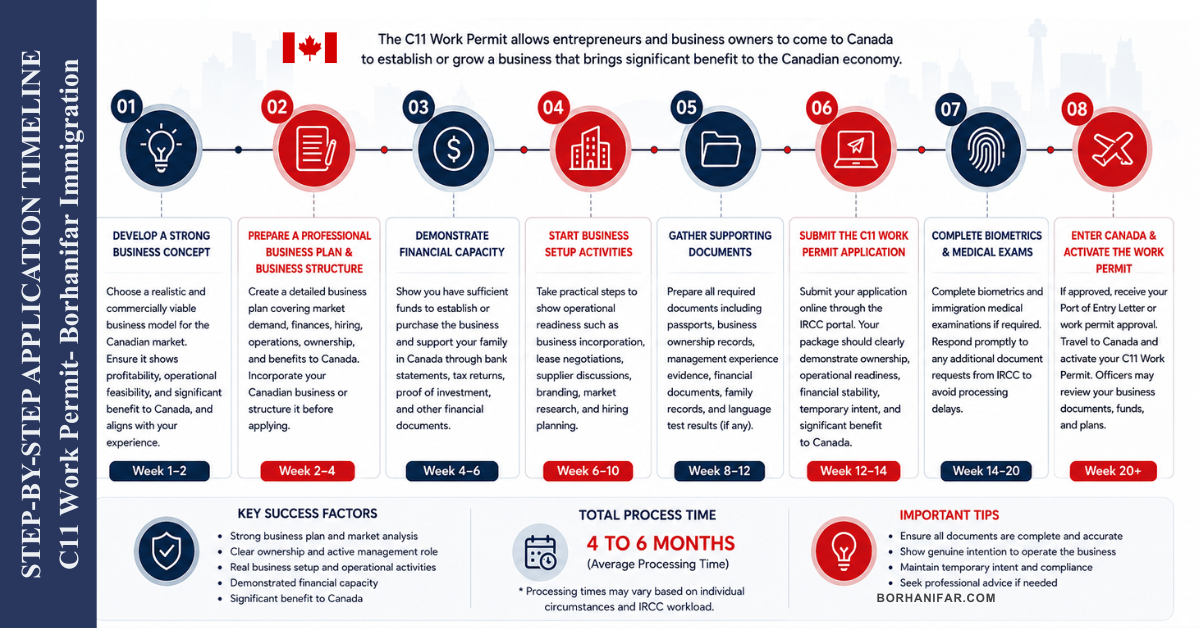
How to Apply for a C11 Work Permit in Canada
Applying for a C11 Work Permit involves both business preparation and the immigration work permit process. The applicant should establish a credible Canadian business structure, prepare evidence supporting the C11 LMIA exemption, complete the applicable employer-compliance steps, and submit a work permit application with supporting documentation.
The exact process depends on the applicant’s circumstances and whether the application involves establishing a new business, purchasing an existing Canadian business, or developing another qualifying business operation.
Key Point: C11 approval is not based on completing a fixed series of business-registration steps. The application must establish that the applicant meets the applicable C11 requirements and that the proposed work is expected to create or maintain significant social, cultural, or economic benefits or opportunities for Canadian citizens or permanent residents.
Assess C11 Eligibility and the Proposed Business
Before establishing or acquiring a business for immigration purposes, the applicant should assess whether the proposed structure can satisfy the applicable C11 requirements.
This assessment should consider the applicant’s ownership and control, relevant experience, financial capacity, proposed role in Canada, business viability, temporary residence considerations, and the significant benefit expected from the applicant’s work.
Establish or Acquire the Canadian Business
Depending on the proposed structure, the applicant may establish a new Canadian business, purchase an existing business, or acquire the ownership interest required for the proposed C11 application.
Corporate and transaction documents should accurately establish the applicant’s ownership, control, and intended role in the Canadian operation. Where an existing business is being acquired, appropriate due diligence and transaction documentation may also form part of the supporting evidence.
Prepare the Business Plan and Significant-Benefit Case
The business plan should explain how the Canadian operation will be implemented and how the applicant will actively operate the business.
Depending on the business, the plan and supporting evidence may address:
- Business model, products, and services
- Canadian market and competitive environment
- The applicant’s ownership and operational role
- Startup or acquisition costs
- Revenue, expense, and cash-flow projections
- Staffing and recruitment plans, where applicable
- Implementation milestones and timelines
- The significant economic, social, or cultural benefit or opportunities expected from the applicant’s work
Material assumptions should be supported by appropriate market, financial, operational, or third-party evidence where reasonably available.
Document Financial Capacity and Source of Funds
The applicant should document sufficient financial resources for the proposed Canadian business and sufficient personal funds for themselves and accompanying family members.
Depending on the circumstances, supporting evidence may include:
- Personal and corporate bank statements
- Business financial statements
- Tax records
- Investment or asset records
- Business acquisition and payment documents
- Loan or financing documents, where applicable
- Evidence establishing the source and availability of significant funds
The financial evidence should be consistent with the costs, investment, working capital, and other assumptions presented in the business plan.
Complete Appropriate Business Implementation Steps
Where appropriate for the business and its stage of development, the applicant should document genuine steps taken toward implementing the proposed Canadian operation.
Evidence may include:
- Corporate registration and organizational records
- Commercial premises or lease arrangements
- Supplier, distributor, or partnership communications
- Licensing or regulatory preparation
- Insurance arrangements or quotations
- Website, branding, or marketing development
- Equipment or procurement planning
- Recruitment and staffing preparation
- Market research specific to the proposed location and industry
The appropriate level of pre-application implementation depends on the particular business. Not every applicant is expected to complete the same business setup activities before applying.
Submit the Offer of Employment Through the Employer Portal
Because C11 is generally an employer-specific LMIA-exempt work permit, the Canadian business must normally complete the applicable employer-compliance process before the applicant submits the work permit application.
This generally includes submitting an offer of employment through IRCC’s Employer Portal using the appropriate LMIA exemption code and paying the applicable employer compliance fee, unless an exemption from the Employer Portal or compliance-fee requirements applies.
After submission, the employer receives an offer of employment number that is used in the worker’s work permit application.
Prepare and Submit the Work Permit Application
The applicant must submit the applicable work permit application with the required forms and supporting evidence. The method and place of application depend on the applicant’s circumstances and the rules that apply at the time of filing.
The application should clearly establish:
- Eligibility for the C11 LMIA exemption
- Required ownership and control of the Canadian business
- The applicant’s proposed duties and active operational role
- The significant benefit expected from the applicant’s work
- Business viability and implementation evidence
- Financial capacity and source of funds
- The applicant’s relevant experience and ability to perform the proposed work
- Compliance with temporary residence and work permit requirements
Where the applicant is represented, a representative submission letter may also organize the facts, applicable legal framework, and supporting evidence.
Complete Biometrics, Medical Examination, and Additional Requirements
Depending on the applicant’s circumstances, biometrics and an immigration medical examination may be required. IRCC may also request additional documents or information while processing the application.
Applicants should comply with any applicable deadlines and ensure that requested information is complete and consistent with the application already submitted.
Receive a Decision and Travel to Canada
If an outside-Canada work permit application is approved, the applicant generally receives a port of entry letter of introduction. The letter of introduction is not the work permit itself.
When travelling to Canada, the applicant should carry the documents required for entry and documents relevant to the approved work permit application. At the port of entry, a Canada Border Services Agency officer may verify the applicant’s identity, admissibility, purpose of entry, and continuing eligibility to enter Canada as a worker.
If the officer is satisfied that the applicable requirements are met, the work permit is issued at the port of entry. The applicant should review the work permit immediately to confirm the employer, occupation, location where applicable, validity period, and other conditions.
Operate the Business and Maintain Supporting Records
After entering Canada, the business owner should operate the business consistently with the work permit conditions and the representations made in the application.
Business records may later be relevant to demonstrate actual operations, including corporate records, financial activity, premises, contracts, customers, suppliers, payroll, hiring, regulatory compliance, and other evidence of implementation and business activity.
Practical Note: The sequence above is a general C11 application framework rather than a universal procedure for every applicant. The appropriate business, corporate, employer-compliance, and immigration steps should be determined according to the facts of the individual case and the IRCC requirements in effect when the application is submitted.
C11 Work Permit Canada Costs and Government Fees in 2026
The cost of a C11 Work Permit application includes applicable IRCC government fees as well as business and professional expenses that vary considerably between applicants.
Government fees are relatively straightforward, but the overall cost of pursuing a C11 business project depends on factors such as whether the applicant is establishing or purchasing a business, the industry, location, family composition, and the operational requirements of the Canadian business.
Important: Government processing fees are separate from the capital required to establish, acquire, or operate the Canadian business. C11 does not have a universal minimum investment amount.
C11 Work Permit Government Fees in 2026
| Fee | Amount (CAD) | When It Applies |
|---|---|---|
| Work Permit Processing Fee | $155 | Paid by the principal work permit applicant, unless exempt |
| Employer Compliance Fee | $230 | Generally paid by the Canadian business when submitting the LMIA-exempt offer of employment through the Employer Portal, unless exempt |
| Biometrics Fee | $85 per person | Applies where biometrics are required |
| Biometrics – Family Maximum | $170 | Maximum biometrics fee for an eligible family of two or more applying at the same time |
| Spouse Open Work Permit | $255 | $155 work permit processing fee plus the $100 open work permit holder fee, where the spouse is eligible and applies for an open work permit |
These amounts reflect IRCC fees in effect in 2026 and may change. Applicants should confirm the current fee schedule with IRCC before submitting an application.
Example: Basic C11 Government Fees for One Applicant
For a C11 applicant who requires biometrics and whose Canadian business is subject to the employer compliance fee, the basic government fees would generally include:
- Work permit processing fee: CAD $155
- Employer compliance fee: CAD $230
- Biometrics fee: CAD $85
In this example, the combined government fees would be CAD $470. This example does not include accompanying family applications, medical examinations, visa application centre services, business expenses, professional fees, or other case-specific costs.
Costs for an Accompanying Spouse and Children
Family-related costs depend on the immigration applications submitted for each accompanying family member.
If an accompanying spouse is eligible for and applies for an open work permit, the spouse generally pays both the CAD $155 work permit processing fee and the CAD $100 open work permit holder fee, for a total of CAD $255 before any applicable biometrics fee.
Dependent children may require separate temporary residence or study authorization depending on their circumstances. The applicable government fees therefore depend on the type of application submitted for each child.
Medical Examination and Other Third-Party Costs
An immigration medical examination may be required depending on the applicant’s circumstances, including factors such as intended occupation and immigration history. The examination is performed by an IRCC-approved panel physician, and the applicant pays the physician or clinic directly.
Because medical examination charges are set by individual physicians or clinics rather than by IRCC, there is no single IRCC medical examination fee.
Other potential third-party expenses may include:
- Document translation and certification
- Police certificates, where required
- Medical examinations, where required
- Visa Application Centre services, where applicable
- Courier or document-processing expenses
Business Setup and Acquisition Costs
Business expenses are separate from immigration processing fees and can vary substantially depending on the proposed operation.
Depending on the business, potential expenses may include:
- Federal or provincial incorporation and registration
- Business acquisition or share-purchase costs
- Commercial lease deposits and rent
- Equipment, vehicles, technology, or inventory
- Licensing and regulatory costs
- Business insurance
- Accounting and bookkeeping
- Website, branding, and marketing
- Employee wages and payroll costs
- Working capital
There is no reliable universal cost range for these expenses. A professional consulting business, for example, may have a substantially different capital structure from a restaurant, construction company, retail operation, or manufacturing business.
Professional Fees
Professional fees are not government fees and vary according to the services required and the complexity of the business and immigration matter.
Depending on the case, an applicant may incur costs for immigration representation, business planning, accounting, tax advice, corporate or transactional legal services, commercial due diligence, market research, financial forecasting, or other specialized professional services.
C11 Investment vs. Application Fees
The amount invested in the Canadian business should not be confused with the fees required to apply for a C11 Work Permit.
IRCC does not prescribe a universal minimum investment amount for every C11 business. The financial resources required depend on the actual business model and should be sufficient to support the proposed acquisition, startup, implementation, and operating costs.
Accordingly, an applicant should evaluate three different financial categories:
- Government fees: fees payable in connection with the immigration application and employer-compliance process
- Business capital: funds required to establish, acquire, and operate the Canadian business
- Personal funds: resources available to support the applicant and accompanying family members in Canada
Fee Update: The government fees listed above reflect the IRCC fee schedule available in 2026. Immigration fees can change, so the current IRCC fee schedule should be checked before payment or submission.
C11 Work Permit Canada Processing Time in 2026
There is no single processing time that applies specifically to all C11 Work Permit applications. C11 applications are processed within Canada’s work permit system under the International Mobility Program (IMP), and the estimated processing time can vary depending on where the applicant applies and the circumstances of the application.
IRCC processing times change regularly and should be treated as estimates rather than guaranteed decision dates. Applicants should check the current work permit processing time applicable to their place of application directly through IRCC before making travel or business plans.
Important: IRCC does not publish a separate guaranteed processing time specifically for C11 applications. The processing time shown by IRCC for a work permit is an estimate, and an individual application may take longer depending on its complexity and the additional review required.
How Long Does a C11 Work Permit Take?
The most reliable way to estimate the current processing time is to use IRCC’s official processing time tool and select the applicable work permit category and place of application.
IRCC explains that processing times may be calculated using historical processing data or forward-looking estimates, depending on the application type. For some applications, processing times may also be displayed according to where the applicant is applying from.
The estimate shown in the IRCC tool is not a maximum processing period and does not guarantee that an individual C11 application will receive a decision within that timeframe.
Check current IRCC work permit processing times
When Does C11 Work Permit Processing Time Start?
For an online application, IRCC generally calculates processing time from the date a complete application, including the applicable fees, is submitted until a decision is made.
IRCC’s published processing estimates may include the time required to provide biometrics. The actual time required for an individual application can still vary depending on the circumstances of the case.
What Can Affect C11 Work Permit Processing Time?
Several factors can affect how long a work permit application takes to process. According to IRCC, processing may vary based on whether the application is complete, how easily the information can be verified, how quickly the applicant responds to requests or concerns, and other case-specific factors.
Potential factors include:
- Whether the application is complete
- The complexity of the business and immigration circumstances
- Verification of information and supporting documents
- Biometrics requirements
- Medical examination requirements, where applicable
- Background, security, or admissibility screening
- Requests for additional information or documents
- An interview, where required
- The time taken by the applicant to respond to IRCC requests
- IRCC processing capacity and application inventory
Can a Complete C11 Application Be Processed Faster?
Submitting a complete and well-organized application can help avoid preventable delays, but it does not guarantee faster processing or priority treatment.
Before submission, applicants should ensure that the required forms, fees, Employer Portal information, and supporting documents are complete and internally consistent.
For a C11 application, this may include clearly documenting:
- Business ownership and control
- The applicant’s proposed role and duties in Canada
- The significant benefit relied upon under the C11 framework
- Financial capacity and source of funds
- Business planning and implementation evidence
- The applicant’s relevant business or industry experience
- Temporary residence considerations
Providing complete evidence at the outset may reduce the likelihood of delays caused by missing information or additional document requests, but processing remains subject to IRCC’s assessment of the individual application.
Why Can a C11 Application Take Longer Than the IRCC Estimate?
An individual application may take longer than the processing time displayed by IRCC if additional review is required.
Examples may include:
- Additional verification of business, employment, or financial information
- Requests for additional documents or clarification
- Background or security screening that remains in progress
- Medical or other admissibility issues
- An interview or further eligibility assessment
- Complex business ownership or transaction structures
- Changes in the applicant’s circumstances during processing
A processing time that exceeds the estimate does not by itself indicate that the application will be refused. Processing times are estimates and individual cases may require different levels of review.
Processing Time Update: IRCC processing times change regularly. For the most current estimate, use the official IRCC processing time tool and select the work permit option applicable to your circumstances and place of application.
Realistic C11 Work Permit Application Timeline
The overall timeline for a C11 Work Permit involves more than IRCC processing. Before the work permit application is submitted, an applicant may need time to assess the proposed business, establish or acquire the Canadian operation, prepare the business plan, document financial resources, complete appropriate implementation steps, and satisfy the applicable employer-compliance requirements.
For this reason, the total time from initial planning to entering Canada can be considerably longer than the processing time displayed in IRCC’s online processing time tool.
Important: The preparation periods below are planning estimates only. They are not IRCC processing times, service standards, or guaranteed timelines. The actual preparation period depends on the applicant, business structure, transaction, documentation, and complexity of the case.
Typical Stages of a C11 Application
| Stage | Timing Considerations |
|---|---|
| Initial Assessment and Strategy | Depends on the complexity of the applicant’s background, proposed business, ownership structure, and C11 eligibility assessment |
| Business Establishment or Acquisition | May involve incorporation, ownership structuring, an existing-business acquisition, due diligence, agreements, registrations, or other corporate steps |
| Business Plan and Significant-Benefit Evidence | Depends on the availability of market information, financial data, operational assumptions, supporting evidence, and the complexity of the proposed business |
| Financial and Source of Funds Documentation | May require collection and review of banking, corporate, tax, investment, transaction, or other records supporting the availability and source of funds |
| Business Implementation | Varies significantly by business and may include premises, suppliers, licensing, insurance, equipment, recruitment, marketing, or other appropriate pre-launch activities |
| Employer Compliance | The Canadian business generally completes the applicable Employer Portal process before the employer-specific LMIA-exempt work permit application is submitted |
| Work Permit Application Submission | Once the required application forms, supporting documents, fees, and applicable employer information are ready, the work permit application can be submitted |
| Biometrics and Medical Examination | Biometrics and an immigration medical examination may be required depending on the applicant’s circumstances |
| IRCC Processing | Processing times change regularly. Applicants should check the current IRCC work permit processing time applicable to their circumstances and place of application |
| Approval and Travel to Canada | For an approved outside-Canada application, the applicant can make travel arrangements after receiving the applicable approval documents and should be prepared for examination at the port of entry |
How Long Should You Allow for C11 Preparation?
There is no standard preparation period for a C11 application. A relatively straightforward new business may require less preparation than the acquisition of an operating Canadian company or a business subject to significant licensing, premises, equipment, financing, or regulatory requirements.
Some stages may also proceed at the same time. For example, market research, financial planning, corporate setup, supplier discussions, and document collection may overlap rather than occurring one after another.
Applicants should therefore plan the timeline around the actual business and evidentiary requirements of the case rather than attempting to meet a predetermined number of weeks.
What Can Help Avoid Preventable Processing Delays?
A well-prepared application does not guarantee faster IRCC processing. However, completeness and clear, verifiable information may help avoid preventable delays caused by missing documents, inconsistencies, or requests for additional information.
Before submission, applicants should consider whether:
- The required forms and supporting documents are complete
- The ownership and corporate records are consistent
- The financial evidence is clear and can be verified
- The source and availability of significant funds are adequately documented
- The business plan is consistent with the financial and operational evidence
- The significant-benefit claims are supported by appropriate evidence
- The Employer Portal information is consistent with the work permit application
- Material facts and potential immigration concerns have been adequately addressed
What Can Make IRCC Processing Take Longer?
IRCC explains that processing times can vary based on factors such as whether an application is complete, how easily the information can be verified, how quickly the applicant responds to requests or concerns, application complexity, and other processing factors.
Depending on the individual case, additional time may be required because of:
- An incomplete or complex application
- Additional verification of information or documents
- Requests for additional documents or clarification
- Background or security screening
- Medical or other admissibility considerations
- An interview or further assessment, where required
- Delays in responding to an IRCC request
- Changes in IRCC application inventory or processing capacity
Preparation Time vs. IRCC Processing Time
It is important to distinguish between the time required to prepare a C11 application and the time IRCC takes to process it after submission.
IRCC processing time generally begins when a complete application is received and ends when a decision is made. Business planning, incorporation, acquisition negotiations, source-of-funds preparation, and other work completed before submission are therefore not included in the published IRCC processing time.
Applicants planning a business launch in Canada should account for both periods when developing their overall implementation schedule.
Planning Note: A C11 timeline should be built around the actual business transaction, implementation requirements, supporting evidence, and current IRCC processing estimate. Applicants should avoid making irreversible business or travel commitments based solely on an estimated immigration processing time.
What Happens After Applying for a C11 Work Permit?
After a C11 Work Permit application is submitted, IRCC reviews the application, supporting documents, and information provided to determine whether the applicant meets the requirements for the requested LMIA-exempt employer-specific work permit.
For a C11 application, the assessment may include the applicant’s proposed role in Canada, ownership and control of the business, relevant experience, financial capacity, business viability, significant-benefit considerations, temporary residence requirements, and admissibility.
Important: After submission, IRCC may request additional information, biometrics, a medical examination, or an interview depending on the applicant’s circumstances. Applicants should monitor their IRCC account and respond to requests within the specified deadlines.
1. IRCC Reviews the Application
An immigration officer reviews the information and documents submitted with the work permit application.
In a C11 case, relevant evidence may include:
- The applicant’s ownership and control of the Canadian business
- The applicant’s proposed duties and active operational role
- Business and management experience
- The business plan and supporting market evidence
- Financial capacity and source of funds
- Evidence supporting the claimed significant benefit
- Business implementation and operational evidence
- Temporary residence considerations and immigration history
- General work permit eligibility and admissibility requirements
The exact assessment depends on the facts and evidence in the individual application.
2. Biometrics May Be Required
If biometrics are required, IRCC generally issues a Biometrics Instruction Letter after the application is submitted. The applicant should follow the instructions and complete biometrics within the applicable deadline.
Applicants who previously provided biometrics may not need to provide them again if their existing biometrics remain valid and can be used for the application, subject to current IRCC requirements.
3. A Medical Examination May Be Required
An immigration medical examination may be required depending on factors such as the applicant’s circumstances, previous residence or travel, intended occupation, and applicable Canadian immigration requirements.
Where a medical examination is required, it must be completed through an IRCC-approved panel physician.
4. IRCC May Request Additional Information
During processing, IRCC may request additional documents or clarification if further information is required to assess the application.
Depending on the issues in the individual case, additional evidence could relate to:
- Business ownership or corporate structure
- Financial resources or source of funds
- The applicant’s business or management experience
- Business activities or implementation
- Employment information
- Admissibility or background information
- Other information relevant to eligibility
Applicants should respond accurately and within the deadline specified by IRCC. New evidence should also remain consistent with the information previously submitted unless a change in circumstances is being disclosed and explained.
5. An Interview May Be Requested
An interview is not required in every C11 application. However, an officer may request an interview where additional information or clarification is considered necessary.
If an interview is required, IRCC will provide instructions regarding the date, time, location, or method of the interview.
6. If the C11 Work Permit Application Is Approved
For an application made from outside Canada, approval generally results in a Port of Entry Letter of Introduction. The letter confirms that the work permit application has been approved, but it is not the work permit itself.
The applicant should review the approval information carefully and ensure that the required travel and immigration documents remain valid before travelling to Canada.
7. Arriving in Canada After C11 Approval
When arriving in Canada, the applicant must present the required documents to the border services officer. These generally include the applicant’s passport, required travel document, Port of Entry Letter of Introduction, and other applicable supporting documents.
Applicants should also be prepared to provide documents relevant to their approved application, which may include evidence relating to:
- The Canadian business and ownership structure
- The applicant’s proposed work and qualifications
- The employer-specific offer of employment
- Financial resources
- Business implementation
- Medical examination, where required
- Accompanying family members
The border services officer will verify the applicant’s identity and assess whether the applicant continues to meet the applicable eligibility and admissibility requirements for entry to Canada.
If the applicable requirements are met, the work permit is issued at the port of entry. The applicant should review the permit immediately and verify the employer, occupation, location where applicable, expiry date, and any other conditions.
8. If the C11 Work Permit Application Is Refused
If the application is refused, IRCC provides a decision explaining the refusal. The appropriate next step depends on the reasons for refusal and the circumstances of the case.
Depending on the situation, an applicant may consider whether to submit a new application addressing the identified concerns or seek legal advice regarding other available remedies.
A new application should not simply reproduce the refused application. Before reapplying, the refusal reasons and underlying evidentiary or eligibility issues should be carefully assessed and addressed where possible.
9. After Entering Canada on a C11 Work Permit
After receiving the work permit, the applicant must comply with the conditions stated on the permit and should implement and operate the Canadian business consistently with the representations made in the application.
Depending on the business, post-arrival activities may include:
- Obtaining a Social Insurance Number (SIN)
- Opening or activating business banking arrangements
- Finalizing commercial premises
- Obtaining required licences, permits, or insurance
- Executing supplier and commercial agreements
- Hiring employees where contemplated by the business plan
- Launching or expanding business operations
- Maintaining corporate, accounting, payroll, and tax records
Applicants should maintain organized evidence of actual business operations and implementation. This documentation may become relevant to a future work permit extension or another immigration application.
Can Family Members Accompany a C11 Work Permit Applicant?
A spouse or common-law partner and dependent children may be able to accompany the principal applicant to Canada, but each family member must qualify for the appropriate temporary resident status or authorization.
Depending on their circumstances:
- A spouse or common-law partner may be eligible for an open work permit if the current IRCC eligibility requirements are met
- A dependent child may require a study permit depending on the child’s circumstances and intended studies
- A family member may require visitor status if they are not authorized to work or study
- A temporary resident visa or eTA may also be required for travel to Canada, depending on nationality and circumstances
Family Work Permit Rules: A C11 Work Permit does not automatically make the principal applicant’s spouse eligible for an open work permit. Spousal open work permit eligibility is subject to the IRCC rules in effect at the time of application and should be assessed separately.
C11 Work Permit Refusal and Reapplication
A C11 Work Permit application may be refused if the officer is not satisfied that the applicant meets the requirements of the requested work permit or the broader requirements for temporary entry to Canada.
For C11 applications, an important part of the assessment is whether the proposed work would create or maintain significant social, cultural, or economic benefits or opportunities for Canadian citizens or permanent residents under IRPR 205(a). The applicant must also satisfy the other applicable work permit, temporary residence, and admissibility requirements.
Important: A C11 refusal should be reviewed based on the actual reasons and officer decision notes rather than assumptions about why the application was refused. Since July 29, 2025, IRCC has provided officer decision notes with refusal letters for most work permit applications.
Common Issues That May Lead to a C11 Work Permit Refusal
There is no single refusal reason that applies to all C11 applications. Depending on the facts of the case, concerns may relate to the C11 exemption itself, the proposed business and employment, temporary residence requirements, financial circumstances, admissibility, or the overall evidence submitted.
Potential concerns may include:
- Insufficient evidence of significant benefit under IRPR 205(a)
- Questions regarding the viability or credibility of the proposed business
- Insufficient evidence of the applicant’s ownership, control, or active operational role
- Inadequate evidence of relevant business, management, or industry experience
- Financial resources that do not adequately support the proposed business or the applicant’s stay in Canada
- Unclear or insufficiently documented source and availability of funds
- Inconsistencies between the business plan and supporting financial or operational evidence
- Insufficient evidence supporting material claims made in the application
- Concerns regarding temporary residence requirements
- Incomplete, inconsistent, or unverifiable information
- General work permit eligibility or admissibility concerns
Business and Evidence Problems in C11 Applications
A business plan alone does not establish eligibility for a C11 Work Permit. Material claims regarding the proposed business, the applicant’s role, financial capacity, and expected significant benefit should be supported by credible evidence appropriate to the circumstances.
Potential weaknesses may include:
- Generic market analysis that does not adequately address the proposed Canadian market
- Financial projections that are inconsistent with the proposed business model or supporting evidence
- Insufficient explanation of how the applicant will actively operate the business
- Weak connection between the applicant’s background and the proposed responsibilities in Canada
- Ownership or corporate records that do not clearly support the proposed structure
- Significant-benefit claims that are general or unsupported
- Business implementation claims that are not supported by documentation
- Financial records that do not clearly establish the availability or source of material funds
The appropriate evidence varies considerably by business. A new professional-services company, for example, may require different implementation evidence from a restaurant, construction company, manufacturing operation, or acquisition of an existing Canadian business.
What Happens After a C11 Work Permit Refusal?
If a work permit application is refused, IRCC issues a refusal decision explaining the outcome. For most work permit refusals, IRCC also provides the officer decision notes with the refusal letter.
The first step should therefore be to review the refusal letter and officer decision notes carefully and identify the specific factual, evidentiary, eligibility, or legal concerns underlying the decision.
Depending on the circumstances, the applicant may then consider:
- Reapplying with new or materially improved evidence
- Correcting factual inconsistencies or documentary deficiencies
- Providing additional evidence addressing the officer’s concerns
- Revising the business or immigration strategy where appropriate
- Obtaining additional records where further information about the processing of the application is necessary
- Obtaining legal advice regarding judicial review where there may have been a reviewable error
Can You Reapply After a C11 Refusal?
In most cases, a refusal does not by itself prevent an applicant from submitting another work permit application, unless the decision letter indicates otherwise or another legal restriction applies.
However, IRCC advises applicants to reapply only when they can provide information that was not included previously or when their circumstances have changed in a way that addresses the reason for refusal.
A new application should directly address the previous refusal rather than simply resubmitting substantially the same evidence and arguments.
Depending on the refusal reasons, this may involve:
- Providing stronger evidence supporting significant benefit
- Clarifying the applicant’s ownership and active operational role
- Providing additional financial or source-of-funds documentation
- Correcting inconsistencies identified in the previous application
- Providing additional evidence supporting the applicant’s experience or qualifications
- Addressing temporary residence concerns identified by the officer
- Providing evidence of material developments in the Canadian business since the previous application
Do You Need GCMS Notes After a C11 Refusal?
Not necessarily. IRCC now provides officer decision notes with refusal letters for most work permit applications. These notes should normally be reviewed first because they may provide substantially more detail about the officer’s reasons for refusing the application.
Additional records obtained through an Access to Information or Privacy request may still be useful in some cases where the information provided with the refusal does not adequately explain the decision or where additional processing records are relevant to the review of the case.
Reapplication or Judicial Review?
There is no formal appeal process for a refused temporary residence application. The appropriate response depends on the nature of the refusal.
A new application may be appropriate where the refusal can be addressed through new evidence, changed circumstances, clarification, or a materially stronger application.
Where there are concerns that the decision was unreasonable or involved an error of law or procedural fairness, an application for leave and judicial review in the Federal Court may be considered. Judicial review is different from reapplying and is subject to strict legal requirements and filing deadlines.
Practical Note: The appropriate response to a C11 refusal depends on the actual reasons for the decision. Reapplication, additional records, reconsideration, or judicial review serve different purposes and should not be treated as interchangeable remedies.
Permanent Residence Pathways After a C11 Work Permit
A C11 Work Permit is a temporary work permit and does not provide a direct pathway to Canadian permanent residence.
A C11 permit holder may later qualify for permanent residence through a separate federal or provincial immigration program, but eligibility must be assessed independently under the requirements of that program.
Important: Obtaining a C11 Work Permit, establishing a business in Canada, or operating that business for a particular period does not automatically make the applicant eligible for permanent residence.
Does a C11 Work Permit Lead Directly to Permanent Residence?
No. C11 is an LMIA-exempt temporary work permit category under the International Mobility Program. It is not a permanent residence program and does not itself result in permanent resident status.
A C11 permit holder who wishes to remain permanently in Canada must qualify under a separate permanent residence program available at the relevant time.
Potential Permanent Residence Options After C11
Depending on the applicant’s circumstances and the immigration programs available at the time, potential options may include:
- Express Entry, if the applicant independently meets the requirements of an Express Entry program
- Provincial Nominee Programs (PNP), where the applicant qualifies under an applicable provincial stream
- Provincial entrepreneur or business immigration pathways, where available
- Other federal or provincial economic immigration programs for which the applicant becomes eligible
The appropriate pathway depends on factors such as age, language proficiency, education, qualifying work experience, NOC classification, province of residence, business activities, family circumstances, and the immigration rules in effect when the permanent residence application is considered.
Express Entry After a C11 Work Permit
A C11 permit holder may create an Express Entry profile only if they meet the eligibility requirements of at least one of the federal economic immigration programs managed through Express Entry.
Holding a C11 Work Permit does not itself provide Express Entry eligibility or guarantee additional Comprehensive Ranking System (CRS) points.
Important Express Entry Rule: Self-employed work experience in Canada is generally excluded when calculating qualifying Canadian work experience for the Canadian Experience Class and Canadian work-experience points under the CRS, subject to specific exceptions provided by IRCC.
This distinction can be particularly important for C11 business owners. The immigration treatment of the applicant’s Canadian work experience depends on the actual employment and business structure and the requirements of the permanent residence program being considered.
For this reason, applicants should not assume that operating their own Canadian business for one year will automatically qualify them for the Canadian Experience Class or provide Canadian work-experience CRS points.
Do C11 Business Owners Receive CRS Points for a Job Offer?
As of March 25, 2025, Express Entry no longer awards additional CRS points for arranged employment or job offers.
This change also removed the additional points that were previously available for qualifying senior management job offers under NOC Major Group 00.
A job offer may still be relevant to eligibility under certain immigration programs, but applicants should not assume that a C11-related job offer will increase their CRS score.
Senior Managers and Express Entry in 2026
Senior managers may have additional Express Entry opportunities in 2026 depending on their occupation and Canadian work experience.
However, eligibility for any category-based selection round is separate from eligibility for an Express Entry program. Applicants must first qualify for Express Entry and then meet the specific requirements of the applicable category.
For C11 business owners, particular attention should be given to whether the Canadian work experience relied upon is recognized under the applicable Express Entry rules. A managerial or executive title alone does not establish qualifying Canadian work experience.
Provincial Nominee Programs After C11
Provincial Nominee Programs may provide another potential route to permanent residence, but C11 status does not itself create eligibility for provincial nomination.
Each participating province and territory establishes its own immigration streams and eligibility requirements. Depending on the program, streams may target skilled workers, entrepreneurs, business owners, or other applicants who can contribute to the provincial economy.
For entrepreneur or business streams, requirements may include factors such as:
- Minimum net worth or investment requirements
- Business ownership and management experience
- Establishment or acquisition of an eligible business
- Active management of the business within the province
- Job creation requirements
- Minimum periods of business operation
- Language requirements
- Performance agreements or provincial monitoring
These requirements vary considerably between provinces and programs and may change over time.
Does Operating a C11 Business for One Year Guarantee PR Eligibility?
No. There is no general rule that operating a business in Canada for one year, two years, or any other fixed period under a C11 Work Permit automatically creates eligibility for permanent residence.
The required period of business operation or work experience depends entirely on the permanent residence program being considered.
For example, a provincial entrepreneur stream may impose its own business-operation and performance requirements, while an Express Entry program applies separate rules governing qualifying work experience.
Why Business Structure Matters for Future Immigration Planning
Applicants considering permanent residence after C11 should assess the immigration implications of the proposed business and employment structure before relying on Canadian work experience as part of a future immigration strategy.
Relevant considerations may include:
- The applicant’s ownership interest in the Canadian company
- The nature of the applicant’s employment relationship
- The applicant’s actual duties and NOC classification
- Whether the work may be treated as self-employment under the relevant immigration program
- How the applicant is remunerated
- Whether the Canadian experience satisfies the requirements of the intended permanent residence program
Corporate structure alone does not determine how work experience will be treated for immigration purposes. The actual circumstances of the working relationship and the requirements of the relevant immigration program must be assessed.
Can Family Members Be Included in a Future PR Application?
If the principal applicant later qualifies for a permanent residence program, an eligible spouse or common-law partner and dependent children may generally be included in the permanent residence application, subject to the requirements of that program.
Family members must still satisfy the applicable immigration requirements, including medical, security, background, and admissibility requirements.
Planning for Permanent Residence After C11
Applicants who have both temporary business objectives and long-term permanent residence goals should evaluate the two strategies separately.
Factors that may become relevant to a future permanent residence strategy include:
- Eligibility under an existing federal or provincial immigration program
- English or French language proficiency
- Education and educational credential assessment, where applicable
- Qualifying Canadian and foreign work experience
- NOC classification and actual job duties
- Provincial nomination opportunities
- Business performance where relevant to a provincial entrepreneur stream
- Continued compliance with temporary resident and work permit conditions
Because permanent residence programs and selection criteria can change, a long-term immigration strategy should be reassessed periodically rather than assuming that the immigration pathway available when the C11 application is filed will remain unchanged.
Key Takeaway: C11 can allow an eligible entrepreneur or business owner to operate a business temporarily in Canada, but it should not be presented as a direct or guaranteed pathway to permanent residence. Any future PR strategy must independently satisfy the requirements of the applicable immigration program.
C11 Work Permit Extension Rules
C11 Work Permit Canada is initially issued for a temporary period, but many entrepreneurs and business owners may later qualify for extensions if Canadian business operations remain active and compliant.
Extension eligibility usually depends on the operational activity of the Canadian business, continued business ownership and management involvement, financial sustainability, and the overall economic viability of the business in Canada.
Summary:
C11 Work Permit extensions generally require active Canadian business operations, ongoing management involvement, payroll and tax compliance, and evidence that the business continues to provide economic or operational benefit in Canada.
How Long Can C11 Work Permit Canada Be Extended?
The extension period may vary depending on the operational success of the Canadian business, the applicant’s management role, and overall compliance with immigration and corporate requirements.
In many cases, extensions may be granted in increments of one or two years depending on the strength of the business operations and supporting documentation.
Final extension decisions remain discretionary and depend on IRCC assessment of ongoing business activity, economic benefit, and immigration compliance.
Key Requirements for C11 Work Permit Extensions
IRCC generally expects applicants to demonstrate that the Canadian business became genuinely operational after the initial C11 Work Permit approval.
Common extension requirements may include:
- Active Canadian business operations
- Continued ownership or management involvement
- Canadian payroll and tax compliance
- Operational revenue or commercial activity
- Canadian employee hiring evidence
- Proof of office, retail, or commercial premises
- Updated business licenses or registrations
- Evidence of ongoing business growth or expansion
- Proof that the business continues to provide economic benefit in Canada
How IRCC Assesses C11 Extension Applications
During extension review, immigration officers often focus heavily on whether the original business plan became operationally realistic and commercially active.
IRCC may assess:
- Whether the Canadian business is actively operating
- Whether payroll and tax filings are properly maintained
- Whether the business generated commercial activity or revenue
- Whether the applicant remains actively involved in management
- Whether the business created economic or operational benefit in Canada
- Whether the company complied with previous C11 conditions
Applications supported by active operations, proper accounting compliance, realistic revenue activity, and business growth are generally easier for officers to assess.
Common Reasons for C11 Work Permit Extension Refusals
- Inactive or weak Canadian business operations
- Failure to demonstrate economic benefit
- Weak payroll or accounting compliance
- Insufficient operational revenue
- Failure to remain actively involved in business management
- Weak business growth evidence
- Inconsistent financial or corporate documentation
- Unrealistic business operations compared to the original business plan
Many extension refusals occur when applicants fail to demonstrate that the Canadian business became genuinely active and commercially viable after the initial C11 approval.
What Documents Are Usually Required for C11 Extensions?
Typical supporting documents may include:
- Corporate tax filings
- Payroll records and employee documents
- Business bank statements
- Commercial lease agreements
- Invoices and operational contracts
- Corporate ownership documents
- Financial statements
- Updated business activity reports
- Marketing and operational evidence
- Proof of ongoing Canadian business operations
Can C11 Work Permit Holders Transition to PR Instead of Extending?
Yes. Many C11 Work Permit holders later pursue permanent residence rather than repeatedly extending temporary work permit status.
Applicants may eventually qualify through:
- Canada Express Entry
- Provincial Nominee Programs (PNP)
- Entrepreneur and business immigration pathways
- Canadian work experience pathways
Long-term immigration planning is often important before future extension applications or business restructuring decisions.
Advanced Legal Analysis of C11 Work Permit Extensions
Under current IRCC operational practices, C11 extension applications increasingly focus on real business activity, economic contribution, and operational credibility rather than theoretical business plans alone.
Immigration officers frequently examine whether:
- The Canadian business became genuinely operational
- The applicant remains actively involved in management
- The company maintained payroll and tax compliance
- The business generated measurable economic activity
- The business structure remains commercially credible
- The company demonstrates realistic long-term sustainability
Applications supported by operational evidence, accounting compliance, active staffing, and realistic business growth generally have stronger extension approval potential.
Conclusion
The Canada C11 Work Permit is an LMIA-exempt option for eligible entrepreneurs and self-employed business owners whose proposed work may create or maintain significant social, cultural, or economic benefits or opportunities for Canadian citizens or permanent residents.
A strong C11 application should connect the applicant’s background, proposed role, business model, financial capacity, and supporting evidence to the requirements of IRPR 205(a). The strength and type of evidence will depend on the nature and stage of the proposed Canadian business.
Relevant supporting evidence may include:
- A realistic and evidence-based business plan
- Clear and traceable financial documentation
- Evidence supporting the proposed significant benefit to Canada
- Relevant business, management, or industry experience
- Evidence of ownership and active involvement in the business
- Practical business preparation or implementation evidence, where applicable
- Organized corporate, financial, and immigration documentation
Applicants should also remember that C11 is a temporary work permit category, not a permanent residence program. A C11 permit holder may later qualify for a separate permanent residence pathway, but eligibility must be assessed independently under the requirements in effect at that time.
Because business models, ownership structures, financial circumstances, and immigration histories differ significantly, C11 applications should be assessed and documented on a case-by-case basis.
C11 Work Permit FAQ
This section answers common questions about the C11 Work Permit, including eligibility, investment, business ownership, family members, processing times, refusals, and permanent residence.
What is the Canada C11 Work Permit?
The C11 Work Permit is an LMIA-exempt work permit under IRPR 205(a). It may be available where the proposed work by an entrepreneur or self-employed applicant would create or maintain significant social, cultural, or economic benefits or opportunities for Canadian citizens or permanent residents.
Does the C11 Work Permit require an LMIA?
No. C11 is an LMIA-exempt work permit category under the International Mobility Program. Applicants must still meet the applicable requirements for the C11 exemption and for a Canadian work permit.
Who may qualify for a Canada C11 Work Permit?
C11 may be available to entrepreneurs and self-employed business owners who will actively operate a Canadian business and whose proposed work meets the significant-benefit requirements. Eligibility depends on the applicant’s circumstances, proposed work, business structure, and supporting evidence.
How much investment is required for a C11 Work Permit?
There is no general fixed minimum investment amount for C11. The available capital and proposed investment should be commercially reasonable for the particular business and sufficient to support the proposed operations.
Can I purchase an existing Canadian business for C11?
Purchasing an existing Canadian business may support a C11 application where the applicant will actively operate the business and the proposed work satisfies the applicable significant-benefit and work permit requirements. Purchasing a business does not by itself guarantee C11 eligibility or approval.
Is a business plan required for a C11 Work Permit?
A detailed business plan is commonly an important part of a C11 application because it can help demonstrate the proposed operations, financial feasibility, implementation strategy, and expected benefit to Canada. The required supporting evidence depends on the circumstances of the application.
Can family members accompany a C11 applicant?
Eligible family members may be able to accompany the principal applicant as visitors, students, or workers. A spouse or common-law partner does not automatically qualify for an open work permit solely because the principal applicant holds a C11 Work Permit. Eligibility depends on the family-member work permit rules in effect at the time of application, including the principal applicant’s occupation and other applicable requirements.
Can a C11 Work Permit lead to permanent residence?
A C11 Work Permit does not directly lead to permanent residence. A permit holder may later qualify independently for Express Entry, a Provincial Nominee Program, a provincial entrepreneur stream, or another permanent residence program if the applicable eligibility requirements are met.
Does C11 work experience count for Express Entry?
Not necessarily. C11 business owners should not assume that work performed for their own Canadian business will automatically qualify as Canadian work experience for the Canadian Experience Class or provide Canadian work-experience CRS points. The nature of the working relationship and the requirements of the relevant Express Entry program must be assessed.
How long does C11 Work Permit processing take?
There is no single C11 processing time. Processing depends on factors such as the country from which the application is submitted, application complexity, biometrics, medical requirements, background or security screening, and IRCC processing conditions. Applicants should check IRCC’s current processing-time tool for the most recent estimate.
What can cause a C11 Work Permit refusal?
A C11 application may be refused for different reasons depending on the case. Potential concerns may include insufficient evidence of significant benefit, questions about the credibility or viability of the proposed business, insufficient financial evidence, concerns regarding the applicant’s active role, temporary residence requirements, or inconsistencies in the supporting documentation.
Can I reapply after a C11 Work Permit refusal?
In most cases, a refusal does not by itself prevent a new application unless another legal restriction applies. Before reapplying, the refusal reasons and officer decision notes should be reviewed carefully, and a new application should address the concerns identified in the previous decision.
Do C11 applicants need 100% ownership of the business?
Not necessarily. Ownership and control are important considerations in C11 applications, particularly in demonstrating that the applicant will actively operate the business rather than act as a passive investor. The appropriate ownership structure should be assessed in the context of the particular business and application.
Are IELTS or other language test results mandatory for C11?
There is no general standardized language-test threshold specifically established for the C11 category. However, the applicant should be able to demonstrate that they can realistically perform the proposed work and manage the business. Language evidence may be relevant depending on the applicant’s role and circumstances.
Can a C11 Work Permit be extended?
A C11 permit holder may apply for a further work permit if they continue to meet the applicable requirements. An extension is not automatic, and evidence of actual Canadian business operations, continued active involvement, and the ongoing basis for significant benefit may be relevant to the assessment.
Canada C11 Work Permit Assessment and Consultation
Applicants considering establishing or purchasing a business in Canada may begin by completing our
online immigration assessment form
to provide information about their business background, proposed investment, and immigration objectives.
For questions about C11 eligibility, business structure, supporting evidence, refusal concerns, or long-term immigration planning, applicants may also contact us through
WhatsApp.
Official IRCC and Legal References
The Canada C11 Work Permit is generally assessed under IRPR section 205(a), which allows LMIA-exempt work permits where the proposed business activities may create economic, social, or cultural value for Canada.
Application timelines may vary depending on the visa office, biometrics, background screening, and overall application complexity. Applicants may verify updated timelines through the official IRCC processing time tool.
Official immigration planning updates and International Mobility Program (IMP) levels may also be reviewed through the Canada Immigration Levels Plan 2025–2027.
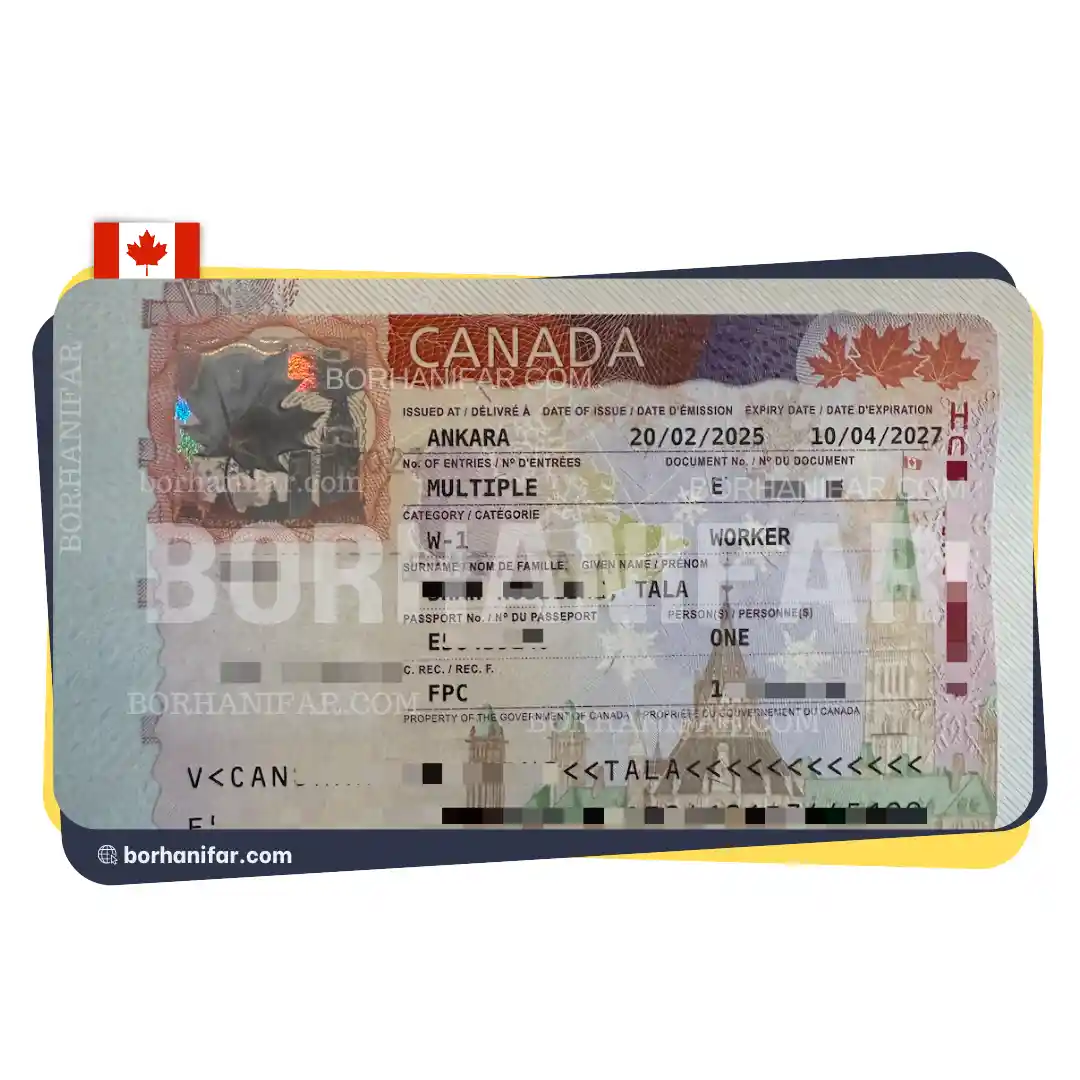
Anonymized C11 Work Permit Case Example
The following anonymized case example is based on a C11 Work Permit application involving the establishment and development of a healthcare-related business in the Greater Toronto Area (GTA).
| Business Sector | Healthcare and medical management services in the Greater Toronto Area |
| Applicant Profile | Business immigration application involving healthcare professionals and an accompanying dependent child |
| Business Preparation | Canadian corporate setup, business planning, financial preparation, and supporting operational documentation prepared before application submission |
| Application Outcome | The principal applicant received a C11 Work Permit. The accompanying spouse and dependent child also received the temporary resident authorizations applicable to their respective applications. |
Key Factors Addressed in the Application
The application was structured around the applicant’s proposed business activities, professional and management background, financial capacity, implementation planning, and the evidence supporting the significant benefit of the proposed work in Canada.
Supporting documentation addressed the relationship between the applicant’s professional background and proposed role in Canada, the operational feasibility of the business, available financial resources, and the practical steps taken toward establishing the Canadian operations.
Important: This example describes the outcome of one particular application. Previous approvals do not predict or guarantee the outcome of another C11 Work Permit application. Each application is assessed individually based on its facts, supporting evidence, applicable immigration requirements, and the officer’s assessment.
Privacy Notice: This case example has been anonymized to protect client confidentiality. Certain non-material details have been generalized or omitted and no personally identifying information is disclosed.
About Borhanifar Immigration
Borhanifar Immigration provides professional Canadian immigration services and strategic guidance for temporary and permanent residence applications, including business immigration and individual immigration pathways. Professional memberships include CICC, CBA, OBA, and CAPIC.
Our practice is supervised by a licensed Canadian immigration professional (RCIC) and focuses on practical immigration solutions, strategic case preparation, and clear guidance based on current Canadian immigration laws and IRCC policies.
This content is provided for general informational purposes only and should not be interpreted as individualized legal advice or a guarantee of approval or immigration results.